


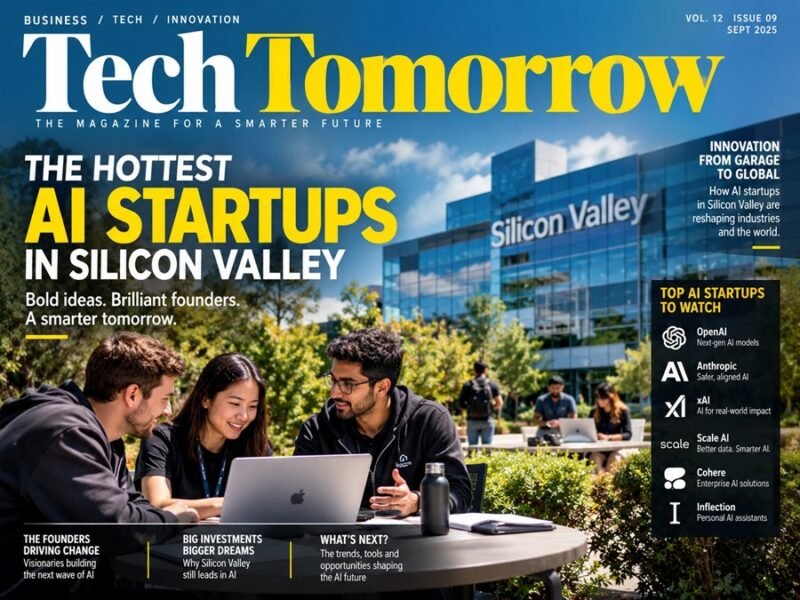
The hottest AI startups in Silicon Valley in 2026 are the ones whose revenue matches their valuations: Fireworks AI (over $1 billion in annualized revenue), Cognition, Sierra, Glean and Perplexity. Alongside them sit ambitious bets in robotics and chips, including Figure AI, Physical Intelligence and MatX. This guide ranks companies by evidence of traction rather than headline funding alone.
At Pro Business Cop, we explore the AI companies and emerging technologies shaping the future of business. We separate announced funding from estimated valuations, and every figure is dated.
Key Takeaways
- Highest disclosed revenue: Fireworks AI reports an annualized run rate above $1 billion (July 2026), the highest among the independent startups we reviewed.
- Highest valuations: Figure AI ($39 billion, September 2025), Cognition (about $26 billion, May 2026), Fireworks AI ($17.5 billion, July 2026) and Sierra ($15 billion, May 2026).
- Best-evidenced categories: enterprise agents and AI coding, where companies disclose revenue and named customers.
- Least-evidenced categories: robotics and chips, which carry large valuations but little public revenue.
- Cursor reached roughly $4 billion in annualized revenue by June 2026 and was acquired by SpaceX in August 2026, so it is no longer an independent startup.
- Read funding news carefully: valuations are private marks, and annualized revenue is a run-rate projection.
Why Silicon Valley Remains a Global AI Startup Hub
Silicon Valley remains the leading AI startup hub because it concentrates venture capital, senior engineers and enterprise buyers in one region. Crunchbase data cited by the venture firm CRV puts Bay Area AI venture funding in 2025 at roughly $122 billion, close to three fifths of the global total. Y Combinator lists more than 1,000 AI startups headquartered in the Bay Area, many of them tiny teams from the 2026 batches.
Research institutions such as Stanford and Berkeley feed the talent pool, while giants like Nvidia, Google, Meta, OpenAI and Anthropic anchor the ecosystem and spin out experienced founders. Entrepreneurs also launch here because the first institutional round, the first enterprise reference customer and the first senior hires are all easier to land in one place.
Hottest AI Startups in Silicon Valley to Watch in 2026
What counts as a “hot” AI startup? A hot AI startup is a privately held, Bay Area company that shows revenue growth, customer proof and rising investor confidence, not just a large funding round. We used five tests:
- Revenue evidence: disclosed annualized revenue or customer proof, not waitlists.
- Growth and round cadence: repeated raises at rising valuations within 12 to 18 months.
- Product ownership: the product completes a job, not just suggests one.
- Defensibility: data, distribution or technology a rival cannot copy quickly.
- Bay Area base: headquartered or primarily operating in the region, and still independent.
We left out trillion-dollar giants and the frontier labs, which are now priced like public companies, and Cursor, which ceased to be an independent startup in August 2026.
Quick comparison of the hottest Silicon Valley AI startups (data checked October 22, 2026):
| Company | AI specialization | Target market | Latest verified development |
| Fireworks AI (San Mateo) | Inference and custom-model platform | Enterprises, developers | $1.505B Series D at $17.5B valuation, July 2026; >$1B annualized revenue |
| Cognition (San Francisco) | Autonomous software engineering (Devin) | Enterprise engineering teams | >$1B raised at ~$26B valuation, May 2026; ~$492M annualized revenue |
| Sierra (San Francisco) | Customer service agents, priced per resolved case | Large consumer brands | $950M at $15B valuation, May 2026 |
| Glean (Palo Alto) | Enterprise search, assistant and agents | Large enterprises | $300M ARR, May 2026; $7.2B valuation (June 2025 round) |
| Perplexity (San Francisco) | AI answer engine and agents | Consumers, professionals | >$450M annualized revenue, March 2026 |
| Ambience Healthcare (San Francisco) | Clinical documentation and coding | Health systems | $243M Series C, July 2025 (valuation reported at $1B+) |
| Figure AI (San Jose) | General-purpose humanoid robots | Industrial, later homes | $1B+ Series C at $39B post-money, Sept 2025 |
| Physical Intelligence (San Francisco) | Foundation models for robots | Robot makers, industry | $600M at $5.6B valuation, Nov 2025 |
| MatX (Mountain View) | Chips built for large language models | Frontier AI labs | $500M Series B, Feb 2026; chips due to ship in 2027 |
AI Startups Transforming Enterprise Productivity
Glean and Sierra are the leading enterprise productivity AI startups in our review: Glean for company-wide knowledge and agents, Sierra for customer service.
Glean (Palo Alto) connects a company’s scattered apps into one search and assistant layer that respects each employee’s permissions. It announced it passed $300 million in annualized recurring revenue in late May 2026, roughly tripling in 15 months. Its latest priced round ($150 million Series F, June 2025) valued it at $7.2 billion. Its pitch shifted from “find things faster” to “cut costs,” which resonates as CFOs scrutinize AI budgets. Two caveats: analysts note part of the reported ARR is a usage-based run-rate that can shrink if usage dips, and Microsoft bundles Copilot to the same buyers.
Sierra (San Francisco), co-founded by former Salesforce executive Bret Taylor, builds customer service agents that resolve a case inside the customer’s own systems. It charges per resolved case, so a conversation escalated to a human costs the customer nothing. That aligns revenue with outcomes, and a dip in resolution rates hits revenue immediately. Sierra raised $950 million at a $15 billion valuation in May 2026.
Generative AI and Foundation Model Startups
The frontier labs (OpenAI, Anthropic, xAI) are in a class of their own, so the interesting startup stories sit around them. Fireworks AI, Perplexity and MatX are the standouts in our review.
Fireworks AI (San Mateo) helps companies turn open models into specialized ones trained on their own data, then runs them at scale. Its July 2026 announcement reported a run rate above $1 billion, more than 40 trillion tokens served daily and over 95% of traffic coming from customized models. Uber and Shopify are named customers. Its valuation climbed from about $552 million in mid-2024 to $17.5 billion, and Nvidia is both an investor and a supplier, a circularity some analysts flag.
Perplexity (San Francisco) went subscription-only in February 2026, dropped advertising, and reported more than $450 million in annualized revenue by March 2026 as its agent products grew. Unresolved copyright suits from publishers are a real risk to its sourcing model.
MatX (Mountain View) designs chips specifically for large language models. Founded by former Google TPU engineers, it raised a $500 million Series B in February 2026 led by Jane Street and Situational Awareness. It has not disclosed its valuation (Sacra estimates roughly $4.65 billion), and its first chips are not expected to ship until 2027, so it is a bet on execution, not yet on revenue.
AI Startups Revolutionizing Healthcare
Ambience Healthcare is the leading healthcare AI startup in our review, focused on clinical documentation and coding.
Ambience Healthcare (San Francisco) automates clinical documentation, coding and related workflow inside electronic health record systems. Its $243 million Series C in July 2025 was co-led by Andreessen Horowitz and Oak HC/FT and valued the company above $1 billion, according to Bloomberg (other outlets reported $1.25 billion). Sacra estimated about $30 million in ARR in May 2025. These are the latest figures we could verify, so treat them as a year old.
Regulation shapes this category: patient privacy rules, clinician sign-off and integration with hospital systems slow sales but also protect incumbents once a vendor is embedded. A newer entrant, Latent Health, claims more than 45 health systems and over $20 million in annualized revenue by automating prior-authorization paperwork, according to CRV and Forbes.
AI Coding and Developer Tool Startups
Cognition is the leading independent AI coding startup in our review.
Cognition (San Francisco) builds Devin, an agent that carries a software task from code to tested pull request. It raised more than $1 billion at about a $26 billion valuation in May 2026 against roughly $492 million in annualized revenue, with Citi, Goldman Sachs and Mercedes-Benz among reported customers. The test ahead is whether agent pilots convert into broad seat expansion.
The category also shows how fast a startup can graduate. Cursor (Anysphere) went from about $100 million in annualized revenue in January 2025 to roughly $4 billion by June 2026, then agreed to be acquired by SpaceX in an all-stock deal reported at $60 billion, which closed in August 2026. It is no longer an independent startup, but it set the benchmark everyone else is measured against.
Robotics and Physical AI Startups
Figure AI and Physical Intelligence are the best-funded robotics startups in our review, and both carry large valuations with limited public revenue evidence.
Figure AI (San Jose) is building general-purpose humanoid robots, and its Figure 03 targets industrial work first. A Series C in September 2025 valued it at $39 billion, with roughly $1.9 billion raised in total. The valuation is the debate: analysts point out it already exceeds some forecasts for the entire humanoid market in 2035, and public evidence of customer revenue is limited.
Physical Intelligence (San Francisco) develops general-purpose models for robot control and raised $600 million at a $5.6 billion valuation in November 2025. It had not announced a first paying commercial deployment at the time of CRV’s review.
Early-Stage AI Startups to Watch
Established winners are a lagging indicator. CRV’s seed and Series A picks include Axiom (mathematical reasoning), Periodic Labs (AI-run scientific experiments) and Resolve AI (diagnosing production software outages). From Y Combinator’s Fall 2026 Bay Area batch, three themes stand out, all self-reported by the companies:
- Agent security: Armorer tests AI agents with simulated attacks for regulated industries.
- Agent infrastructure: Pomerado turns websites into APIs that agents can call, and Papaya analyzes and improves production agents.
- Physical-world automation: startups such as Shepherd Robotics and Rodeo Robotics target data-center work and vehicle maintenance.
The pattern: after chatbots and copilots, founders are building the plumbing, safety and measurement layers for autonomous agents.
What Makes These AI Startups Stand Out?
The standout AI startups share four traits: they own the workflow, price on outcomes, improve with usage data and show measurable customer proof.
- They own the workflow: Cognition opens the pull request, Sierra closes the case.
- They price on outcomes, which taps labor budgets rather than software budgets.
- Their data improves with usage: Fireworks says customer data keeps tuning its models, and Glean’s permission-aware graph deepens with every connected app.
- They show customer proof, such as named enterprises and disclosed revenue, instead of demos.
AI Startup Funding and Investment Trends in Silicon Valley
Silicon Valley AI funding in 2026 is concentrated in large rounds for companies with proven revenue. Fireworks went from a $4 billion valuation to $17.5 billion in under a year, and rounds above $500 million (Cognition, Sierra, MatX, Fireworks) are now routine for category leaders. Investors increasingly reward revenue velocity over model novelty.
When reading funding news, separate three things:
- Announced funding is cash raised in a round, as in Fireworks’ $1.505 billion.
- Valuation is a private mark set by the round, not a market price. Glean’s $7.2 billion dates from June 2025.
- Estimates from data sites (such as MatX’s $4.65 billion) are unconfirmed and should be labeled as such.
Annualized revenue is also a run-rate projection, not recognized revenue. Risks include circular deals in which chip vendors invest in customers, valuations that outrun sales, and concentration in a few hot categories. This is not financial advice, so do independent research before any investment.
How AI Startups Are Changing Different Industries
- Finance and business operations: agents that automate compliance reviews, onboarding and back-office workflows (Glean and Sierra serve operations teams; many YC startups target back-office tasks).
- Healthcare and life sciences: documentation and prior-authorization automation (Ambience, Latent Health).
- Retail, marketing and customer service: Sierra’s resolution-priced agents for consumer brands.
- Software development and manufacturing: Cognition for code, Figure and Shepherd Robotics for physical work.
- Education and training: none of the funded leaders we reviewed is primarily an education company, a sign this vertical is less crowded and possibly underserved.
Challenges Facing AI Startups in 2026
- Compute costs: Fireworks and MatX both raise capital largely to secure infrastructure.
- Incumbents: Microsoft’s Copilot competes directly with Glean, and the large model providers keep expanding into applications.
- Legal and privacy risk: Perplexity’s copyright disputes and healthcare data rules show that compliance can make or break a business.
- Talent: senior engineers field multiple offers, and compensation reflects it.
- Monetization: usage-based and outcome-based pricing can swing revenue sharply, and we found no public profitability disclosures among the companies profiled.
How to Evaluate a Promising AI Startup
To evaluate an AI startup, check dated revenue, customer expansion, team experience, defensibility and dependencies, and separate verified milestones from marketing.
- Look for dated, sourced revenue (ARR, customers), and check whether it is a run-rate or consumption figure.
- Check net expansion: do existing customers spend more over time?
- Examine the team: prior leadership at frontier labs, big tech or relevant industries.
- Test defensibility: if a larger company shipped this feature tomorrow, what would remain?
- Check the dependencies: reliance on one model provider or one chip supplier is a risk.
- Separate verified milestones from marketing: a startup’s own blurb, like those on directories, is a claim, not evidence.
What Is the Future of AI Startups in Silicon Valley?
The future of Silicon Valley AI startups points toward agents that finish tasks end to end, models specialized on company data, and outcome-based pricing, while robotics and new chips remain unproven.
Established trends: agents that complete tasks end to end, specialization on open models (Fireworks’ core thesis), outcome-based pricing, and enterprise buyers demanding measurable ROI.
Still speculative: humanoid robots at scale (Figure’s valuation assumes a market that has not materialized), new chip architectures (MatX ships in 2027 at the earliest), and general-purpose robot models like Physical Intelligence’s reaching paying customers. Expect more acquisitions on the Cursor model as large players buy proven teams.
Frequently Asked Questions About Silicon Valley AI Startups
What are the hottest AI startups in Silicon Valley in 2026?
Fireworks AI, Cognition, Sierra, Glean and Perplexity lead on disclosed revenue and customer proof. Figure AI, Physical Intelligence and MatX are the most heavily funded bets in robotics and chips, with less commercial evidence so far. Rankings change quickly, so check dates on every figure.
Which Silicon Valley AI startup has the highest revenue?
Among independent startups we reviewed, Fireworks AI reports the highest annualized revenue, above $1 billion as of July 2026, ahead of Cognition at roughly $492 million. Cursor reported about $4 billion by June 2026 but was acquired by SpaceX in August 2026 and is no longer independent.
Why are so many AI startups based in Silicon Valley?
Silicon Valley offers venture capital, research talent, experienced founders and enterprise customers in one region. That concentration shortens the path from seed round to first reference customer. Crunchbase data cited by CRV shows the Bay Area drew roughly $122 billion of AI venture funding in 2025.
Which industries are attracting the most AI startup activity?
Enterprise software and agents, developer tools, AI infrastructure and chips, healthcare administration and robotics attract the most activity among the companies we reviewed. Customer service and back-office automation are especially active, while education had no clear funded leader in our research.
How do AI startups make money?
AI startups earn revenue through subscriptions (Perplexity), enterprise licenses (Glean), usage-based API and compute pricing (Fireworks AI) and outcome-based pricing, such as Sierra’s per-resolved-case model. Pricing tied to outcomes lets vendors tap labor budgets, but revenue can swing with usage or resolution rates.
How can I tell if an AI startup’s numbers are reliable?
Look for a date, a named source and the type of figure. Annualized revenue is a run-rate, not recognized revenue, and a valuation is a private mark set by a funding round. Treat estimates from data sites and a startup’s own directory blurb as unconfirmed claims.
Which early-stage AI startups should I watch?
Names to watch include Axiom, Periodic Labs and Resolve AI from CRV’s seed and Series A picks. Y Combinator’s Fall 2026 batch also includes Armorer for agent security and Pomerado and Papaya for agent infrastructure. Their descriptions are self-reported and not independently verified.
How can someone invest in AI startups?
Options include venture funds, angel syndicates and secondary platforms, usually limited to accredited investors. Private startup stakes are risky and illiquid, and valuations are marks rather than market prices. This is not financial advice; consult a licensed financial advisor.
