

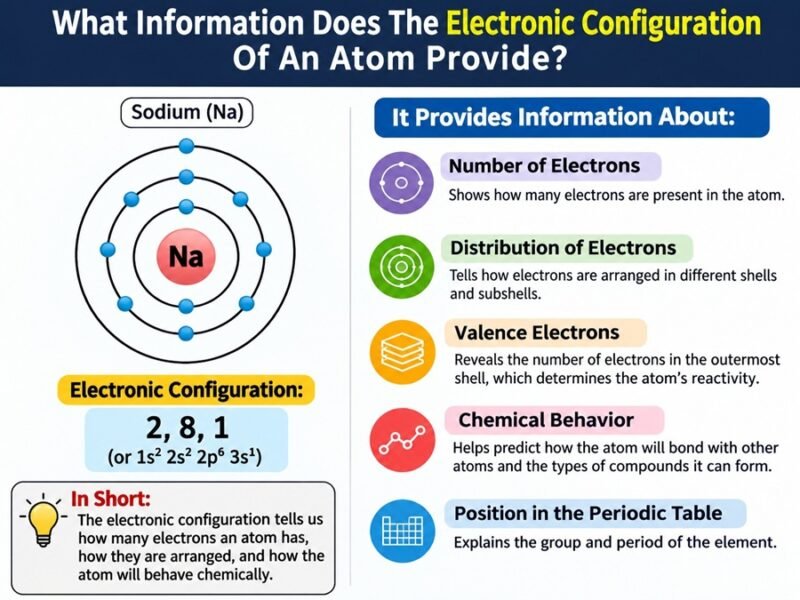
The electronic configuration of an atom tells you how its electrons are arranged in shells and subshells. From that arrangement you can work out the total number of electrons, valence electrons, valency, period, group, block, metallic or non-metallic nature, magnetic behaviour and chemical reactivity.
Written by Sonja Dewing, Pro Business Cop | Last updated: November 2026
Writing 1s² 2s² 2p⁶ 3s¹ is the easy part. Reading it is where the marks are won in board exams, NEET, JEE and CUET, and where real chemistry begins. This guide from Pro Business Cop shows you how to read a configuration the way a chemist does, using real elements and simple steps.
In this guide:
- What electronic configuration means
- The 10 things it tells you
- A step-by-step method to decode any configuration
- Valence electrons, valency, period, group and block
- Reactivity, ions, bonding and magnetism
- Real-life uses, common mistakes and exam-ready answers
What Information Does The Electronic Configuration Of An Atom Provide
Electronic configuration is the way electrons are distributed in the shells, subshells and orbitals of an atom. It is written in two common styles.
- Shell style (Class 9 and 10): sodium is written as 2, 8, 1. This means 2 electrons in the K shell, 8 in the L shell and 1 in the M shell.
- Subshell style (Class 11 and 12): sodium is written as 1s² 2s² 2p⁶ 3s¹. The number is the shell, the letter is the subshell and the superscript is the count of electrons in it.
Three rules decide how electrons fill up. The Aufbau principle says electrons enter the lowest energy orbital available first. The Pauli exclusion principle says one orbital holds at most two electrons, and they must have opposite spins. Hund’s rule says electrons occupy separate orbitals of the same subshell singly before any of them pairs up.
For long configurations, a shortcut uses the nearest noble gas in brackets. Sodium becomes [Ne] 3s¹, because neon already covers 1s² 2s² 2p⁶.
What Information Does the Electronic Configuration of an Atom Provide?
A configuration gives you these 10 pieces of information:
- Total number of electrons. For a neutral atom, this equals the atomic number.
- Number of shells and subshells occupied. Each shell number that appears is a shell in use.
- Number of valence electrons. These are the electrons in the outermost shell.
- Valency. The combining capacity of the element, worked out from the valence electrons.
- Period. The highest shell number in the configuration.
- Group. Found from the valence electrons, with slightly different rules for s, p and d blocks.
- Block (s, p, d or f). The subshell that receives the last electron.
- Metallic or non-metallic nature. Few valence electrons usually means a metal. Many usually means a non-metal.
- Magnetic behaviour. Unpaired electrons make an atom paramagnetic. All paired electrons make it diamagnetic.
- Reactivity and ion formation. Atoms react to reach a stable, noble gas style arrangement.
One note on wording. Some textbooks say a configuration shows the “position” of an electron. More accurately, it shows which orbitals the electrons occupy, and an orbital is a region where an electron is most likely to be found, not a fixed track.
How to Read an Electronic Configuration: Step-by-Step Examples
Use this four-step method on any element:
- Add up the superscripts to get the total electrons.
- Find the highest shell number. That is the period.
- Count the electrons in that outermost shell. Those are the valence electrons.
- Look at the last subshell filled to find the block.
Example 1: Sodium (Z = 11)
Configuration: 1s² 2s² 2p⁶ 3s¹
| What you want to know | Answer | How you got it |
|---|---|---|
| Total electrons | 11 | 2 + 2 + 6 + 1 |
| Shells used | 3 | Highest number is 3 |
| Valence electrons | 1 | Only 3s¹ is in the outer shell |
| Valency | +1 | It easily loses 1 electron |
| Period | 3 | Highest shell is 3 |
| Group | 1 | s-block, so group equals valence electrons |
| Nature | Reactive metal | One loosely held outer electron |
Example 2: Chlorine (Z = 17)
Configuration: 1s² 2s² 2p⁶ 3s² 3p⁵, or [Ne] 3s² 3p⁵
The outer shell has 2 + 5 = 7 electrons. Chlorine needs just one more to complete 8, so it gains one electron and forms Cl⁻. It sits in period 3, group 17 (10 + 7), in the p-block, and it is a reactive non-metal.
Example 3: Iron (Z = 26)
Configuration: [Ar] 3d⁶ 4s²
The highest shell is 4, so iron is in period 4. The last electron enters a d subshell, so it is a d-block element. Its group is 6 + 2 = 8. Iron is a transition metal, and it forms both Fe²⁺ and Fe³⁺, which is why you see two common iron compounds in labs, such as iron(II) sulphate and iron(III) chloride.
Valence Electrons and Valency from Electronic Configuration
Valence electrons are the electrons in the outermost shell, and they decide how an atom bonds. The quick rule for main group elements is simple. Atoms with 1 to 3 valence electrons usually lose them. Atoms with 5 to 7 usually gain electrons to reach 8. Carbon, with 4, usually shares.
Here are the first 20 elements at a glance (yaad rakhne ka easy table):
| Element | Configuration | Valence electrons | Usual valency |
|---|---|---|---|
| Hydrogen (H) | 1s¹ | 1 | 1 |
| Helium (He) | 1s² | 2 | 0 |
| Lithium (Li) | [He] 2s¹ | 1 | 1 |
| Beryllium (Be) | [He] 2s² | 2 | 2 |
| Boron (B) | [He] 2s² 2p¹ | 3 | 3 |
| Carbon (C) | [He] 2s² 2p² | 4 | 4 |
| Nitrogen (N) | [He] 2s² 2p³ | 5 | 3 |
| Oxygen (O) | [He] 2s² 2p⁴ | 6 | 2 |
| Fluorine (F) | [He] 2s² 2p⁵ | 7 | 1 |
| Neon (Ne) | [He] 2s² 2p⁶ | 8 | 0 |
| Sodium (Na) | [Ne] 3s¹ | 1 | 1 |
| Magnesium (Mg) | [Ne] 3s² | 2 | 2 |
| Aluminium (Al) | [Ne] 3s² 3p¹ | 3 | 3 |
| Silicon (Si) | [Ne] 3s² 3p² | 4 | 4 |
| Phosphorus (P) | [Ne] 3s² 3p³ | 5 | 3 |
| Sulphur (S) | [Ne] 3s² 3p⁴ | 6 | 2 |
| Chlorine (Cl) | [Ne] 3s² 3p⁵ | 7 | 1 |
| Argon (Ar) | [Ne] 3s² 3p⁶ | 8 | 0 |
| Potassium (K) | [Ar] 4s¹ | 1 | 1 |
| Calcium (Ca) | [Ar] 4s² | 2 | 2 |
Notice the pattern for nitrogen, oxygen and fluorine. Their valency is 8 minus the number of valence electrons (8 − 5 = 3, 8 − 6 = 2, 8 − 7 = 1). Neon and argon have a complete outer shell, which is why they hardly react.
How to Find Period, Group and Block from Electronic Configuration
- Period: the highest shell number in the configuration.
- Block: the type of subshell that received the last electron (s, p, d or f).
- Group (modern periodic table):
- s-block: group number equals the number of valence electrons (1 or 2).
- p-block: group number equals 10 plus the number of valence electrons (13 to 18).
- d-block: group number equals the number of (n − 1)d electrons plus the ns electrons (3 to 12).
Try these before you read the answers:
- Magnesium, [Ne] 3s²: period 3, s-block, group 2.
- Phosphorus, [Ne] 3s² 3p³: period 3, p-block, group 10 + 5 = 15.
- Argon, [Ne] 3s² 3p⁶: period 3, p-block, group 10 + 8 = 18.
Helium is the one oddity. Its configuration is 1s², which looks like an s-block element, but it is placed in group 18 because its outer shell is complete.
Metallic or Non-Metallic Nature and Chemical Reactivity
An atom with few valence electrons can lose them with little effort, so it behaves like a metal. An atom that is one or two electrons short of a full outer shell pulls electrons in, so it behaves like a non-metal.
A real example is the alkali metals. Lithium, sodium and potassium each have one valence electron, so all three are reactive and all three form +1 ions. Yet potassium reacts more violently with water than lithium does. The reason is that potassium’s outer electron is in the 4th shell, farther from the nucleus and held more loosely, so it is lost more easily. Same configuration pattern, different strength, and the shell number explains the difference.
The same logic works for non-metals. Fluorine (7 valence electrons in the 2nd shell) is more reactive than chlorine (7 valence electrons in the 3rd shell) because its small size lets it pull in an extra electron more strongly.
Ion Formation and Chemical Bonding
Atoms tend to move toward the configuration of the nearest noble gas.
- Na (2, 8, 1) loses one electron to become Na⁺ (2, 8), which matches neon.
- Cl (2, 8, 7) gains one electron to become Cl⁻ (2, 8, 8), which matches argon.
The oppositely charged ions attract each other, and that gives you sodium chloride, the common salt in your kitchen. This is ionic bonding.
When atoms need electrons but none are willing to give them up, they share instead. In water, oxygen needs 2 more electrons and each hydrogen needs 1. Oxygen shares one electron pair with each of two hydrogen atoms, so everyone completes their outer shell. That is covalent bonding, and it is why the formula is H₂O.
Pro Business Cop tip: when a question asks about an ion, write the configuration of the ion, not the atom. Fe³⁺ is [Ar] 3d⁵, not [Ar] 3d⁶ 4s².
Magnetic Behaviour: Paramagnetic vs Diamagnetic
If an atom has one or more unpaired electrons, it is paramagnetic and is weakly attracted by a magnetic field. If all its electrons are paired, it is diamagnetic and is weakly repelled.
| Element | Configuration (outer part) | Unpaired electrons | Behaviour |
|---|---|---|---|
| Nitrogen | 2s² 2p³ | 3 | Paramagnetic |
| Oxygen | 2s² 2p⁴ | 2 | Paramagnetic |
| Iron | 3d⁶ 4s² | 4 | Paramagnetic |
| Zinc | 3d¹⁰ 4s² | 0 | Diamagnetic |
| Neon | 2s² 2p⁶ | 0 | Diamagnetic |
Why does nitrogen have 3 unpaired electrons? Hund’s rule. The three 2p electrons go into three separate p orbitals before any pairing happens. In oxygen, the fourth 2p electron has to pair up with one of them, leaving 2 unpaired.
Exam tip for JEE and NEET: the spin-only magnetic moment is √[n(n + 2)] Bohr magnetons, where n is the number of unpaired electrons. For 4 unpaired electrons, that is about 4.9 BM.
Real-Life Uses of Electronic Configuration
Configuration is not just theory. It explains things you can see around you.
- Sodium vapour street lamps: the orange-yellow glow comes from sodium’s outer electron dropping between energy levels. The strongest emission is around 589 nm, the famous sodium yellow line.
- Neon signs: neon atoms get excited by electricity and release red-orange light as electrons return to lower levels. Different gases give different colours because their energy levels are different.
- Flame tests in the lab: sodium salts burn yellow, potassium salts burn lilac and copper salts burn green. Each metal has its own set of energy levels, so each has its own colour signature.
- Coloured compounds: copper sulphate crystals are blue because Cu²⁺ is [Ar] 3d⁹, with an incomplete d subshell that can absorb visible light. Zn²⁺ is 3d¹⁰, a full d subshell, and zinc compounds are usually colourless.
- Computer chips: silicon has 4 valence electrons. Adding a little phosphorus (5 valence electrons) or boron (3 valence electrons) changes how silicon conducts electricity. That is the basic idea behind the semiconductors in your phone.
- Magnets: iron’s unpaired 3d electrons are a big reason it can be magnetic, although bulk magnetism also depends on how atoms interact in the solid.
Exceptions and Common Mistakes Students Make
The Aufbau order is a very good guide, not a law without exceptions. Two famous cases:
- Chromium (Z = 24): [Ar] 3d⁵ 4s¹, not [Ar] 3d⁴ 4s².
- Copper (Z = 29): [Ar] 3d¹⁰ 4s¹, not [Ar] 3d⁹ 4s².
In both, one electron moves from 4s to 3d because half-filled (d⁵) and fully filled (d¹⁰) subshells are especially stable.
| Common mistake | Correct approach |
|---|---|
| Removing 3d electrons first when forming transition metal ions | Remove 4s electrons first. Fe²⁺ is [Ar] 3d⁶. |
| Writing the neutral atom’s configuration for an ion | Adjust the electron count first, then fill. |
| Mixing up shell, subshell and orbital | Shell is n. Subshell is s, p, d or f. Orbital holds a maximum of 2 electrons. |
| Pairing electrons in p orbitals too early | Fill each orbital singly first (Hund’s rule), then pair. |
| Writing 4s² 3d⁵ style order in the final answer for Class 11 | Both orders are accepted, but writing by increasing n (3d before 4s) matches the NCERT convention. |
Exam-Ready Answer (Class 9 to 12)
Class 9 and 10 (3 to 4 lines): The electronic configuration of an atom shows how its electrons are distributed in different shells. It helps us find the number of valence electrons, the valency of the element and its position in the periodic table. For example, sodium has the configuration 2, 8, 1, so it has 1 valence electron and a valency of 1.
Class 11 and 12 (5 to 6 lines): The electronic configuration shows how electrons are distributed among the shells, subshells and orbitals of an atom. It tells us the total number of electrons, the number of valence electrons and the valency. It also helps us find the period, group and block of the element. The number of unpaired electrons shows whether the atom is paramagnetic or diamagnetic. It also explains chemical reactivity and ion formation, because atoms try to reach a stable noble gas configuration.
Frequently Asked Questions
What does the electronic configuration of an element tell us?
It tells us how electrons are arranged in the shells, subshells and orbitals of the atom. From this you can find the number of electrons, valence electrons, valency, period, group, block, magnetic behaviour and reactivity.
How do you find valence electrons from electronic configuration?
Look at the highest shell number and add the electrons in all subshells of that shell. For chlorine (1s² 2s² 2p⁶ 3s² 3p⁵), the highest shell is 3, and 2 + 5 gives 7 valence electrons.
How do you find the period and group of an element from its configuration?
The period is the highest shell number. For s-block elements, the group equals the valence electrons. For p-block elements, add 10 to the valence electrons. For d-block elements, add the (n − 1)d and ns electrons. Phosphorus, [Ne] 3s² 3p³, is in period 3 and group 15.
Why are chromium and copper exceptions to the Aufbau principle?
Half-filled (d⁵) and fully filled (d¹⁰) subshells have extra stability, and the 3d and 4s energies are very close. So one electron shifts from 4s to 3d, giving [Ar] 3d⁵ 4s¹ for chromium and [Ar] 3d¹⁰ 4s¹ for copper.
How does electronic configuration decide whether an element is a metal or non-metal?
Elements with 1 to 3 valence electrons usually lose them easily and behave as metals. Elements with 5 to 7 valence electrons usually gain electrons and behave as non-metals. There are borderline cases, such as silicon, which is a metalloid.
What is the difference between paramagnetic and diamagnetic substances?
Paramagnetic substances have unpaired electrons and are weakly attracted to a magnetic field. Diamagnetic substances have all electrons paired and are weakly repelled. Oxygen is paramagnetic and neon is diamagnetic.
Is electronic configuration important for NEET, JEE and board exams?
Yes. It is the base for periodic properties, chemical bonding, coordination compounds and magnetic properties. Questions range from writing a configuration to finding unpaired electrons or predicting an ion’s behaviour.
Conclusion and Key Takeaways
Electronic configuration is a short code that holds a lot of information. Once you can decode it, topics like the periodic table, bonding and reactivity stop feeling like separate chapters and start feeling connected.
- It gives you the total electrons, shells and valence electrons.
- It helps you find valency, period, group and block.
- It explains why some elements are metals and others are non-metals.
- It shows ion formation, bonding and reactivity.
- Unpaired electrons decide whether an atom is paramagnetic or diamagnetic.
- Real examples like sodium lamps, neon signs, silicon chips and blue copper sulphate all trace back to electron arrangements.
Pick any element, write its configuration and run the four-step method from this guide. For more simple, exam-focused study guides, explore the rest of the library on Pro Business Cop.
About the author: Sonja Dewing is a chemistry teacher and science writer at Pro Business Cop. She writes simple, exam-focused science guides that help Indian students understand tough topics step by step.
