


Quick Answer: How Do You Register a Small Business in India?
Choose a legal structure first (sole proprietorship, partnership, LLP, OPC or private limited company). Then get a PAN, register with the MCA if you chose a company or LLP, apply for GST if required, and complete the free Udyam Registration for MSME benefits. Most steps can be done online.
In short:
- Fastest and cheapest: Sole proprietorship (days)
- Best for professionals with partners: LLP (1 to 3 weeks)
- Best for funding: Private limited company (1 to 3 weeks)
- Free and optional but useful: Udyam Registration
Disclaimer: This is general information, not legal or tax advice. Rules change, so confirm details on official portals or with a Chartered Accountant (CA) or Company Secretary (CS) before filing.
Which Business Structure Should You Choose?
Your structure decides your tax, your personal risk and how much paperwork you will handle every year. Pick it before you file anything.
| Feature | Sole Proprietorship | Partnership Firm | LLP | One Person Company (OPC) | Private Limited |
|---|---|---|---|---|---|
| MCA registration needed | No | No | Yes | Yes | Yes |
| Owners needed | 1 | 2 or more | 2 or more partners | 1 | Min. 2 directors and 2 shareholders |
| Personal liability | Unlimited | Unlimited | Limited | Limited | Limited |
| Compliance load | Low | Low to medium | Medium | Medium to high | High |
| Best for | Freelancers, small shops | Family or friends’ business | Consultancies, agencies | Solo founders | Startups seeking investors |
Sole Proprietorship
This is the simplest structure. You and the business are legally one, so your personal assets are not protected if the business has debts. There is no MCA registration. You usually take GST registration (if needed), a Shops and Establishment licence and a current bank account.
Partnership Firm
Two or more people run the business under a Partnership Deed, governed by the Indian Partnership Act, 1932. Registration is not mandatory, but it is strongly advised because an unregistered firm has limits on suing third parties in court.
Limited Liability Partnership (LLP)
An LLP gives partners limited liability with partnership-style flexibility. It is registered with the MCA under the LLP Act, 2008, and suits professional service firms.
One Person Company (OPC)
An OPC lets a single founder enjoy limited liability without a co-founder. It has eligibility conditions (for example, a nominee must be named), so check the rules with a CS before choosing it.
Private Limited Company
This is the usual choice for startups that plan to raise money. It needs at least two directors and two shareholders, and it is registered under the Companies Act, 2013. Compliance is heavier, but investors and banks trust it more.
Simple rule: Testing an idea alone? Start as a sole proprietorship. Running a service firm with partners? Choose an LLP. Planning to raise funds? Choose a private limited company.
What Documents Do You Need?
Most registrations need this core set:
- PAN card of the owner, partners or directors
- Aadhaar card for identity verification
- Address proof of the business premises (utility bill, rent agreement or property papers) plus an NOC from the owner if the space is rented
- Passport-size photographs
- Digital Signature Certificate (DSC): an electronic signature used to sign online filings, needed for company and LLP registrations
- Director Identification Number (DIN): a unique ID for company directors (it can be applied for inside the SPICe+ form)
- Partnership Deed or LLP Agreement: for partnerships and LLPs
How Do You Register a Sole Proprietorship?
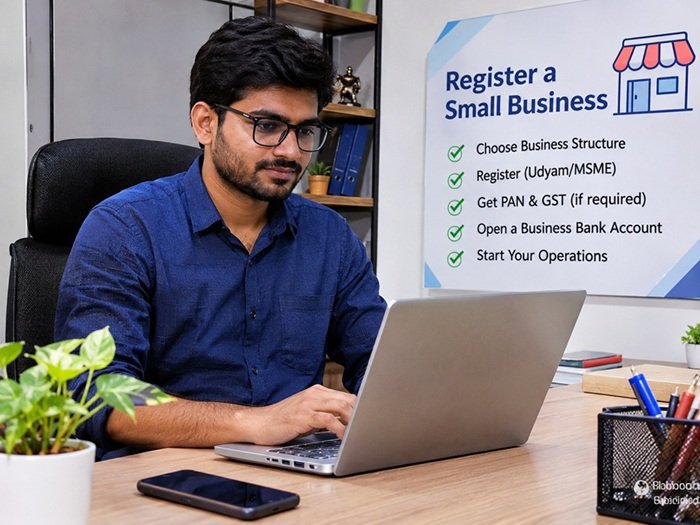
A sole proprietorship does not need MCA incorporation, so it is the quickest to start. Typical time: a few days to two weeks, depending on your state.
- Choose a business name. There is no formal name reservation, but check that nobody else has trademarked it.
- Get a PAN in your name if you do not have one.
- Apply for a Shops and Establishment licence from your state or local municipal authority.
- Register for GST if your turnover crosses the limit (see the GST section below).
- Open a current bank account using documents like GST certificate, Shops licence or Udyam certificate.
- Register on Udyam to claim MSME benefits.
How Do You Register a Private Limited Company?
Companies are incorporated through the MCA’s SPICe+ form (Simplified Proforma for Incorporating a Company Electronically Plus). Typical time: one to three weeks if documents are complete.
- Get DSCs for all proposed directors.
- Apply for DINs. You can do this within SPICe+.
- Reserve the company name on the MCA portal. The system checks it against existing companies and trademarks.
- File SPICe+. One form covers incorporation, PAN, TAN, optional GST, EPFO and ESIC registration, and bank account opening.
- File the MOA and AOA. The Memorandum of Association states your business objectives, and the Articles of Association set the internal rules.
- Receive the Certificate of Incorporation from the Registrar of Companies (ROC).
Practical tip: Most delays come from name rejections and mismatched details between PAN, Aadhaar and address proof. Check spellings before filing.
How Do You Register an LLP?
The steps are similar: get DSCs for designated partners, reserve the name, file the incorporation form with the MCA, then sign and file the LLP Agreement. Expect one to three weeks with correct documents.
What Is Udyam Registration and Do You Need It?
Udyam Registration is the government’s online system to register and classify Micro, Small and Medium Enterprises (MSMEs). It is free on the official Udyam portal and is not compulsory, but it is worth doing.
Benefits include:
- Priority-sector and collateral-free lending support from banks
- Protection against delayed payments from buyers
- Subsidies on patent registration and similar schemes
- Access to government tenders that reserve a share for MSMEs
MSME Limits (Effective from 1 April 2025)
Your category depends on both investment in plant and machinery or equipment and annual turnover.
| Category | Investment | Annual Turnover |
|---|---|---|
| Micro | Up to ₹2.5 crore | Up to ₹10 crore |
| Small | Up to ₹25 crore | Up to ₹100 crore |
| Medium | Up to ₹125 crore | Up to ₹500 crore |
What You Need for Udyam
You need the Aadhaar of the owner or authorised signatory and your PAN. Investment and turnover details are now verified through linked income tax and GST data, so keep your PAN and GST details accurate and consistent.
Note: MSME rules have been updated recently. Check the official Udyam portal and the Ministry of MSME for the latest notifications before applying.
Do You Need GST Registration?
Yes, once your turnover crosses the threshold, and sometimes earlier.
- Goods: register when annual turnover exceeds ₹40 lakh (₹20 lakh in many special category states).
- Services: register when annual turnover exceeds ₹20 lakh (₹10 lakh in special category states).
- Always required in many cases: certain inter-state suppliers and most e-commerce sellers, with some exemptions for small suppliers. Check the current rules for your case.
Thresholds can differ by state and by the type of supply, so confirm on the official GST portal. You can also register voluntarily if you want input tax credit or if your business customers need GST invoices. For a walkthrough of accessing your account after registration, see our guide to the GST portal login.
What Compliance Is Required After Registration?
Registration is only the first step. Missed filings lead to penalties and, in some cases, strike-off.
| Structure | Typical Ongoing Compliance |
|---|---|
| Sole Proprietorship | Annual income tax return; GST returns (monthly or quarterly) if registered |
| Partnership Firm | Annual income tax return; GST returns if registered |
| LLP | Annual Return and Statement of Account and Solvency with MCA every year, even with no business; income tax return; audit above prescribed turnover or contribution limits |
| OPC / Private Limited | Annual financial statements and annual return with the ROC, board meetings, statutory audit (regardless of turnover), income tax return |
Once you have a formal structure, a CA or CS can save you from costly mistakes.
How Much Does Registration Cost and How Long Does It Take?
- Sole proprietorship: very low government cost; mainly licence fees. Usually a few days to two weeks.
- LLP and private limited company: costs include MCA filing fees, state stamp duty on incorporation documents, DSC charges and professional fees if you hire a CA or CS. Stamp duty differs by state. Timeline is usually one to three weeks.
- Udyam and GST registration: no government fee on the official portals.
Get a written fee quote from your professional before you begin, so there are no surprises.
Common Mistakes to Avoid
- Choosing a private limited company when a sole proprietorship would do, and then missing annual filings
- Name or spelling mismatches between PAN, Aadhaar and address proof
- Skipping the Partnership Deed or leaving it vague
- Ignoring GST until turnover has already crossed the limit
- Forgetting that LLPs and companies must file annually even with zero income
- Paying agents without a clear list of fees
Planning to Grow? Think About Your Team Early
Once you are registered, growth usually depends on sales. A good business development executive can help you find clients, build partnerships and increase revenue, so plan this role into your budget as you scale.
Final Thoughts: Start on Solid Legal Ground
Registering in India is far easier online than it used to be, but the structure you choose affects your taxes, risk and workload for years. Map out the next two to three years before filing. If you expect investors or co-founders, a private limited company is worth the extra paperwork. If you are working solo, start simple and restructure later.
For more practical business guides, explore Probusinesscop.
Frequently Asked Questions
How much does it cost to register a small business in India?
It depends on the structure. A sole proprietorship has very low government costs. LLPs and private limited companies involve MCA fees, state stamp duty and professional fees. Udyam and GST registration are free on the official portals.
How long does business registration take in India?
A sole proprietorship can start within days. LLP and private limited company registration usually takes one to three weeks when documents are correct.
Is Udyam Registration mandatory?
No. It is voluntary and free, but you need it to claim most MSME benefits like priority lending and tender reservations.
Do I need GST registration for a small business?
Only if your turnover crosses the limit (₹40 lakh for goods, ₹20 lakh for services in most states) or you fall under a mandatory category. You can also register voluntarily.
What is the difference between a partnership firm and an LLP?
In a partnership firm, partners are personally liable for business debts. In an LLP, each partner’s liability is limited to their agreed contribution.
Can I register a business from my home address?
In many cases yes, with address proof and an NOC from the owner if the property is not yours. Some state licences and zoning rules may apply, so check locally.
Can a foreigner register a business in India?
Yes, usually through a private limited company, subject to Foreign Direct Investment (FDI) rules under RBI and government policy. Some sectors have caps or need approval.
Which is better: LLP or private limited company?
Choose an LLP for professional services with lower compliance. Choose a private limited company if you want to raise equity funding.

1 Comment
Pingback: What Is A Business Development Executive? Role, Salary & Skills (India)