

Last updated: November 12, 2026 | Reviewed by Pro Business Cop Team, [CA / CFP / Ex-Banker] | Read our Editorial Policy
You can apply for an instant personal loan of up to ₹1 crore online in about 10 to 15 minutes, and many lenders disburse the money within 24 to 72 hours once your documents are verified. Pre-approved customers sometimes get it the same day. Many lenders advertise “up to ₹1 crore” loans, but that is the best-case limit, not what most people get. Interest rates on personal loans in India usually start around 10% to 11% for strong profiles and go much higher for others. Your income, credit score and employer decide where you land. The 10.25% rate used in the examples below is an illustrative figure, not an offer from any specific lender.
This guide shows you who qualifies, which documents to keep ready, the exact steps to follow, and real EMI numbers so you know what you will pay before you apply.
Quick answer
Who qualifies: Salaried or self-employed borrowers aged roughly 21 to 60, with a credit score of 750 or above and a high, stable income.
What you need: PAN, Aadhaar, income proof and 3 to 6 months of bank statements.
How long it takes: 10 to 15 minutes to apply, usually 1 to 3 days to receive the money.
What it costs: Interest from 10.25%* for the strongest profiles, plus a processing fee and GST.
What to watch: A ₹1 crore loan over 5 years means an EMI of about ₹2.14 lakh. Check that number against your income first.
What is an instant personal loan up to ₹1 crore?
An instant personal loan is an unsecured loan you apply for and get approved for digitally, without pledging a house, car or gold. You can use the money for almost anything: a wedding, medical bills, a home renovation, higher education or clearing expensive debt. Repayment happens through fixed monthly instalments (EMIs), usually over 1 to 7 years.
The “instant” part comes from technology, not from relaxed rules. Lenders verify your identity through Aadhaar e-KYC, pull your credit report in seconds, and read your bank statements digitally. That removes the branch visit and the paperwork, but the lender still checks whether you can afford the loan.
What does the asterisk after 10.25% mean?
It means the rate is conditional. Personal loan rates in India commonly range from about 10% to 24% a year, and the lowest figure is reserved for applicants with a high credit score, a strong income and often a salary account or employer tie-up with the lender. If your profile is average, expect a higher rate. Ask for your personalised rate before you submit the full application, and read the final sanction letter for the rate you will actually pay.
Who is eligible for a personal loan of up to ₹1 crore?
To borrow ₹1 crore, you generally need a credit score of 750 or above and a net monthly income high enough that the EMI stays within about 40% to 50% of it. Each lender sets its own cut-offs, so treat the table below as a typical picture and confirm the details on the lender’s official page.
| Factor | What lenders usually look for |
|---|---|
| Age | 21 to 60 years at application, with the loan ending before 65 in many cases |
| Employment (salaried) | At least 2 years of total experience and 6 to 12 months with the current employer |
| Employment (self-employed) | 3 or more years in the same business or practice, with ITR filed |
| Net monthly income | Often ₹2 lakh to ₹5 lakh or more for the top loan amounts |
| Credit score | 750 or above, with no recent missed payments |
| Employer type | Large corporates, government bodies, MNCs and well-known firms get the best rates |
| Existing EMIs | Total EMIs, including the new one, within 40% to 50% of net income |
How much income do you need for a ₹1 crore loan?
Lenders look at your fixed obligations to income ratio (FOIR). A ₹1 crore loan at 10.25% for 5 years has an EMI of about ₹2,13,703. If your lender caps total EMIs at 50% of income, you would need a net monthly income of roughly ₹4.27 lakh. At a 40% cap, it rises to about ₹5.34 lakh.
Stretching the tenure to 7 years lowers the EMI to about ₹1,67,306, which brings the income requirement down to roughly ₹3.35 lakh to ₹4.18 lakh. Any car loan or credit card dues you already pay come out of that same limit.
What documents do you need?
Keep scanned copies or clear photos of these ready before you start, because a mismatch in names or addresses is one of the most common reasons an instant approval turns into a manual review.
For salaried applicants
- PAN card and Aadhaar card (the mobile number linked to Aadhaar should be active for the OTP)
- Last 3 months’ salary slips
- Last 3 to 6 months’ bank statement of the account where your salary is credited
- Employment ID or offer letter, and a work email address
- Recent passport-size photograph or a live selfie, depending on the lender
For self-employed applicants
- PAN card and Aadhaar card
- Last 2 to 3 years’ ITR with computation of income
- Last 12 months’ bank statement of your primary business account
- Business proof such as GST registration, a Udyam certificate or a professional licence
- Profit and loss account and balance sheet, if the lender asks for them
When the lender asks for your name and date of birth, enter them exactly as they appear on your PAN. Small differences, such as an initial written in full on one document and abbreviated on another, can trigger a rejection or a delay.
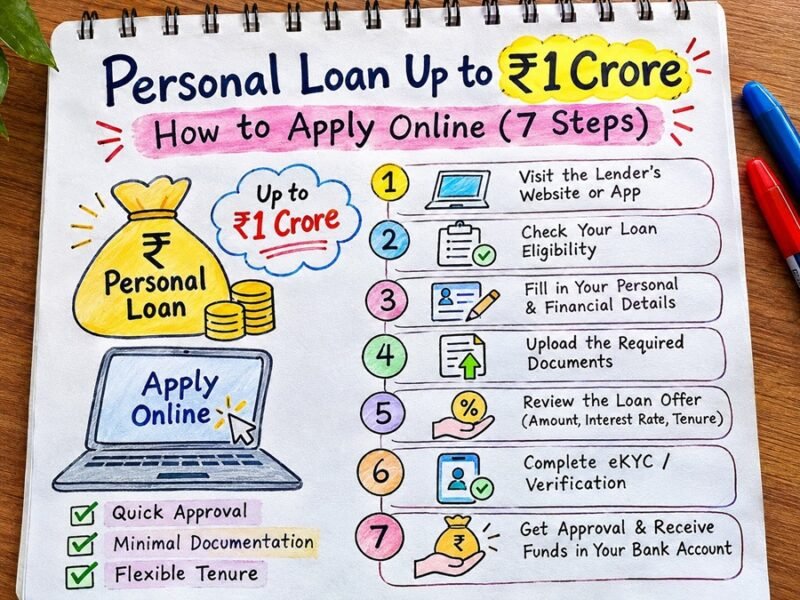
How to apply for an instant personal loan up to ₹1 crore: 7 steps
- Check your credit score and report first. Get your score and full report from a credit bureau such as CIBIL, Experian, Equifax or CRIF High Mark. Indian borrowers can get one free full report a year from each bureau. Look for wrong entries, old closed loans still showing as active, or missed payments you don’t recognise, and get them fixed before applying.
- Decide the amount and tenure with an EMI calculator. Borrow what you need, not the maximum you are offered. Try 3, 5 and 7 year tenures and note the EMI and the total interest for each, so you can see what the extra time really costs.
- Compare at least three lenders on total cost. Don’t stop at the headline rate. Compare the processing fee, GST, foreclosure charges and the annual percentage rate (APR), which the lender must show you in the Key Fact Statement for retail loans.
- Check your eligibility with a soft enquiry. Most lender apps let you see a personalised offer without a full credit pull. This tells you your likely rate and limit without adding hard enquiries to your report, which can lower your score if you apply to many lenders in a short time.
- Fill in the application and complete e-KYC. Enter your personal, employment and income details, then verify with the Aadhaar OTP and your PAN. Use the lender’s official website or app only, and never share your OTP or card PIN with anyone claiming to be a loan agent.
- Upload documents and finish verification. Add your salary slips, bank statements or ITR. Many lenders fetch bank data digitally with your consent, and some will schedule a short video KYC or a call with a credit officer for large amounts like ₹1 crore.
- Review the sanction letter, e-sign and set up the e-mandate. Check the final loan amount, interest rate, tenure, EMI date, fees and the Key Fact Statement before accepting. Once you e-sign and set up auto-debit for EMIs, the money is usually credited to your bank account within a day or two.
A genuine lender will never ask you to pay a “processing fee” or “insurance” to a personal account before approval. If someone does, stop and report it.
Real examples: what will your EMI be?
EMI depends on three things: the loan amount, the interest rate and the tenure. The formula lenders use on a reducing balance is below, where P is the loan amount, r is the monthly interest rate (annual rate divided by 12 and by 100) and n is the number of months.
EMI = \frac{P \times r \times (1 + r)^n}{(1 + r)^n - 1}Here are worked examples using that formula. They exclude the processing fee and GST.
| Loan amount | Interest rate | Tenure | Monthly EMI | Total interest paid |
|---|---|---|---|---|
| ₹10 lakh | 10.25% | 5 years | ₹21,370 | ₹2,82,216 |
| ₹10 lakh | 14% | 5 years | ₹23,268 | ₹3,96,095 |
| ₹25 lakh | 10.25% | 5 years | ₹53,426 | ₹7,05,540 |
| ₹50 lakh | 10.25% | 5 years | ₹1,06,851 | ₹14,11,079 |
| ₹1 crore | 10.25% | 3 years | ₹3,23,847 | ₹16,58,488 |
| ₹1 crore | 10.25% | 5 years | ₹2,13,703 | ₹28,22,158 |
| ₹1 crore | 10.25% | 7 years | ₹1,67,306 | ₹40,53,741 |
Example 1: the rate gap on a ₹10 lakh loan. Take Priya, a 32-year-old software engineer in Pune (an illustrative case). She wants ₹10 lakh for a home renovation. One lender offers her 10.25% and another offers 14%. Over 5 years, the cheaper offer saves her ₹1,13,879 in interest, even though the monthly difference is only ₹1,898.
Example 2: the tenure trade-off on ₹1 crore. Suppose a business owner borrows ₹1 crore at 10.25%. Choosing 7 years instead of 5 lowers the EMI by about ₹46,400 a month, but the total interest rises by ₹12,31,583. A shorter tenure costs you more each month and far less overall.
Example 3: the fee you forget. If the lender charges a 1% processing fee on ₹1 crore, that is ₹1,00,000, plus 18% GST of ₹18,000, so ₹1,18,000 is deducted or paid up front. Your real cost of borrowing is higher than the interest rate alone suggests.
How to get the lowest interest rate
The lowest advertised rate goes to borrowers who look like the lowest risk. You can’t change your employer overnight, but you can improve several of the other signals in a few weeks.
- Raise your score above 780 if you can. Pay every EMI and credit card bill on time, and keep card usage below 30% of your limit. A higher score gives you room to negotiate.
- Clear small debts before you apply. Closing a ₹2 lakh loan with a ₹9,000 EMI frees that amount for your FOIR, which can raise your eligible loan amount.
- Avoid applying to many lenders at once. Each full application triggers a hard enquiry. Use soft-check eligibility tools first, then apply to your top one or two choices.
- Add a co-applicant with a steady income. A working spouse or parent can improve eligibility and sometimes the rate, since the lender counts both incomes.
- Start with the bank where you hold your salary account. Existing customers often see pre-approved offers with lower rates and faster processing, because the bank already knows your cash flow.
- Ask for a better rate in writing. If another lender has offered you less, tell your preferred lender and ask whether they can match it or cut the processing fee.
Fees and charges to check before you accept
The interest rate is only part of what a loan costs. These are the charges that most often change the real price, with typical ranges that vary by lender.
| Charge | Typical range | What to check |
|---|---|---|
| Processing fee | About 0.99% to 3% of the loan, plus 18% GST | Whether it is deducted from the disbursed amount, which means you receive less than you borrowed |
| Foreclosure or prepayment fee | 0% to 5% of the outstanding amount | Any lock-in period, often 6 to 12 months, and whether part-payments are allowed |
| Late payment charges | Often around 2% a month on the overdue amount | The grace period, if any, and how the charge is calculated |
| EMI bounce charge | Commonly ₹500 to ₹1,000 per failed debit | Keep enough balance in your account on the EMI date |
| Insurance or add-ons | Optional | Whether it is bundled into the loan amount without your clear consent |
Ask for the Key Fact Statement and read the APR line. It combines the interest and the mandatory charges into one yearly percentage, which makes two offers easier to compare.
Common mistakes that lead to rejection or a costly loan
- Applying to five lenders in one week. Every hard enquiry shows on your report, and lenders read many of them as a sign of financial stress.
- Ignoring existing EMIs. A borrower earning ₹3 lakh a month who already pays ₹90,000 in EMIs has far less room than the income suggests.
- Choosing the longest tenure by default. A lower EMI feels comfortable, but as the 7-year example shows, it can add over ₹12 lakh in interest on ₹1 crore.
- Not reading the sanction letter. The rate and fees in the final letter can differ from the ad that attracted you.
- Taking the maximum offered. A pre-approved limit is what the lender is willing to give, not what you should borrow.
- Using unofficial apps or agents. Download lender apps only from the official app stores and type the website address yourself.
Frequently asked questions
Can I really get a ₹1 crore personal loan instantly?
The application and approval can be instant for strong profiles, but the final amount depends on your income and credit history. Many applicants are approved for less than the maximum, and large amounts often need an extra verification step.
What is the minimum salary for a ₹1 crore personal loan?
There is no single figure, but you typically need a net monthly income of about ₹3.5 lakh to ₹5.5 lakh, depending on the tenure and your existing EMIs. The lender’s FOIR limit decides the exact number.
What credit score is needed for a 10.25% rate?
A score of 750 or above is the usual minimum, and 780 or above gives you a stronger chance at the lowest rate. A high score alone is not enough, since income and employer type also count.
Does checking my eligibility affect my credit score?
A soft enquiry for an eligibility check generally does not affect your score. A hard enquiry, which happens when you submit a full application, can lower it slightly for a short time.
Can self-employed people get a personal loan of up to ₹1 crore?
Yes, if they have 3 or more years of business history, filed ITRs and healthy bank statements. Lenders look at your net profit and cash flow rather than turnover.
Can I prepay or foreclose the loan early?
Usually yes, but many lenders charge a foreclosure fee and set a lock-in period. Ask for the exact terms in writing, because prepaying can save you a lot of interest.
How long does disbursal take after approval?
Once you e-sign and set up the auto-debit mandate, the money is commonly credited within a few hours to 2 working days.
Final thoughts
Getting a personal loan of up to ₹1 crore is mostly about preparation. Check your credit report, work out an EMI you can carry comfortably, compare the total cost across lenders, and read the sanction letter before you sign. If the numbers fit your income, the digital process itself takes only minutes.
Your next step is simple: pull your free credit report today, then run the EMI for your amount and tenure on a calculator so you walk into the application knowing your limit.
*Terms and conditions apply. Interest rates, eligibility criteria, fees and approval timelines are indicative, vary by lender and borrower profile, and are subject to the lender’s credit policy. The examples in this article are for illustration only. This article is for general information and is not financial advice.
Fact-checked by Satendra Kumar, [CA/CFP/Banking professional with 10 years of experience]. Rates, fees and rules were checked against official lender pages and RBI guidelines on November 12, 2026.
Must Read: How to Find Customer ID in HDFC Bank: The Fastest Safe Method for Your Situation
