


Quick Answer
In the FD vs Gold vs Mutual Funds debate, no single option wins for everyone.. Fixed deposits (FDs) suit money you need within 1 to 3 years. Equity mutual funds suit goals that are 5 or more years away. Gold works best as a small hedge, not as your main investment. The right mix depends on your goal, your time horizon and how much loss you can handle.
The RBI’s rate hike on 7 October 2026 makes this question more relevant. Banks are raising FD rates, gold has been falling in November, and the stock market has just had a very strong week.
What Changed This Month
Three developments matter for your decision:
- RBI raised the repo rate to 5.50%. The Monetary Policy Committee voted unanimously on 7 October 2026 to raise the rate by 25 basis points, the first hike since February 2023. It also moved to a “calibrated tightening” stance.
- FD rates are moving up. HDFC Bank raised rates on select tenures by up to 50 basis points from 4 November 2026. General customers can now earn up to 6.60% and senior citizens up to 7.20%.
- Gold and shares are moving in different directions. The IBJA 999 gold price was ₹1,40,805 per 10 grams on 11 November, down ₹1,615 from the previous day’s benchmark. Meanwhile, the Sensex rose 8.82% to 81,028 in the week ended 6 November, its best week in nearly six years.
Prices change daily, so check live rates before you invest.
FD vs Gold vs Mutual Funds at a Glance
| Factor | Fixed Deposit | Gold | Equity Mutual Fund |
|---|---|---|---|
| Return type | Fixed, agreed in advance | Depends on market price | Market-linked, not guaranteed |
| Risk | Low | Medium to high (price swings) | Medium to high (short-term ups and downs) |
| Liquidity | Premature exit allowed, usually with a penalty | Easy to sell, but jewellery loses value through making charges | Redeem anytime in open-ended funds |
| Tax on gains | Interest taxed at your slab rate | 12.5% long-term capital gains on physical gold held over 24 months | 20% short-term, 12.5% long-term above ₹1.25 lakh a year |
| Best for | Short-term goals, emergency money, retirees | Diversification and inflation hedge | Long-term goals like retirement or children’s education |
| Main drawback | Post-tax return can be low | No regular income, prices can fall | Can lose value in the short term |
Fixed Deposits: Safe, but Check the After-Tax Return
FDs give certainty. You know your return on day one, and that is their biggest strength.
What rates are on offer?
- Large banks such as HDFC Bank offer up to 6.60% for general customers after the November revision.
- Small finance banks pay more. In September, Suryoday Small Finance Bank offered up to 8.25% for general customers and 8.50% for senior citizens.
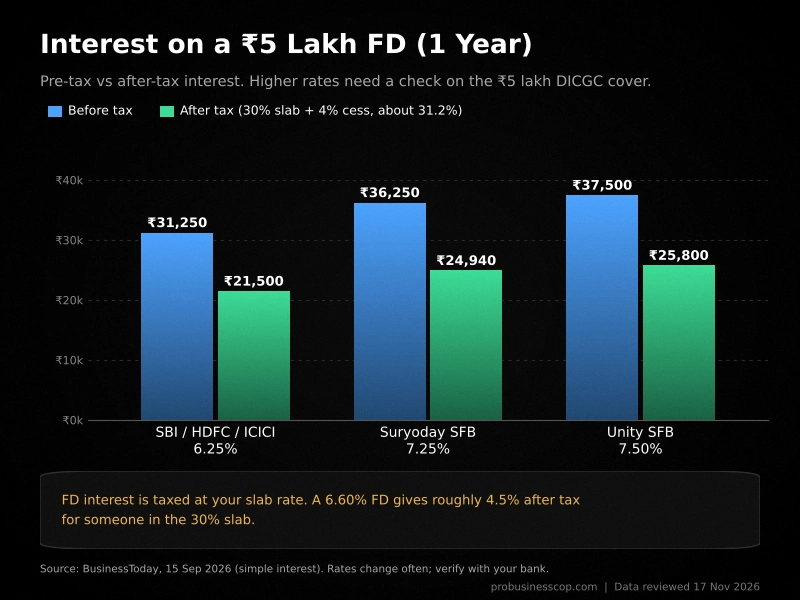
- On a ₹5 lakh one-year deposit (simple interest), 6.25% earns ₹31,250, while 7.25% earns ₹36,250. That is a ₹5,000 difference.
Two things to check before choosing a higher rate:
- Deposit insurance. DICGC insures deposits only up to ₹5 lakh per depositor per bank. Do not put large sums in a single small bank for a slightly higher rate.
- Tax. FD interest is added to your income and taxed at your slab rate. For someone in the 30% slab (about 31.2% with cess), a 6.60% FD gives roughly 4.5% after tax.
Does the rate hike help? Possibly. Banks often raise deposit rates after a policy hike, but not always quickly. If you plan to open an FD, compare 3 to 4 banks and consider splitting money across different tenures (a “ladder”) instead of locking everything at one rate.
Opening an FD online? HDFC Bank customers need their Customer ID to log in to net banking. Here is how to find your Customer ID in HDFC Bank.
Forgot to report FD interest? Missing income in your return can lead to a tax department intimation. Read what an income tax demand notice under Section 143(1) means and how to respond.
Gold: A Hedge, Not a Guarantee

Gold often rises when markets are uncertain. Over the last five years, it has done very well. One report published on 29 October 2026 estimated that ₹1 lakh in 24-carat gold would have grown to about ₹2.95 lakh, compared with about ₹1.31 lakh in a general bank FD and about ₹1.25 lakh in the Nifty 50.
Be careful with that number. Recent gold returns have been unusually strong. A FundsIndia report from August 2026 found that over 15 to 20 year periods, gold has generally lagged the Nifty 50 Total Return Index by about 2 to 3 percentage points.
What to remember about gold:
- It pays no interest or dividend. Your return comes only from the price rising.
- Jewellery includes making charges, so you lose money the day you buy it. Gold ETFs and gold funds avoid this.
- Prices fell sharply in early November. For example, the 24K rate dropped ₹2,890 per 10 grams on 2 November and ₹2,620 from Monday on 11 November.
- Physical gold held for more than 24 months is taxed at 12.5% on gains, without indexation. Rules for gold ETFs and gold mutual funds depend on the product type, so check before you sell.
Equity Mutual Funds: Best for Long-Term Growth, With Ups and Downs
Equity mutual funds invest in company shares. They can beat inflation over long periods, but returns are not smooth.
Why short-term numbers can mislead. The Sensex jumped 8.82% in one week, yet Sensex and Nifty ended Muhurat trading in the red for the first time since 2017. Over five years, the report above shows the Nifty 50 growing ₹1 lakh to only about ₹1.25 lakh. Markets reward patience, but not on a fixed schedule.
A simple SIP example (for illustration only):

- You invest ₹10,000 per month for 10 years. Total invested: ₹12 lakh.
- At an assumed 8% yearly return, you would have about ₹18.4 lakh.
- At an assumed 12% yearly return, you would have about ₹23.2 lakh.
- These are assumptions, not promises. Actual returns can be higher, lower or even negative.
Tax on equity mutual funds (FY 2026-27):
- Gains sold within 12 months: 20% short-term capital gains tax.
- Gains after 12 months: 12.5% on profits above ₹1.25 lakh in a financial year.
- Debt mutual funds are taxed at your slab rate, much like FD interest.
How the rate hike affects equity. On the day of the hike, rate-sensitive sectors such as auto and real estate fell while bank stocks rose. Higher rates can slow borrowing-driven sectors, but markets react to many factors, not just the repo rate.
How to Choose: Match the Money to the Goal
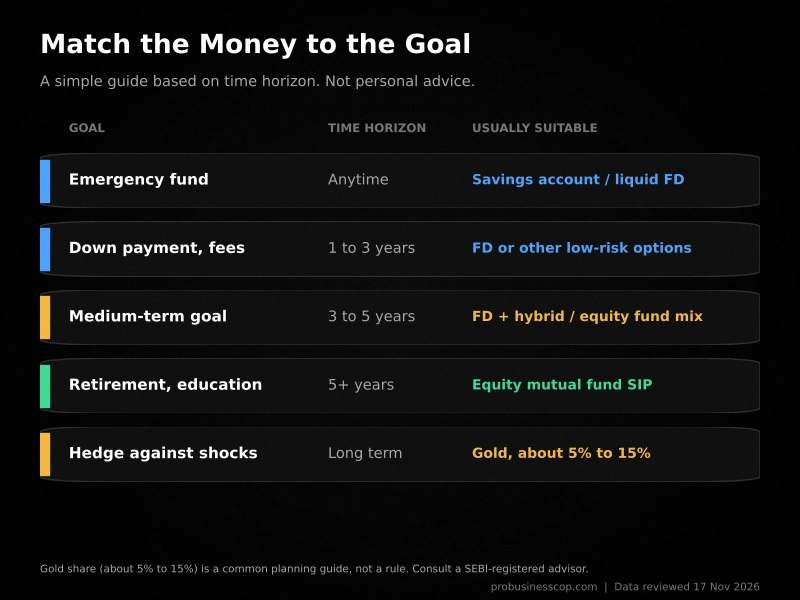
| Your goal | Time horizon | Usually suitable | Why |
|---|---|---|---|
| Emergency fund | Needed anytime | Savings account, liquid FD | Safety and quick access |
| Down payment, wedding, fees | 1 to 3 years | FD or other low-risk options | You cannot afford a market fall |
| Medium-term goal | 3 to 5 years | A mix of FD and a hybrid or equity fund | Some growth with some protection |
| Retirement, children’s education | 5 years or more | Equity mutual fund SIP | Time helps absorb ups and downs |
| Protection against inflation and global shocks | Long term | Gold as a small share of the portfolio | Often moves differently from shares |
Many planners suggest keeping gold to roughly 5% to 15% of a portfolio. Treat that as a general guide, not a rule.
5 Mistakes to Avoid
- Chasing last year’s winner. Gold’s recent run does not mean it will repeat.
- Comparing pre-tax FD returns with post-tax returns elsewhere. Always compare after tax.
- Putting everything in one asset. A mix lowers the damage when one asset falls.
- Investing short-term money in equity. If you need the money within 2 to 3 years, a market dip can hurt.
- Ignoring the DICGC limit. Keep deposits above ₹5 lakh spread across banks.
FAQs
Is FD still a good option after the RBI rate hike?
Yes, especially for short-term goals and for people who want certainty. Rates are rising at some banks, but compare offers and check your post-tax return.
Should I buy gold now because the price has fallen?
A lower price does not guarantee a rise. If you want gold for diversification, consider buying in small parts over time instead of in one lump sum.
Which gives the highest return: FD, gold or mutual fund?
It depends on the period. Gold has led in the last five years, but long-term studies show equity has done better over 15 to 20 years in some comparisons. FD returns are lower but fixed.
Can I invest in all three?
Yes. Many investors use FDs for safety, equity mutual funds for long-term growth and a small amount of gold for diversification.
How much can I earn from a ₹5 lakh FD?
At 6.25% for one year, simple interest is ₹31,250 before tax. Your actual earnings depend on the bank, tenure and compounding.
Are mutual fund returns guaranteed?
No. Mutual fund investments are subject to market risk. Read the scheme documents before investing.
Conclusion
The rate hike has made FDs more attractive than they were a few months ago, but it has not made them the best choice for every goal. Use FDs for money you need soon, equity mutual funds for goals that are far away, and keep gold as a small cushion. Start by writing down your goal and timeline, then choose the option that fits.
Disclaimer: This article is for information only and is not financial advice. Returns shown are from published reports or illustrative assumptions and may not repeat. Rates and prices change daily. Check current figures with the bank, the fund house or official sources, and consult a SEBI-registered advisor before investing.

6 Comments
Pingback: The Following Data Were Reported By A Corporation: Solved
Pingback: Personal Loan EMI Calculator: EMI, Interest & Real Cost
Pingback: TDS Interest Calculator 2026: Late Payment Rules & Examples
Pingback: Bandhan Small Cap Fund Direct Growth NAV: Returns & Risk
Pingback: Sovereign Gold Bond 2026: Status, Redemption And Tax Rules
Pingback: Emergency Fund Calculator India: How Much Should You Save?