

Quick Answer
The Bandhan Small Cap Fund Direct Growth NAV was ₹56.575 on 20 November 2026. As per AMFI data to that date, the fund returned 21.5% a year over 3 years and 19.5% over 5 years, against 10.6% and 13.0% for its benchmark, the BSE 250 SmallCap TRI. The Direct plan’s expense ratio was 0.63% from 12 November 2026, and a 1% exit load applies if you redeem within one year.
Plenty of first-time investors look at a NAV of ₹56, decide the fund is “too costly”, and pick one trading at ₹12 instead. It is one of the most common NAV mistakes, and it can push people away from a fund for exactly the wrong reason.
So this guide does two jobs. It gives you the latest Bandhan Small Cap Fund Direct Growth NAV and the numbers behind it, and it explains what that NAV can and cannot tell you before you put money in.
Latest NAV and Key Numbers
| Detail | Figure | As of / Source |
| NAV, Direct Growth | ₹56.575 | 20 Nov 2026 (Value Research) |
| Scheme AUM | ₹38,339 crore | 19 Nov 2026 (AMFI, via Integrato) |
| Expense ratio (TER), Direct | 0.63% | From 12 Nov 2026 (AMFI disclosure) |
| Exit load | 1% if redeemed within 1 year | Scheme details |
| Benchmark | BSE 250 SmallCap TRI | Scheme details |
| Riskometer | Very High | AMFI, 19 Nov 2026 |
| Launched | 25 Feb 2020 (formerly IDFC Emerging Businesses Fund) | Allotment date |
| Fund managers | Manish Gunwani (since 28 Jan 2023), Kirthi Jain (since 5 Jun 2023) | Scheme data |
| Minimum investment | SIP ₹100, lump sum ₹1,000 | Value Research |
NAV is declared every business day, so treat the figure above as a snapshot. For today’s value, check AMFI’s NAV page or the Bandhan Mutual Fund website.
Three Things the NAV Cannot Tell You
1. A higher NAV does not mean the fund is expensive
NAV is simply the value of one unit: the fund’s total assets minus expenses, divided by the number of units. This fund started at ₹10 in February 2020. Its NAV is ₹56 because the holdings grew in value, not because you are paying a premium.
Here is the practical test: ₹10,000 invested today buys about 176.7 units at ₹56.575 (after the 0.005% stamp duty). If the portfolio rises 10%, your ₹10,000 becomes about ₹11,000. The same ₹10,000 in a fund with a ₹12 NAV would buy more units, but a 10% rise still gives you about ₹11,000. Units are not the return. The percentage change is.
2. The Direct and Regular plans have different NAVs
On 30 September 2026, the Direct Growth NAV was ₹56.68 while the Regular Growth NAV was ₹51.20. Both started at ₹10 and hold the same stocks. The gap of about 10.7% has built up because the Direct plan carries no distributor commission and therefore deducts a lower expense ratio every day.

So when you compare NAVs online, make sure you are looking at the plan you actually hold. Mixing them up is a common reason investors think an app is showing the wrong value.
3. NAV alone says nothing about performance
A NAV of ₹56 tells you nothing about whether the fund did well. For that, you need returns over a period and a comparison with the benchmark, which we cover below.
Which Day’s NAV Will You Get?
Under SEBI’s rules for equity funds, the NAV you receive depends on when your money reaches the fund, not when you click Buy. If your money is credited to the fund before the 3 PM cut-off on a business day, you get that day’s NAV. If it arrives after 3 PM, you get the next business day’s NAV.
This matters most on days when small caps move sharply. A UPI payment made at 2:50 PM can still reach the fund after the cut-off if the platform takes time to transfer it. If the exact NAV matters to you, invest earlier in the day.
How the Fund Has Performed
The latest AMFI return figures, to 20 November 2026, show a wide lead over the benchmark:
| Period | Direct Growth (CAGR) | BSE 250 SmallCap TRI | Lead |
| 1 year | 8.6% | 3.2% | +5.4 points |
| 3 years | 21.5% | 10.6% | +10.9 points |
| 5 years | 19.5% | 13.0% | +6.5 points |
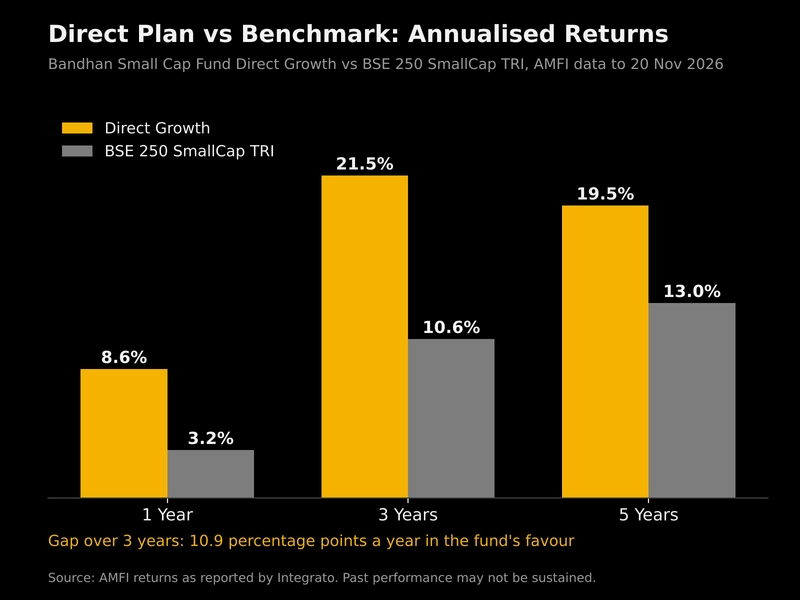
The official factsheet data to 30 September 2026 tells the same story. Since launch, the Direct plan returned 30.06% a year against 21.06% for the benchmark. On that date, ₹10,000 invested five years earlier had grown to about ₹24,387.
A SIP example: A monthly SIP of ₹10,000 running for five years to 20 November 2026 meant ₹6,00,000 invested. That grew to about ₹10,32,915, an XIRR of 21.4%, as per Integrato’s AMFI-based calculation.
The 2023 Turning Point
Long-term averages can hide when the outperformance actually happened. The calendar-year view shows it clearly.
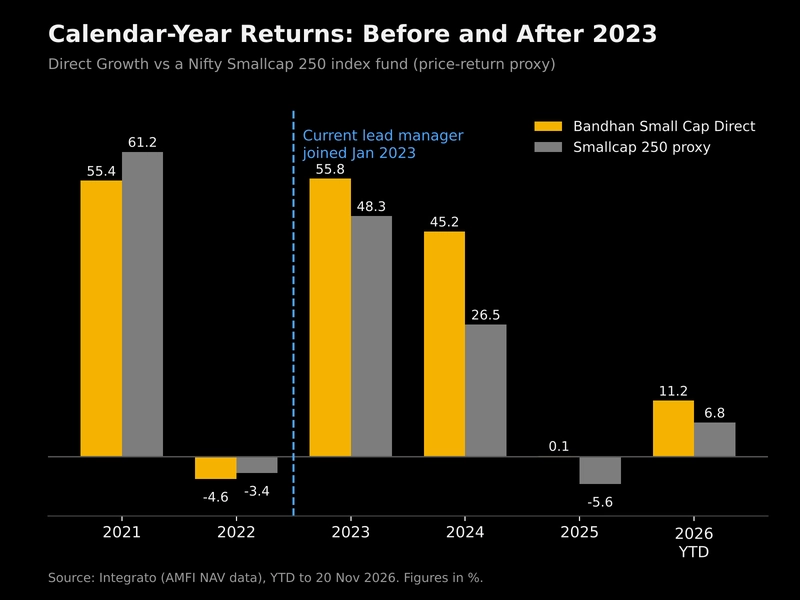
In 2021 and 2022, the fund trailed a Nifty Smallcap 250 index fund. From 2023 onwards, it beat that index every year, including 2025, when the fund ended roughly flat while the index fund fell 5.6%. That shift lines up with Manish Gunwani taking charge in January 2023, followed by Kirthi Jain in June 2023.
Why this matters for you: most of the fund’s strong record belongs to the current team, which has managed it for under four years. That is a shorter track record than the 5-year return suggests. If the management changes, it would be sensible to review your holding.
Inside the Portfolio
According to the October 2026 factsheet data (as of 30 September 2026), the fund held roughly 70% in small caps, 10.6% in mid caps, 6.7% in large caps and about 13% in cash and equivalents. SEBI rules require a small-cap fund to keep at least 65% in small caps, defined as companies ranked 251st onwards by full market capitalisation.
The portfolio is spread thin by design. The top 10 holdings made up about 17% of the fund, and no single stock was above roughly 2.3%. Leading names included Sobha, REC, Cholamandalam Financial Holdings and LT Foods. The fund says it picks stocks using three filters: quality, growth and reasonable valuation.
The 13% cash level is worth noticing. It gives the managers money to buy during falls and can cushion a decline. It can also hold returns back during a sharp rally, so do not expect this fund to capture every bit of a small-cap boom.
Risk Check: How Rough Can It Get?
- Volatility: Annualised standard deviation of about 20.6% over 36 months, slightly above the category median of 19.7%.
- Worst fall in 5 years: -23.3%, a little better than the category median of -24.1%. The worst fall in the fund’s history took 359 days to recover.
- Rolling 3-year returns: Measured from every business day, all 3-year periods so far were positive, and the worst was 21.2% a year. The fund has existed only since 2020, mostly in a strong market for small caps, so this record has not been tested by a long bear phase.
Volatility and drawdown figures are from Integrato’s AMFI-based data to 20 November 2026. A small-cap fund can fall 30% to 50% in a severe correction, as the category has done in the past, so invest only money you will not need for at least 7 years.
Costs and Exit Load
One detail you will not find on most NAV pages: the Direct plan’s TER changes often. AMFI disclosures show it moved four times in November 2026 alone, from 0.66% down to 0.63% by 12 November. The Regular plan’s TER was about 1.72%.
Small shifts like 0.01% do not change much for you. What does matter is the roughly 1 percentage point gap between Direct and Regular, which compounds every year. That gap is why the two NAVs have drifted 10.7% apart in under seven years.
Exit load: If you redeem or switch out within one year of buying, 1% of the redemption value is deducted. Each SIP instalment counts separately, so units bought last month are still within the load period even if your first SIP was two years ago.
How Your Gains Are Taxed
This is an equity-oriented fund, so the Income-tax Act, 2025 (in force from 1 April 2026) taxes it the same way as shares. Gains on units held for 12 months or less are taxed at 20%. Gains on units held longer are taxed at 12.5% above ₹1.25 lakh of total equity long-term gains in a tax year, according to Taxmann. Surcharge and cess apply.
Example: You invest ₹2,00,000 and sell after eight months when it is worth ₹2,30,000. You pay a 1% exit load of ₹2,300 and short-term tax of 20% on the gain. The load reduces your sale value, so the taxable gain is about ₹27,700 and the tax about ₹5,540 plus cess. Waiting past 12 months would remove the exit load and, within the ₹1.25 lakh limit, the tax too.
Report these gains correctly in your return. Capital gains that do not match the data the tax department receives are a common trigger for an income tax demand notice under Section 143(1).
Who This Fund May Suit, and Who Should Skip It
It may suit you if you already have a stable base, such as your Employees Provident Fund and an emergency fund, and you want a small, high-growth slice of equity for goals 7 to 10 years away. A SIP spreads your entry over many NAVs, which suits a volatile category.
You may want to skip it if you need the money within five years, would panic at a 25% fall, or are still deciding between safer options. Our comparison of FD vs gold vs mutual funds in 2026 can help you decide where small caps fit, if at all.
Many investors keep small caps as a minor part of their equity holdings rather than the core. The right share depends on your goals and risk appetite, which a SEBI-registered investment adviser can help you set.
Frequently Asked Questions
What is the NAV of Bandhan Small Cap Fund Direct Growth today?
It was ₹56.575 on 20 November 2026. The NAV changes every business day, so check AMFI or the Bandhan Mutual Fund website for the current figure.
Why is the Direct NAV higher than the Regular NAV?
The Direct plan has a lower expense ratio because it pays no distributor commission. Less is deducted each day, so its NAV has grown faster from the same ₹10 starting point.
Is Bandhan Small Cap Fund the same as IDFC Emerging Businesses Fund?
Yes. The scheme was launched as IDFC Emerging Businesses Fund and was renamed after IDFC Mutual Fund became Bandhan Mutual Fund.
When is the NAV updated?
Fund houses publish NAVs on AMFI’s website by the evening of each business day. Your purchase gets the NAV of the day your money reaches the fund before 3 PM.
Can I withdraw anytime?
Yes, there is no lock-in. A 1% exit load applies to units redeemed within one year of purchase, and short-term capital gains tax may apply.
Is a lower NAV fund a better buy?
No. A lower NAV only means each unit costs less. Your returns depend on the percentage change in NAV, the fund’s costs and its strategy, not on the starting price of a unit.
Before You Invest
Open the fund’s latest factsheet and Scheme Information Document on the Bandhan Mutual Fund website, confirm the current TER and exit load, and decide on a SIP amount you can continue through a bad year. For more plain-English money guides, explore the Pro Business Cop homepage.
Disclaimer
This article is for educational purposes only and is not investment, tax or legal advice. Mutual fund investments are subject to market risks; read all scheme-related documents carefully. Past performance may or may not be sustained in future. All figures are as of the dates mentioned and may have changed. Please consult a SEBI-registered investment adviser or a qualified tax professional before making decisions.

1 Comment
Pingback: Elitecon International Ltd Share Price: Why It Fell 95%