

Quick Answer
The Employees Provident Fund (EPF) is a retirement savings scheme run by the Employees’ Provident Fund Organisation (EPFO), where you and your employer each contribute 12% of your PF wages every month. In 2026, three things changed: the wage ceiling rose from Rs 15,000 to Rs 25,000 from 17 September 2026, the interest rate for FY 2025-26 was kept at 8.25%, and on 19 November 2026 EPFO’s board approved cutting the minimum balance you must keep from 25% to 10% of contributions and the waiting period for final withdrawal from 12 months to 2 months. Board decisions apply only after official notification.
Most people only look at their PF account twice: when they join a company and when they need money in a hurry. 2026 has been a year when ignoring it could cost you, because the rules on how much goes in and how much you can take out have both moved.
This guide covers the employees provident fund in four parts: what changed this year, where your monthly contribution actually goes, the latest Employees’ Provident Fund Organisation news in plain words, and how to find the right EPFO regional office when you need one. If you are here for the EPFO admit card for the APFC exam, jump to that section near the end.
Part 1: What Changed in 2026

| Change | Before | Now | Status |
|---|---|---|---|
| Wage ceiling for mandatory coverage | Rs 15,000 a month | Rs 25,000 a month | In force from 17 September 2026 (S.O. 5109(E)) |
| EPF interest rate | 8.25% (FY 2024-25) | 8.25% (FY 2025-26) | Ratified by the government in June 2026 |
| Minimum balance to keep in account | 25% of contributions | 10% of contributions | Approved by EPFO board on 19 November 2026 |
| Waiting period for final withdrawal | 12 months | 2 months | Approved by EPFO board on 19 November 2026 |
| Retirement payout option | Lump sum | Systematic Withdrawal Plan (optional) | Approved; scheme amendment to be notified |
Sources: PIB release on the 240th CBT meeting (19 November 2026), Gazette notification S.O. 5109(E) dated 17 September 2026, and reports on interest rate ratification. Accessed 22 November 2026.
The wage ceiling change is the first since September 2014. It matters because the ceiling decides how much of your salary counts for mandatory PF and pension contributions. If your PF wages are between Rs 15,000 and Rs 25,000, both your contribution and your employer’s will now be calculated on more of your pay.
The withdrawal changes are still at the approval stage. The Central Board of Trustees (CBT), EPFO’s top decision-making body, has cleared them, but members should wait for EPFO’s official circular before planning a withdrawal around them.
Part 2: Where Your PF Money Goes Every Month
Payslips usually show one line called “PF”. Behind it, your money is split three ways. Here is the split for someone with PF wages of Rs 25,000, using the figures EPFO has published for the new ceiling:
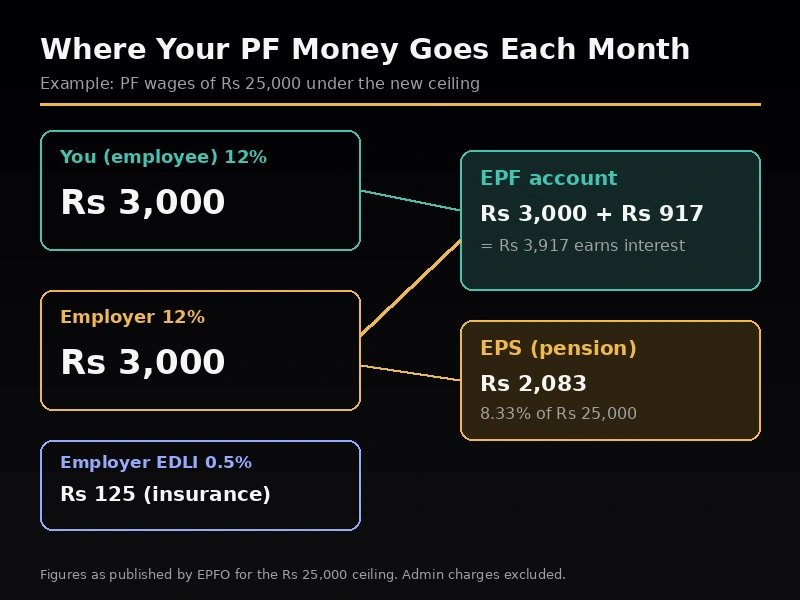
| Component | Who pays | Rate | Amount at Rs 25,000 wages | Where it goes |
|---|---|---|---|---|
| Employee share | You | 12% | Rs 3,000 | Your EPF account |
| Employer EPF share | Employer | 3.67% (balance of 12%) | Rs 917 | Your EPF account |
| Employer EPS share | Employer | 8.33% | Rs 2,083 | Employees’ Pension Scheme |
| EDLI | Employer | 0.5% | Rs 125 | Life insurance cover |
So out of Rs 6,000 that leaves the payroll in your name, about Rs 3,917 lands in your EPF account and earns interest, while Rs 2,083 goes to the pension scheme, which you cannot withdraw like EPF savings. This is the detail most people miss when they check their passbook and wonder why the balance looks smaller than 24% of their salary.
The employer’s 3.67% and 8.33% are two parts of its single 12% share, not extra contributions on top. EPFO’s own contribution table states that the employer share is the difference between the employee share and the pension contribution.
Part 3: EPFO News Decoded, 19 November 2026 Board Meeting
The 240th meeting of the CBT, chaired by Labour Minister Dr Mansukh Mandaviya, approved several changes. Here is what each one means for a member, based on the official PIB release:
Systematic Withdrawal Plan (SWP) for retirees
Retiring members will be able to take their PF savings in monthly, quarterly or half-yearly instalments instead of one lump sum. The release calls it entirely voluntary. Members keep ownership of the corpus, and the remaining balance continues to earn returns. EPFO estimates about 6.32 lakh members above 55 with PF savings over Rs 5 lakh could use it in the first phase. The tax treatment of these payouts is not yet decided; the release says an Income Tax Act amendment is being taken up with the Finance Ministry.
Minimum balance cut from 25% to 10%
Members currently have to keep 25% of their contributions in the account at all times. The board approved reducing this to 10%. Example: if your total contributions are Rs 4,00,000, the amount you must leave untouched would drop from Rs 1,00,000 to Rs 40,000, once the change is notified.
Final withdrawal after 2 months instead of 12
The waiting period for final withdrawal has been approved to come down from 12 months to 2 months. For someone between jobs, this can mean access to savings much sooner, but it also means retirement money can be spent much faster. Withdrawing early breaks the compounding that makes EPF valuable.
Voluntary and micro-contributions through UAN
The board approved UAN-linked ways to make voluntary contributions directly and to receive third-party micro-contributions, such as customer tips, without going through an employer’s payroll.
Faster claim settlement
The board was informed that under the CITES 2.0 system, auto-processing of claims has risen from 39% to 71%, the rejection ratio has fallen from 23% to 7.82%, and average settlement time has dropped from 11.15 days to 2.57 days.
One topic widely reported before the meeting, raising the minimum EPS pension from Rs 1,000 to Rs 3,000, does not appear among the decisions in the official release.
Before You Withdraw: EPF vs a Personal Loan
Easier withdrawals will tempt many members to dip into PF for short-term needs. Before you do, compare the two honestly:
| Question | Withdraw from EPF | Take a personal loan |
|---|---|---|
| Cost | No interest to pay, but that money stops earning 8.25% a year | Interest plus fees; major banks publish rates of roughly 10% to 24% a year |
| Impact on retirement | Permanent hole in your corpus unless you rebuild it | None, if you repay on time |
| Speed | Settlement averaged 2.57 days under CITES 2.0 | Pre-approved loans can disburse in minutes |
| Best for | Genuine long-term needs allowed under EPF rules | Short, time-bound needs you can repay from income |
If you are weighing a loan instead, our guide to pre-approved personal loans explains how to compare the real cost. And if you are thinking about where else to park long-term savings, see our comparison of FD vs gold vs mutual funds.
Part 4: How to Find Your EPFO Regional Office
EPFO works through zonal, regional and district offices across states. You usually do not need to visit one, but when you do, the office that matters is the one where your employer pays PF, not the one nearest your home.

Method 1: Read your PF number
Your PF account number follows a fixed pattern: a two-letter region code, a three-letter office code, a seven-digit establishment code, a three-digit extension, and your member number. In MH/BAN/0000064/000/0000123, MH is the region and BAN is the office. Those five letters tell you which regional office handles your account.
Method 2: Search your employer
EPFO’s Establishment Search on its unified portal lets you search by part of your employer’s name or its establishment code. The result shows the office under which your employer remits PF.
Method 3: Use ‘Locate an EPFO Office’
On epfindia.gov.in, the Locate an EPFO Office tool lets you choose your state, office and district to get the address, along with region and office codes.
Try these before visiting
- EPFiGMS: EPFO’s online grievance system, listed on its website
- Helpline 14470: EPFO’s toll-free help desk number
- Your HR or payroll team: most contribution and KYC mismatches start at the employer’s end
If you run a business and are setting up PF for staff for the first time, our guide on how to register a small business in India covers the registrations to plan for.
For EPFO Job Aspirants: APFC Admit Card 2026
Searches for the Employees Provident Fund Organisation admit card come from candidates for EPFO jobs, not PF members. EPFO’s Assistant Provident Fund Commissioner (APFC) posts are filled through the Union Public Service Commission (UPSC).
| Detail | Information |
|---|---|
| Advertisement | UPSC Special Advertisement No. 52/2026 |
| Posts | 80 Assistant Provident Fund Commissioner vacancies |
| Recruitment Test date | 20 December 2026 (pen-and-paper) |
| Admit card | To be issued on the UPSC e-Admit Card portal before the test |
| Official website | upsc.gov.in |
UPSC issues e-admit cards online; they are not sent by post. When the card is live, it appears under the e-Admit Card section of upsc.gov.in, where you log in with your registration ID or roll number. Only download it from the official UPSC site, and treat any link shared on social media with caution.
Frequently Asked Questions
What is the Employees Provident Fund?
It is a retirement savings scheme managed by the Employees’ Provident Fund Organisation under the Ministry of Labour and Employment. Covered employees and their employers each contribute 12% of PF wages every month, and the EPF balance earns interest declared every year.
What is the EPF interest rate for 2025-26?
8.25% per year. The EPFO board recommended it in March 2026 and the government ratified it in June 2026, the third year in a row at this rate.
Has the EPF wage ceiling changed?
Yes. The wage ceiling for mandatory coverage rose from Rs 15,000 to Rs 25,000 a month from 17 September 2026, under Gazette notification S.O. 5109(E). It was the first change since September 2014.
Can I now withdraw 90% of my PF?
EPFO’s board approved reducing the minimum balance members must keep from 25% to 10% of contributions on 19 November 2026. It applies only once EPFO notifies it, so check the latest EPFO circular before applying for a withdrawal.
How do I find my EPFO regional office?
Read the first five letters of your PF account number, which show the region and office codes, or use the Establishment Search and Locate an EPFO Office tools on epfindia.gov.in.
When will the UPSC EPFO APFC admit card be released?
UPSC has scheduled the APFC Recruitment Test for 20 December 2026. The admit card will be available on the UPSC e-Admit Card portal at upsc.gov.in before the test; candidates should check the site regularly in December.
Your Next Step
Log in to the EPFO member portal or UMANG app this week and check two things: whether your employer’s contributions since September reflect the new Rs 25,000 ceiling, if it applies to you, and whether your KYC and nominee details are complete. Both take minutes now and save weeks when you actually need your money.
Disclaimer
This article is for general information only and is not legal, tax or financial advice. EPF rules are set by the Employees’ Provident Fund Organisation and the Ministry of Labour and Employment, and decisions approved by the Central Board of Trustees take effect only after official notification. Contribution figures follow EPFO’s published examples and may vary with individual wages and rounding. Always confirm the latest rules on epfindia.gov.in, and for recruitment details, on upsc.gov.in.

2 Comments
Pingback: Bandhan Small Cap Fund Direct Growth NAV: Returns & Risk
Pingback: Emergency Fund Calculator India: How Much Should You Save 2026?