

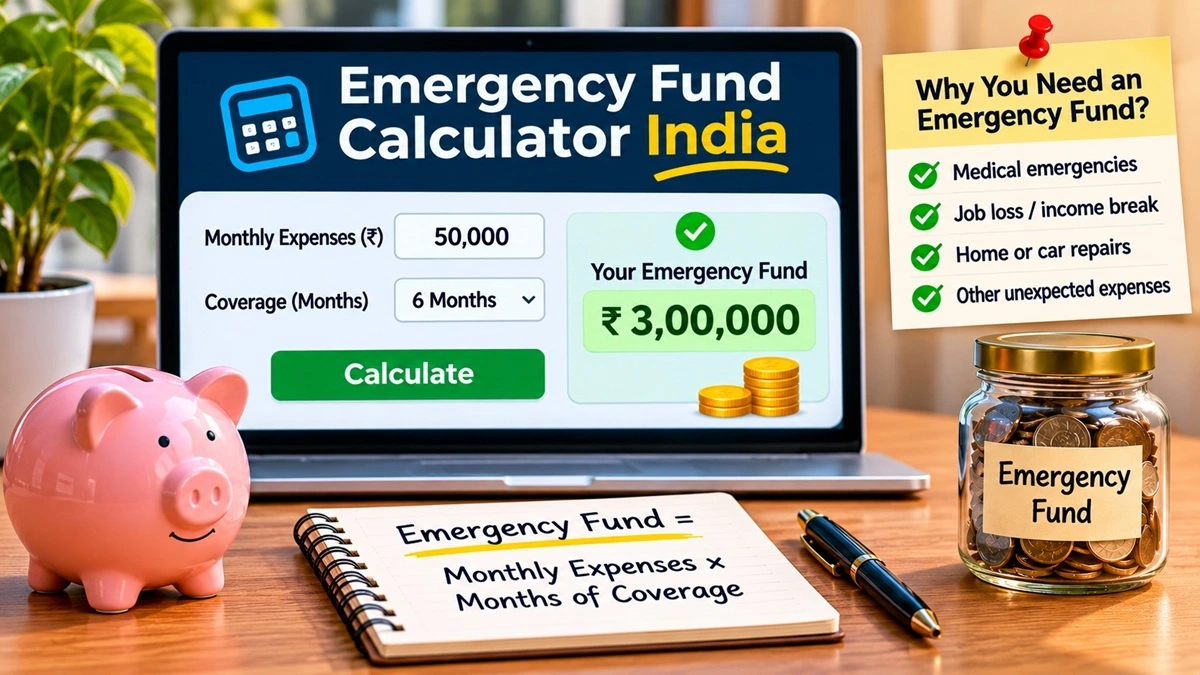
Quick Answer
How much emergency fund do I need?
Add up your essential monthly expenses and multiply by the months you want covered. If essentials are ₹34,000 and you choose 6 months, your target is ₹2,04,000. Three to six months is a common starting point. Single earners, families with dependents and people with irregular income often need 9 to 12 months.
Method: Pro Business Cop calculator logic. Month ranges are widely used planning guidelines, not a rule set by RBI or SEBI. Last updated: 25 November 2026.
This emergency fund calculator shows how much money you should keep aside for a job loss, a hospital bill or a sudden repair, how far you are from that number today, and how many months it will take to get there at your saving rate. Enter your essential costs below, pick your coverage, and the result updates with the full math visible.
Emergency Fund Calculator (India)
Enter your essential monthly costs in rupees. Leave anything that does not apply at 0.
How many months should it cover?
How the Emergency Fund Calculator Works

An emergency fund calculator multiplies your essential monthly expenses by the number of months you want covered, adds any insurance gap you would pay yourself, and subtracts what you have already saved. The result is your target and your remaining gap.
Here is the exact logic the Pro Business Cop calculator uses:
- Monthly essentials = rent or home loan EMI + other EMIs + food + utilities + insurance premiums and regular medicines + transport + school fees and dependents’ costs + other essentials
- Target = monthly essentials × months of coverage + insurance gap buffer
- Gap = target minus emergency savings you already have (never below zero)
- Time to target = gap ÷ what you can save each month, rounded up
One deliberate choice: the calculator assumes no investment return while you build the fund. Some calculators plug in 6% or more, which makes the timeline look shorter than it may turn out to be. Emergency money is meant to be safe and reachable, so its growth is a small bonus, not part of the plan.
The tool also does not compute tax, recommend a specific fund or bank, or replace advice from a SEBI-registered investment adviser. It gives you a number to plan around.
How Much Emergency Fund Do You Need in India?
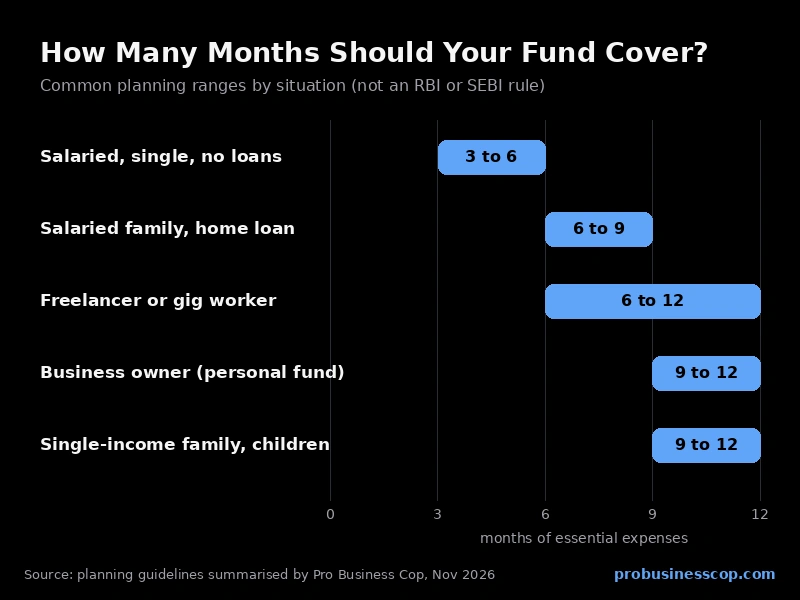
Most people need somewhere between 3 and 12 months of essential expenses, and the right point in that range depends on how stable your income is and how many people rely on it. A salaried single person with a steady job sits near the lower end. A single-income family with a home loan, or a freelancer with uneven payments, sits near the top.
No Indian regulator prescribes a universal amount, so treat the ranges below as planning guidelines.
| Your situation | Usual starting range | What pushes it higher |
|---|---|---|
| Salaried, single, no loans | 3 to 6 months | Layoff risk in your industry, slow hiring in your role |
| Salaried, family, home loan | 6 to 9 months | Single income, dependent parents |
| Freelancer or gig worker | 6 to 12 months | Late client payments, seasonal work |
| Self-employed or business owner | 9 to 12 months (personal), plus a separate business reserve | Seasonality, long receivable cycles |
| Single-income family with children | 9 to 12 months | More dependents, thin health cover |
A Quick Way to Pick Your Number of Months
Start at 3 months and add 1 month for every “yes”:
- You are the only earner in your household
- Children or parents depend on your income
- Your income is variable (freelance, commission, business)
- Your total EMIs take more than 30% of your take-home pay
- Your only health cover comes from your employer
Round the total up to 3, 6, 9 or 12. The calculator’s Help me choose option does this for you and shows which answers raised the number.
That last question matters more than it looks. Group health cover from an employer usually stops when the job does, which is exactly the moment an emergency fund is most likely to be needed.
One thing worth understanding is that choosing an emergency fund target is not just about following the popular three-to-six-month rule. Your household responsibilities matter just as much as your monthly income. For example, someone living alone with a stable salary may be comfortable starting with six months of essential expenses. However, a person supporting parents, children, or an entire household on a single income may need a larger safety net. I would recommend starting with a realistic target that you can build consistently, rather than setting an ambitious amount that feels impossible to achieve. You can always increase your coverage as your financial responsibilities grow.
Which Expenses Should You Count?
Count only the costs you would still have to pay in a bad month. Splitting your spending into three groups makes this quick:
| Group | Examples | How to count it |
|---|---|---|
| Cannot stop | Rent, EMIs, insurance premiums, school fees, electricity | Count in full |
| Can trim | Groceries, fuel, phone and internet plans | Count at a trimmed level |
| Can pause | SIPs, shopping, travel, OTT, eating out | Leave out |
Pull your last three months of bank and UPI statements, not your memory. Yearly payments such as health insurance premiums, school fees and vehicle insurance are easy to miss, so divide each by 12 and add it to the monthly figure.
A common mistake in emergency fund planning is calculating monthly expenses from memory instead of reviewing actual spending records. Small but recurring payments can easily go unnoticed. These may include vehicle insurance, annual health insurance premiums, school fees, vehicle maintenance, regular medicines, mobile recharges, and financial support given to parents. I recommend reviewing at least three months of bank statements and UPI transactions before entering your expenses into the calculator. For yearly or quarterly payments, convert them into a monthly amount so that your emergency fund target reflects your actual financial responsibilities.
Should You Include Home Loan or Personal Loan EMI?
Yes. An EMI is a fixed obligation, and missing one brings late charges and can damage your credit score, which makes future borrowing harder and costlier. If you are unsure of the exact amount, check it with the personal loan EMI calculator before you enter it.
Floating-rate EMIs can also change with policy rates. The Reserve Bank of India’s Monetary Policy Committee raised the repo rate by 25 basis points to 5.50% in October 2026, so recheck your EMI after every rate decision. This guide explains how the repo rate hike changes your home loan EMI.
What About SIPs and Insurance Premiums?
Include insurance premiums, because a lapsed health or term policy is expensive and sometimes impossible to restart on the same terms. Leave SIPs out. Most mutual fund platforms let you pause a SIP, so it is not a cost you are locked into during a crisis.
Emergency Fund for Different Life Situations
The same salary can need very different emergency funds. These three illustrative profiles (not real people or survey data) were run through the calculator logic above.
| Profile | Monthly essentials | Months | Insurance gap buffer | Target | Already saved | Gap | Saves per month | Time to target |
|---|---|---|---|---|---|---|---|---|
| Riya, 27, salaried, single, rents in Bengaluru | ₹34,000 | 6 | ₹0 | ₹2,04,000 | ₹50,000 | ₹1,54,000 | ₹12,000 | 13 months |
| Sharma family, Lucknow, single income, 2 children, home loan | ₹55,000 | 9 | ₹50,000 | ₹5,45,000 | ₹1,20,000 | ₹4,25,000 | ₹15,000 | 29 months |
| Arjun, 31, freelance designer, Pune | ₹40,000 | 12 | ₹0 | ₹4,80,000 | ₹1,00,000 | ₹3,80,000 | ₹20,000 | 19 months |
Emergency Fund for Salaried Employees
Riya’s ₹34,000 covers rent of ₹18,000, groceries of ₹6,000, utilities and phone at ₹3,000, transport at ₹3,000, premiums of ₹1,500 and other essentials of ₹2,500. Her only health cover is through her employer, so the month picker gives 4, which rounds up to 6. Her current savings cover just 1.5 months.
For salaried people, a job loss rarely ends with the last payslip. A notice period, a full-and-final settlement that can take weeks to arrive, and a job search all sit between one salary and the next. Your EPF balance is retirement money with its own withdrawal rules, so do not count it as your first line of defence. This guide covers EPF withdrawal rules in 2026.
Emergency Fund for Freelancers and Self-Employed Professionals
Arjun’s essentials are ₹40,000: rent ₹15,000, groceries ₹7,000, utilities ₹3,000, his own health premium ₹2,000, transport ₹2,500, software and internet ₹3,000 and other costs ₹7,500. He chose 12 months because client payments arrive unevenly.
If your income moves up and down, base your plan on a lean month, not an average one. Look at your last 12 months of income, take the three lowest months, and check whether their average covers your essentials. If it does not, the shortfall is what your emergency fund has to absorb, month after month.
Keep money set aside for GST and advance tax in a separate account. It is not yours to spend in an emergency, and mixing it with your safety net is how a bad month turns into a tax notice.
If you run a business, keep a business reserve separate from your personal emergency fund. Pulling household savings into a working-capital gap leaves your family exposed twice. Steadier receivables make that reserve easier to build, and this guide on managing cash flow in a small business covers how. If the business still needs short-term funding, compare a business loan with a personal loan before you touch household money.
For anyone managing a small business, it is important to understand that personal emergency savings and business working capital serve two different purposes. A business may need money for supplier payments, employee salaries, software subscriptions, taxes, or delayed customer payments. These expenses should not depend on the money reserved for household emergencies. Keeping separate accounts or clearly defined reserves makes financial planning easier and reduces the risk of using family savings to cover routine business expenses. Business owners should also maintain separate provisions for GST and advance tax liabilities rather than treating those amounts as available savings.
Emergency Fund for Families With Children or Dependent Parents
The Sharma family’s ₹55,000 includes a home loan EMI of ₹22,000, groceries ₹12,000, utilities ₹4,000, school fees ₹6,000 a month, transport ₹3,500, premiums ₹3,000, parents’ medicines ₹2,500 and other costs ₹2,000. With one earner and four dependents, 9 months is a reasonable choice. They add a ₹50,000 buffer for costs their health policy may not pay. Their savings cover 2.2 months today.
Their target crosses ₹5 lakh, which affects where they should keep the money. The section on bank deposit insurance below explains why.
Emergency Fund for Single Individuals
A single person without dependents can usually work with a smaller target. Two costs are easy to overlook: a fresh rent deposit if you have to move for a new job, and travel home for a family emergency. Add both to “other essentials” if they apply to you.
Medical Emergencies: The Gap Your Health Insurance Leaves
Health insurance and an emergency fund do different jobs, and one does not replace the other. Medical costs in India are also rising much faster than everyday prices. Aon’s medical trend report projected an 11.5% rise in employee medical plan costs in India for 2026, and its 2027 report projects a 10.1% rise, still well above expected general inflation of about 4%.
Even a good policy can leave you paying part of a hospital bill:
- Co-pay: you pay a fixed share of every claim, common in senior citizen plans.
- Room-rent cap: choosing a room above the limit can reduce the payout on other charges too.
- Deductible: the policy pays only after a set amount.
- Non-payable items: consumables and some charges are excluded.
Read your policy wording for these four terms, estimate what you might pay on one hospital stay, and enter that figure as the insurance gap buffer in the calculator.
If you rely only on group cover from work, consider your own individual policy. Since 22 September 2025, individual life and health insurance policies are exempt from GST, while group policies still carry 18% GST.
Where to Keep Your Emergency Fund in India
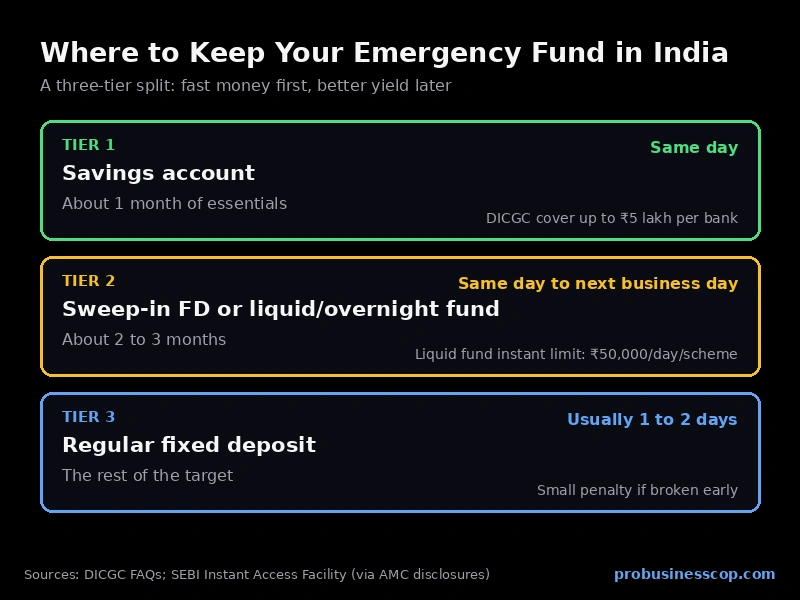
Keep your emergency fund somewhere safe, easy to reach and separate from your spending account. A three-tier split gives you quick access to some money and better returns on the rest:
| Tier | Roughly how much | Where | Access time | Tax on earnings | Deposit insurance |
|---|---|---|---|---|---|
| Tier 1 | 1 month of essentials | Savings account | Same day | Interest taxed at slab rate (some deductions may apply) | DICGC cover up to ₹5 lakh per bank |
| Tier 2 | 2 to 3 months | Sweep-in FD, or a liquid or overnight mutual fund | Same day to next business day | FD: slab rate; liquid fund: slab rate on gains when redeemed | FD yes; mutual fund no |
| Tier 3 | The rest | Regular fixed deposit you can break early | Usually within a day or two | Slab rate, taxed every year as interest accrues | DICGC cover up to ₹5 lakh per bank |
The split is a planning guide, not a product recommendation. The calculator shows your rupee amounts for each tier. FD and liquid fund yields tend to move with policy rates, so read what RBI’s December 2026 decision could change before you lock in a long FD.
Keep in mind what savings accounts actually pay. Keep in mind what savings accounts actually pay. SBI’s savings account rate, for example, is 2.50% a year on all balances, effective 15 June 2025, which is why Tier 1 is limited to about one month.
An important lesson in emergency fund planning is that earning a better return should never come at the cost of accessibility. A savings account may offer relatively modest interest, but it provides convenient access when an urgent payment is due. Sweep-in fixed deposits can offer a useful balance between liquidity and interest, although premature withdrawal conditions and penalties vary by bank. Liquid mutual funds are another option, but investors should understand their redemption timelines, applicable limits, and market-related risks before relying on them. My recommendation is to keep the immediately required portion in a savings account and use other options only for money that does not need instant access.
The ₹50,000 Instant Redemption Limit Most People Miss
Liquid funds are often sold as “instant” money, but there is a daily cap. Under SEBI’s Instant Access Facility, you can redeem up to ₹50,000 or 90% of your holding, whichever is lower, per day, per scheme. SEBI allows this facility only in overnight and liquid schemes, and not every such scheme offers it.
Here is what that means in practice. Suppose you hold ₹6 lakh in one liquid fund and need ₹2 lakh today for a hospital deposit. Instant redemption gets you up to ₹50,000 today. The rest follows the normal redemption cycle, usually the next business day. That gap is exactly why Tier 1 sits in a savings account.
Check your fund’s own page for its current instant redemption limit before you count on it.
How Tax Works on Each Option
FD and savings account interest is added to your income and taxed at your slab rate. FD interest is taxed every year as it accrues, even if you do not withdraw it.
Debt and liquid mutual fund units bought on or after 1 April 2023 are treated differently from before. Gains on these units are treated as short-term capital gains regardless of how long you hold them, under Section 76 of the Income-tax Act, 2025 (the rule was earlier Section 50AA of the 1961 Act). In practice, that means slab-rate tax. The difference from an FD is timing: you pay tax on mutual fund gains only when you redeem.
Is Your Bank Deposit Insured?
The Deposit Insurance and Credit Guarantee Corporation (DICGC), a subsidiary of RBI, insures principal and interest up to a maximum of ₹5 lakh, and deposits in different branches of the same bank are added together for this limit. If your emergency fund is larger than ₹5 lakh, spreading bank deposits across two banks keeps each part within the insured limit.
Where Not to Keep Your Emergency Fund
- Equity funds or stocks: markets can fall just when you need to sell.
- Gold: prices move, and selling at a bad time locks in a loss. This comparison of FD, gold and mutual funds explains why these are growth or diversification assets.
- Long lock-in products: PPF, NSC, tax-saving FDs and ELSS cannot be withdrawn freely. Sovereign Gold Bonds run for eight years, with early redemption allowed only from the fifth year; here is how SGB redemption works.
- Crypto: too volatile for money you may need next week.
Emergency Fund vs Savings Account vs Regular Savings
| Emergency fund | Savings account | Regular savings | |
|---|---|---|---|
| Purpose | Only for genuine emergencies | Daily transactions and bills | Planned goals like a trip, gadget or down payment |
| When you touch it | Job loss, medical bill, urgent repair | Any time | When the goal arrives |
| Where it sits | Split across tiers, ideally a separate account | One bank account | Depends on the goal’s timeline |
The simplest habit is a separate savings account used only for emergencies. If the money sits in the same account you use for UPI payments, it slowly disappears into everyday spending.
How Long Does It Take to Build an Emergency Fund?
How long it takes depends almost entirely on how much you can set aside each month:
| Gap to fill | At ₹5,000/month | At ₹10,000/month | At ₹20,000/month |
|---|---|---|---|
| ₹1,50,000 | 30 months | 15 months | 8 months |
| ₹3,00,000 | 60 months | 30 months | 15 months |
| ₹6,00,000 | 120 months | 60 months | 30 months |
At a small saving rate the full target can take years, so build it in milestones. Get to one month of expenses first, then three, then your full target. One month of cover already turns a broken phone or a surprise bill from a crisis into an inconvenience.
To speed things up:
- Set up an automatic transfer on salary day so the money moves before you can spend it
- Send bonuses, tax refunds and the extra from a salary hike straight to the fund
- Cancel one unused subscription and redirect that amount
- If you are paying off a personal loan, move that EMI amount into the fund once the loan closes
When Should You Use Your Emergency Fund?
Use it for events that are urgent, necessary and unplanned:
- Job loss or a sudden drop in income
- A medical bill your insurance does not fully cover
- An urgent home or vehicle repair you cannot postpone
- Emergency family travel
Sale offers, planned holidays and gadget upgrades are not emergencies. If you can see an expense coming, save for it separately.
After you use the fund, refill it before restarting goals you can postpone. Then top it up every year for inflation. RBI raised its CPI inflation projection for 2026-27 to 5.2%; at 5%, the Sharma family’s ₹5,45,000 target would need about ₹27,250 more next year to cover the same expenses.
Common Emergency Fund Mistakes
- Treating a credit card or pre-approved loan as your emergency fund. It is borrowed money with interest, and the limit is not yours to rely on. Read these checks before accepting a pre-approved personal loan.
- Parking all of it in one liquid fund. The instant redemption cap means only part of it is reachable on day one.
- Never revising the number. Marriage, a child, a new EMI or a move to a costlier city all change your essentials.
- Using it for planned spending. A festival budget or a school admission fee you knew about is a goal, not an emergency.
- Mixing it with business money. A business cash crunch should not drain the fund your family depends on.
One of the biggest mistakes people make is treating their entire bank balance as an emergency fund. Money kept for monthly bills, upcoming EMIs, planned purchases, or business expenses is not necessarily available for unexpected situations. Another common problem is setting a savings target without considering how much can realistically be saved every month. A better approach is to start with one month of essential expenses, gradually build it to three months, and then work towards the final target. Consistency matters more than trying to build the entire emergency fund in a few weeks.
Frequently Asked Questions
How much emergency fund should I have in India?
Start with 3 to 6 months of essential expenses if your income is stable and you have no dependents. Move toward 9 to 12 months if you are the only earner, support children or parents, or earn irregularly. Use the calculator above to turn that range into a rupee figure based on your actual costs.
Is a 3-month emergency fund enough?
It can be enough for a single person or a dual-income household with stable jobs and their own health cover. For a single earner with a home loan or dependents, three months is better treated as a first milestone than a finish line, because a job search alone can take longer.
Should I save 6 months or 12 months of expenses?
Choose 6 months if your salary is steady and someone else in the house also earns. Lean toward 12 months if you freelance, run a business, work on commission, or are the sole earner for a family. The calculator’s Help me choose option scores these factors for you.
What expenses should be included in an emergency fund?
Include costs you cannot stop: rent or home loan EMI, other EMIs, groceries, utilities, insurance premiums, regular medicines, transport and school fees. Leave out SIPs, shopping, travel and entertainment, since you can pause these when money is tight.
Can I use a fixed deposit as an emergency fund?
Yes, for the slower part of the fund. Most banks let you break an FD early, usually with a small interest penalty, and bank deposits carry DICGC cover up to ₹5 lakh per depositor per bank. Keep at least one month in a savings account so you are not breaking an FD for every small emergency.
Is a liquid fund safe for emergency money?
Liquid funds invest in very short-term debt and carry low risk, but not zero risk, and they are not covered by deposit insurance. Instant redemption is capped at ₹50,000 or 90% of your holding per day per scheme, and gains on units bought from 1 April 2023 are taxed at your slab rate.
How much emergency fund does a freelancer need?
Usually 6 to 12 months of essentials, calculated from your leanest months rather than your average income. Keep tax money for GST and advance tax in a separate account so it is never counted as emergency savings.
Can a credit card or personal loan replace an emergency fund?
No. Both are borrowed money with interest, and lenders can reduce limits or decline loans when your income stops, which is exactly when you need cash. Credit is a last resort after your emergency fund, not a replacement for it.
How can I build an emergency fund on a low salary?
Aim for one month of essentials first. Automate even ₹1,000 to ₹2,000 on salary day, and add every bonus, refund or windfall. A small fund that keeps growing is more useful than a large target you never start.
Build Your Safety Net With Pro Business Cop
Run the calculator again whenever your rent, EMIs or family size changes, and check your target once a year for inflation. Bookmark this Pro Business Cop emergency fund calculator so the number is ready when you next review your finances. If you have loans, work out your monthly repayment and total interest before you plan, and browse more money guides in the Pro Business Cop personal finance section.
Disclaimer: This calculator and article are for general information and education only. They are not financial, tax or investment advice. Rates, limits and rules mentioned are as of 25 November 2026 and can change; RBI’s next policy decision is due on 4 December 2026. Mutual fund investments are subject to market risks. Please consult a SEBI-registered investment adviser for advice on your situation. Read our full disclaimer.
Sources
- Reserve Bank of India: Resolution of the Monetary Policy Committee, October 5 to 7, 2026
- Deposit Insurance and Credit Guarantee Corporation (DICGC): Frequently Asked Questions on deposit insurance
- Income Tax Department: Section 76, Income-tax Act, 2025
- Department of Financial Services, Ministry of Finance: GST exemption on individual life and health insurance
- State Bank of India: Interest rates on savings bank deposits
- PPFAS Mutual Fund: Instant Access Facility limits, citing the SEBI Master Circular for Mutual Funds
- Business Standard: SEBI allows instant access facility in overnight schemes
- Aon: India 2026 medical trend rate and 2027 Global Medical Trend Rates (APAC release)
