


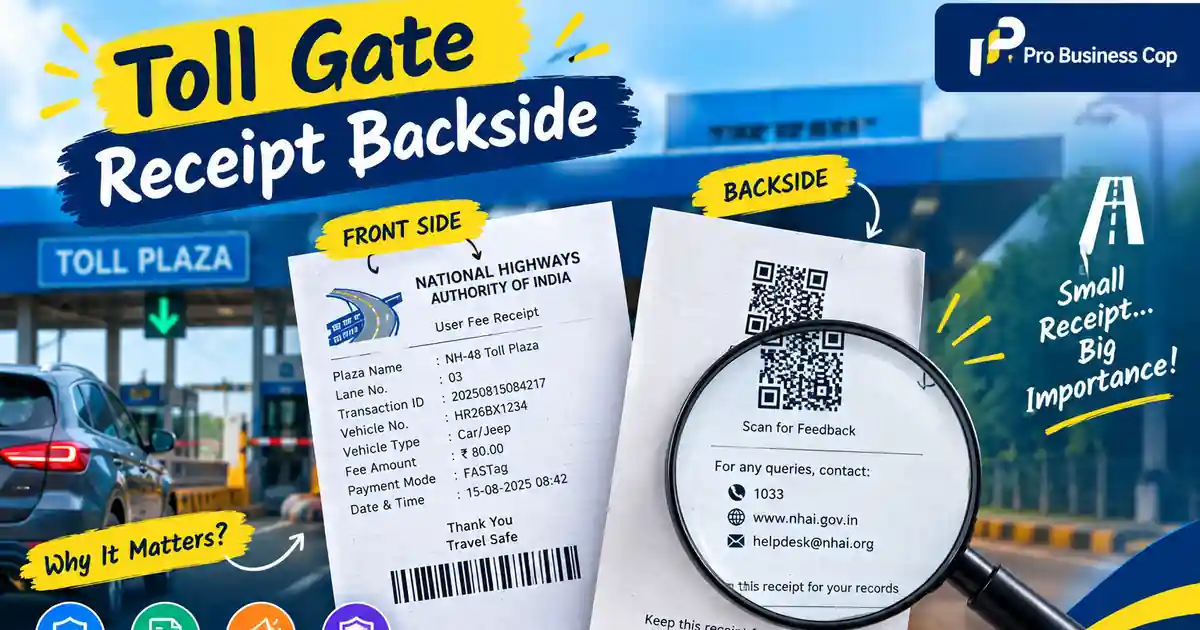
The toll gate receipt backside (or the bottom section on some plazas) usually carries the toll plaza’s emergency contacts: a highway helpline, an ambulance number and a crane or towing number. The front shows the trip details that matter for accounts: plaza name, date and time, vehicle class and the amount paid. What the receipt does not do is unlock free fuel, free puncture repair or a guaranteed 10-minute ambulance, despite what viral WhatsApp forwards claim.
Here is where this becomes a business problem. A sales manager in Pune rejects a ₹4,800 monthly travel claim because half the “toll receipts” are cropped screenshots of FASTag SMS messages. The sales rep was not cheating. Nobody ever told the team what counts as valid proof once paper slips disappeared.
The five facts below cover what every business owner, fleet operator and field employee in India should know about toll receipts, from what is printed on the back to how to claim, track and dispute toll costs properly. Everyday paperwork like this rarely gets explained, which is exactly the gap Pro Business Cop sets out to fill.
Fact 1: What’s Actually Printed on the Toll Gate Receipt Backside
An NHAI toll receipt follows a standard format, but each toll plaza prints the contact block in a slightly different place. Some put it on the back, others at the bottom of the front. Either way, the information is similar.
| Section | What it shows | Why it matters for a business |
|---|---|---|
| Plaza name and location | The toll plaza and highway section | Proves the route taken on a work trip |
| Operator or concessionaire | The company collecting the fee | Useful if you need to raise a complaint |
| Receipt number | A unique slip number | Lets accounts spot duplicate claims |
| Date and time | When you crossed | Must match the trip date in the expense claim |
| Vehicle class | Car, LCV, bus, truck and so on | Confirms you were charged the right rate |
| Journey type and fee | Single journey, return or pass, and the amount | The actual cost to reimburse |
| Helpline number | Usually the 1033 National Highway helpline | Breakdowns, accidents and FASTag complaints |
| Ambulance and crane numbers | Plaza-specific emergency contacts | Faster help on that stretch of highway |

The legal requirement: under the National Highways Fee (Determination of Rates and Collection) Rules, 2008, the toll collector must issue a receipt showing the date and time, the amount received and the vehicle class. There is an important exception: when you pay through FASTag or a similar device, the paper receipt is issued only on demand. That single rule explains why most drivers no longer get a slip at all.
About “return” receipts: the same rules allow a pass for two one-way journeys at one and a half times the one-way fee, valid for 24 hours. If your driver crosses the same plaza twice in a day, the second crossing should be cheaper, and the slip or SMS will show it.
Fact 2: The Viral “Free Fuel and Ambulance” Message Is Mostly a Myth
Most confusion about the toll gate receipt backside comes from one viral toll tax receipt message. You have probably seen the forward: “Never throw away your toll receipt. Call the number on the back and you get free petrol, free puncture repair and an ambulance in 10 minutes.” Here is how each line holds up.
| The viral claim | What is actually true |
|---|---|
| “Keep the receipt or you won’t get emergency help.” | False. Ambulance, patrol, towing and crane services on national highways are meant for all highway users, whether or not they paid toll. You can call 1033 without a receipt. |
| “Call the number for free petrol or diesel.” | False. Toll plazas do not supply free fuel. Any fuel help you arrange is paid for by you. |
| “Free puncture repair is guaranteed.” | Not supported. Fact-checkers at Factly found no puncture or refuelling service listed in the toll concession agreements. |
| “An ambulance reaches within 10 minutes as per rules.” | No such guaranteed time is backed by a cited official rule. Response depends on location and availability. |
| “The receipt has useful emergency numbers.” | True. This is the one part of the message that holds up. |

So the receipt is useful, just not magical. It is a printed contact card for that stretch of highway. For the full line-by-line breakdown of the viral message, read this detailed explainer on the toll receipt myth.
Why this matters to a business: a driver who believes the forward may wait for “free fuel” that never comes, or waste time hunting for a lost slip instead of calling for help. Myths like this cost real hours, which is why we keep a running list of expensive ones in our business myths, busted case files.
Fact 3: The Numbers That Actually Get Help
The numbers on the toll gate receipt backside are only useful if your team can find them in a hurry. Every business with people on the road should save these highway emergency helpline numbers in company phones and fleet drivers’ contacts. A small sticker on the dashboard works even better.
| Number | What it is for | When to use it |
|---|---|---|
| 1033 | NHAI helpline for national highways | Breakdowns, accidents and emergencies on national highways; also FASTag complaints at toll plazas |
| 112 | National emergency response number | Any emergency anywhere, including police |
| 108 | Ambulance service in most states | Medical emergencies (availability varies by state) |
| Plaza numbers on the receipt | Local ambulance and crane contacts | Quickest local help on that highway stretch |

A simple breakdown routine for drivers: 1. Move to the shoulder if it is safe and switch on hazard lights. 2. Stand away from traffic, behind the crash barrier if there is one. 3. Share your live location with your manager or family. 4. Call 1033 and give the nearest landmark, kilometre stone or last toll plaza you crossed. 5. Note the time of the call, which helps later if you need to escalate a slow response.
Fact 4: FASTag Changed What “Receipt” Means for Expense Claims
Most vehicles now pay through FASTag, and as covered in Fact 1, a paper slip is only issued if you ask for it. That means the “receipt” most employees have is digital. The good news: digital records are easier to verify than paper, if your team uses the right ones.
What counts as proof for a FASTag toll payment: – The SMS alert your bank or FASTag issuer sends for every deduction, as stated in NHAI’s FASTag FAQ – The issuer statement, downloadable from the FASTag issuer’s app or website, which shows your full FASTag transaction history: each plaza, date, time and amount – The transaction ID for each deduction, which lets finance match a claim to a specific crossing
How to download a FASTag statement (general steps): log in to your FASTag issuer’s app or customer portal, open the FASTag or transaction history section, choose the date range and download the statement as a PDF. Menu names differ by bank, so check your issuer’s help page if you cannot find it.
A claim-ready checklist for employees: – Date and time of each crossing – Toll plaza name – Amount deducted – Vehicle registration number – Transaction ID or statement line – The business purpose of the trip (client visit, delivery, site inspection)
For finance and admin teams: for any toll reimbursement or travel expense claim, accept the issuer’s statement rather than screenshots, and reconcile tolls monthly against trip logs. A statement is harder to fake and quicker to check, and it keeps every claim on one page.
Never edit a receipt or statement. Changing an amount, date or plaza on any toll record is misrepresentation. It can lead to disciplinary action and, in serious cases, legal trouble. If a record is wrong, fix it through the dispute process in Fact 5.
Keep business and personal tolls apart. If an owner uses one FASTag for both family trips and client visits, every claim becomes a sorting exercise. A separate FASTag for business vehicles keeps records clean, the same principle we explain in our answer on keeping business and personal money separate. For accounting apps that make monthly reconciliation easier, see the small business tool stack.
What about GST? Under Notification No. 12/2017-Central Tax (Rate), services by way of access to a road or bridge on payment of toll charges are exempt from GST. So a toll payment will not carry GST that a business can claim as input tax credit. Treat it as a plain travel expense in your books and confirm the treatment with your chartered accountant.
A worked example (hypothetical): Rohit is a pharma sales representative in Pune who drives the Mumbai-Pune Expressway to meet doctors every week. For months, he submitted SMS screenshots, and his claims kept bouncing back for missing details. He switched to downloading one FASTag statement at the end of each month and highlighting the work trips. His next claim cleared on the first review, and his manager now asks the whole team to do the same.
Our Finance section has more guides on keeping expenses and cash flow under control.
Fact 5: Wrong Deductions Are Fixable If You Act Fast
FASTag errors are common enough that every business with vehicles should know how to get a FASTag refund. The most frequent problems:
- Double deduction at the same plaza for one crossing
- Wrong vehicle class, such as a car charged at a commercial rate
- Charged without crossing, often when another vehicle’s tag is read
- A same-day second crossing charged at the full fee instead of the reduced multi-journey rate
The dispute process, step by step: 1. Check the SMS and statement to confirm the plaza, time and amount of the wrong deduction. 2. Raise it with your FASTag issuer through its customer care or app, or call 1033 for plaza-level FASTag complaints. 3. Let the bank process the chargeback. According to NHAI’s FASTag FAQ, the chargeback process normally takes up to 20 to 30 working days, and proven incorrect deductions are reversed. 4. Follow up with the complaint reference number if nothing changes in that window.

Evidence worth keeping: the SMS, the statement line, your trip time from Google Maps timeline or a trip log, and dashcam footage if your vehicle has one. For fleet management, a shared spreadsheet of disputed deductions helps track refunds that are still pending, and our Tools section covers apps that make this tracking easier.
New Toll Rules Every Business Driver Should Know
Three recent changes affect how much your business pays and what records you get.
1. FASTag Annual Pass. Launched on August 15, 2025, it costs ₹3,000 for one year or 200 toll crossings, whichever comes first. It is meant for private, non-commercial cars, jeeps and vans, works only at national highway and national expressway fee plazas, and is activated through the Rajmargyatra app or the NHAI website.
The catch for businesses: commercial vehicles are not eligible, and state-run roads are not covered. Rohit’s Mumbai-Pune Expressway, for example, is a state expressway run by the Maharashtra State Road Development Corporation, so the annual pass would not cover those tolls. Before buying a pass for a company car, list the plazas your team actually uses and check who runs them.
Quick math: if a private car used for business crosses NH toll plazas around 200 times a year and the average toll is above ₹15, the ₹3,000 pass works out cheaper. Run the numbers on your real routes before deciding. To see how a fixed yearly cost like this compares with what your business earns from those trips, try the free break-even calculator on Pro Business Cop.
2. Non-FASTag payments by UPI. From November 15, 2025, a vehicle without a valid, working FASTag pays 1.25 times the toll if it pays by UPI, compared with twice the toll in cash. On a ₹100 toll, that is ₹125 by UPI or ₹200 in cash. For a fleet, an expired or blacklisted tag now costs real money on every trip, so check tag status monthly.
3. Clean Toilet Picture Challenge. NHAI rewards highway users who report unclean toilets at facilities under its jurisdiction, such as toll plazas. You upload geo-tagged, time-stamped photos through the Rajmargyatra app, and an eligible report earns a ₹1,000 FASTag recharge credited to the vehicle. Each vehicle can receive only one reward during the scheme, which has been reported as extended to June 30, 2027. Check the Rajmargyatra app for current terms before you rely on it.
Frequently Asked Questions
What is written on the back of a toll receipt?
The toll gate receipt backside on most NHAI-format receipts carries emergency contacts: a highway helpline (usually 1033) plus the plaza’s ambulance and crane numbers. The front shows the plaza, date and time, vehicle class, journey type and fee paid.
Is the toll receipt WhatsApp message about free petrol true?
No. Toll plazas do not provide free petrol or diesel, and there is no rule that guarantees free puncture repair. The only accurate part of the message is that the receipt lists useful emergency numbers.
Can I use a FASTag SMS as proof for reimbursement?
It depends on your company’s policy, but a downloaded FASTag statement from your issuer is stronger proof than an SMS screenshot. It shows the plaza, date, time, amount and transaction ID in one document that finance teams can verify.
How do I get a refund for a wrong FASTag deduction?
Raise a complaint with your FASTag issuer or call 1033, and keep the SMS and statement as evidence. NHAI’s FASTag FAQ says the bank chargeback normally takes up to 20 to 30 working days, and proven wrong deductions are reversed.
Toll receipt ke peeche kya likha hota hai?
Zyadatar toll receipt ke peeche ya neeche highway helpline number (aksar 1033), ambulance number aur crane number likha hota hai. Saamne ki taraf toll plaza ka naam, date, time, vehicle class aur fee hoti hai. Receipt se free petrol ya free puncture repair nahi milta.
Toll parchi ke bina emergency help milegi kya?
Haan. National highway par ambulance, patrol aur crane ki suvidha sabhi road users ke liye hai, chahe aapke paas parchi ho ya na ho. Seedha 1033 par call karein, ya kisi bhi emergency me 112 dial karein.
Before Your Team’s Next Highway Trip
The toll gate receipt backside is a small piece of paper, or more often a single SMS, but it touches safety, expense claims and real money. Save the helpline numbers in every work phone, switch your team from screenshots to monthly FASTag statements, and check tag status before a trip turns into a double charge.
Toll rules keep changing. When the next FASTag or fee rule lands, The Brief from Pro Business Cop will explain what it means for your business costs.
-
Run the numbers: Check whether the FASTag Annual Pass or per-trip tolls cost your business less with the break-even calculator.
-
Ask the Cop: Want help setting up a simple travel expense policy for your team? Share how your team travels, and we will suggest a simple format.
Disclaimer
This article is for general information only and is not legal, tax or financial advice. Toll rules, fees, helpline numbers and NHAI schemes can change, and receipt formats vary by toll plaza, so confirm current details with NHAI, IHMCL or your FASTag issuer. The GST position described is based on the exemption notification as currently in force; check with a chartered accountant for your business. The Pune sales representative is a hypothetical example. Read our full disclaimer.

3 Comments
Pingback: Income Tax Demand Notice 143 1: 8 Causes And Smart Fixes
Pingback: MSSC HRMS: Safe Login, Payslip Help And 5 Proven Checks
Pingback: Pin To Pin Distance: 7 Best Tips To Avoid E-Way Bill Errors