


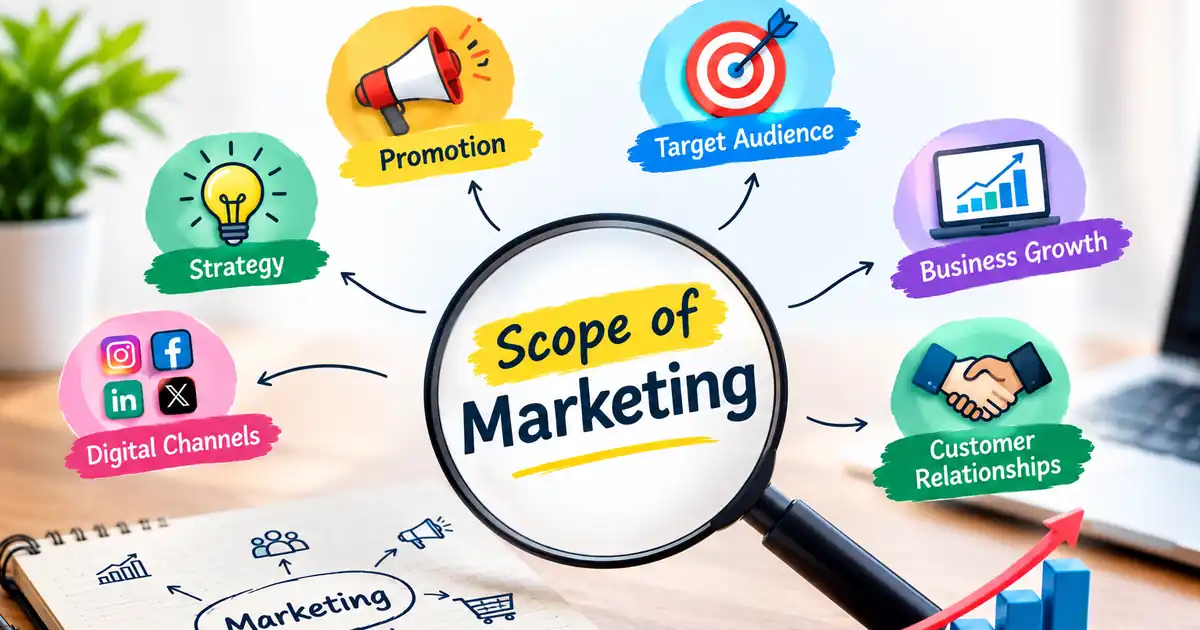
The scope of marketing is everything marketing is responsible for: what can be marketed, which business decisions marketing shapes, which sectors use it, and the careers it creates. It reaches far beyond advertising. Marketing helps decide what a business offers, who it serves, what it charges, how customers get it, and whether those customers come back.
Here is proof of how wide that scope runs. In 1944, the USDA Forest Service, the National Association of State Foresters and the Ad Council introduced Smokey Bear. There was no product to sell and no price to set. They were marketing an idea, wildfire prevention, and the bear is still on the job today. If an idea can be marketed for that long, the reach of marketing is much wider than most people assume.
At Pro Business Cop, we like to map a territory before we work it. This guide shows where marketing starts, where it stops, and what it can do for your business or your career. If you want the plain-English definition first, read our guide on what marketing means, then come back here for the full map.
What Does “Scope of Marketing” Actually Mean?
People search this phrase with two different questions in mind, and this guide answers both.
- “What does marketing cover?” This is the business and textbook meaning: the range of things marketing promotes and the functions it performs.
- “Is there scope in marketing as a career?” This is the career meaning: the jobs, pay and growth the field offers.
Students often see the phrase as nature and scope of marketing. The difference is simple. The nature describes what kind of activity marketing is (customer-focused, ongoing, value-driven). The scope describes how far it reaches.
Jump to what you need: – Running a business? Start with the functions inside marketing and the small business scope. – Studying for an exam? Start with the 10 things marketing can promote and how the scope expanded. – Weighing a career? Go straight to career scope in the US.
The 10 Things Marketing Can Promote
Marketing scholar Philip Kotler groups everything marketers work on into ten types of offerings. This list is the clearest answer to “what falls within the scope of marketing,” yet most guides skip it.
| # | What is marketed | US example | Marketing’s main job |
|---|---|---|---|
| 1 | Goods | A new smartphone model or a snack brand on store shelves | Stand out among similar products |
| 2 | Services | Car insurance, like GEICO’s long-running gecko ads | Make an invisible product feel tangible and trustworthy |
| 3 | Events | The Super Bowl, sold to fans, broadcasters and advertisers | Fill seats and sell sponsorships |
| 4 | Experiences | A Walt Disney World vacation | Sell the feeling, not the ticket |
| 5 | Persons | Realtors, doctors and creators building personal brands | Build a reputation people trust |
| 6 | Places | “I ❤ NY,” launched in 1977 by New York State to attract tourists, with a logo by Milton Glaser | Attract visitors, residents or investors |
| 7 | Properties | Homes and commercial spaces listed by real estate agents | Help buyers picture ownership |
| 8 | Organizations | The American Red Cross asking for blood donations | Earn support, members or donors |
| 9 | Information | Universities marketing degree programs | Prove the knowledge is worth the cost |
| 10 | Ideas | Smokey Bear’s wildfire prevention message | Change a belief or behavior |

The takeaway: if something needs people to choose it, support it or act on it, it sits inside the scope of marketing. That is why nonprofits, cities, hospitals and even individual professionals all need marketing skills.
The Functions Inside the Scope of Marketing
Textbooks list 8 to 11 marketing functions. That list is easier to remember (and to use) when you group it into four jobs.
| Job | Functions included | The question marketing answers |
|---|---|---|
| Understand | Market research, consumer behavior, competitor tracking | Who buys, why, and from whom? |
| Create | Input on product features, branding, packaging, pricing | What should we offer, and what is it worth? |
| Deliver | Distribution choices, e-commerce, customer experience | How do customers find and get it easily? |
| Grow | Promotion, CRM, retention, referrals, analytics | How do we win customers, keep them and measure it? |
Notice that only one of the four jobs is mostly about promotion. Marketing’s influence starts before a product exists and continues long after the sale, which is why customer relationship management (CRM) sits inside its scope, not just advertising. Together, the Create, Deliver and Grow decisions form your marketing mix. If you want to see how these functions connect in a real business, our guide to the six fundamentals of marketing walks through them step by step with a worked example.
The scope of marketing management adds one more layer on top: planning, organizing and controlling all of this work, including setting goals, managing budgets and checking results against targets.
How the Scope of Marketing Expanded Over Time
Marketing did not always cover this much ground. Its scope widened as markets grew more crowded and customers gained more choice.
| Era | Core belief | Scope of marketing |
|---|---|---|
| Production era | Make it cheaply and it will sell | Almost none; the focus was output |
| Selling era | Push hard and people will buy | Advertising and sales tactics |
| Marketing concept | Find out what customers want, then build it | Research, product, pricing, distribution, promotion |
| Societal marketing | Serve customers without harming society | Adds long-term public welfare and ethics |
| Holistic marketing | Everything the business does is marketing | Relationships, every department, results and social impact |

Kotler and Keller describe holistic marketing through four parts:
- Relationship marketing: long-term ties with customers, suppliers and partners
- Integrated marketing: every channel and message working together
- Internal marketing: making sure employees understand and deliver the brand promise
- Performance marketing: judging marketing by financial results and by its effect on society and the environment, which is where green marketing and sustainability claims come in
This is why the modern scope feels so wide. Marketing is now judged on profit, trust and impact, not just on sales volume.
Scope Across Sectors: B2C, B2B, Nonprofit, Government and Global
The same principles apply everywhere, but the day-to-day work changes a lot depending on who the buyer is.
| Sector | Who decides | Main marketing goal | Typical channels | Example |
|---|---|---|---|---|
| B2C marketing | Individual shoppers, often quickly | Awareness and repeat purchase | Social media, search, email, retail | A direct-to-consumer skincare brand |
| B2B marketing | Several stakeholders over weeks or months | Qualified leads and trust | LinkedIn, webinars, case studies, sales teams | Payroll software sold to HR teams |
| Nonprofit marketing | Donors, volunteers, members | Support and participation | Email, events, storytelling, partnerships | A local food bank’s holiday drive |
| Government (social marketing) | The public | Behavior change and public services | PSAs, outreach, tourism campaigns | Smokey Bear, state tourism offices |
| International marketing | Buyers in different cultures and laws | Local relevance | Localized content and products | McDonald’s adapting menus by country |
For a business owner, this table answers a practical question: which playbook should I copy? A B2B firm that copies B2C tactics (viral social posts, flash sales) usually wastes money, because its buyers decide slowly and in groups. Government campaigns that aim to change behavior, like Smokey Bear, are known as social marketing.
Where Marketing Ends: Who Owns What
A wide scope causes a common problem in small teams: two people assume the other one is handling a task, or both handle it differently. We covered the basic split in marketing vs advertising vs sales; this table goes one level deeper into the tasks that sit on the border.
| Task | Marketing | Sales | Product | Customer service |
|---|---|---|---|---|
| Pricing | Leads research and positioning | Gives deal-level feedback | Supplies cost data | Reports price complaints |
| Customer feedback | Collects and analyzes patterns | Shares objections heard | Turns it into features | Captures it first-hand |
| Online reviews | Owns the review strategy | Asks happy clients | Fixes recurring issues | Responds to complaints |
| Product messaging | Owns it | Uses it in pitches | Confirms accuracy | Uses it in support replies |
| Onboarding new customers | Plans welcome emails and content | Handles the handoff | Builds in-app guidance | Answers setup questions |
In a one- or two-person business, the same person may wear every hat. The table still helps, because it shows which “marketing hat” a task needs, such as checking reviews for patterns rather than only replying to them.
The Scope of Marketing for a Small Business
Corporate guides assume a full marketing department. Most small businesses have an owner, a few hours a week and a tight budget. Here is a realistic way to split the work.
| Task | Do it yourself | Outsource | Automate with tools |
|---|---|---|---|
| Talking to customers and reading reviews | ✅ Nobody knows your buyers better | ||
| Positioning and core message | ✅ With outside feedback | Optional consultant | |
| Website build | ✅ If design is not your strength | Templates help | |
| Social media posting | ✅ If you enjoy it | ✅ If you do not | Scheduling tools |
| Paid ads | Start small yourself | ✅ Once spend grows | Platform automation |
| Email newsletters | ✅ Write them | ✅ Sequences and reminders | |
| Bookkeeping of marketing spend | ✅ Track it | ✅ Accounting software |
A realistic time budget: three to five focused hours a week covers customer conversations, one email, a few social posts and a quick look at results. Consistency beats intensity for most small businesses.
Set a marketing budget you can defend. Before spending on ads or agencies, work out how many sales you need just to cover your costs with the free break-even calculator on Pro Business Cop. That number tells you how much small business marketing spend your margins can carry. Still validating the idea itself? Start with our Idea stage checklist before building a full marketing strategy.
Two traps to avoid. First, assuming a strong product does not need marketing; “a great product sells itself” is one of the claims we put under the microscope in business myths, busted. Second, buying tools before knowing what you need. Our small business tool stack lists the categories most owners actually use, so you can pick one per category and skip the rest.
Need customers fast with almost no budget? Our short answer on how to get your first ten customers shows where to start, and you can always Ask the Cop about your specific situation.
New Territory: AI Search, Data Privacy and Automation
The scope of marketing keeps growing, and three newer areas now land on marketing’s desk.
AI-generated answers in search. Many buyers now read AI summaries in Google or ask AI assistants before clicking any website. Being clear, accurate and easy to cite is becoming a marketing responsibility. In practice, that means plain answers to common questions on your site, honest reviews and a complete business profile.
First-party data. As tracking across websites gets harder, the information customers give you directly (email sign-ups, purchase history, survey answers) becomes far more valuable. Building and protecting that data is now a core marketing job.
Privacy law. State laws increasingly shape what marketers may collect and how. California’s Consumer Privacy Act, as amended by the California Privacy Rights Act, gives residents rights to know what data a business collects, to delete it and to opt out of its sale or sharing, according to the California Attorney General. Rules on fake reviews, endorsements and email also apply nationwide; we summarized the main ones in the US rules section of our fundamentals guide.
Automation. Email sequences, ad bidding and reporting increasingly run on software. That shifts the human part of marketing toward strategy, judgment and creative work.
Career Scope of Marketing in the US
If you are weighing a career in marketing, the official numbers are encouraging, with real differences between roles. These figures come from the US Bureau of Labor Statistics Occupational Outlook Handbook.
| Role | Median pay (May 2025) | US jobs (2025) | Projected growth, 2025 to 2035 | Typical entry education |
|---|---|---|---|---|
| Marketing managers | $166,790 | 421,600 | 6%* | Bachelor’s degree |
| Advertising and promotions managers | $133,660 | 33,200 | 6%* | Bachelor’s degree |
| Market research analysts | $78,760 | 952,700 | 7% | Bachelor’s degree |
| Public relations specialists | $74,750 | 314,500 | 2% | Bachelor’s degree |
*BLS projects 6% growth for advertising, promotions and marketing managers as one combined group, with about 36,300 openings a year. Market research analysts are expected to see about 82,000 openings a year, and public relations specialists about 23,000.
Sources: BLS pages for advertising, promotions and marketing managers, market research analysts and public relations specialists.

What the numbers tell you: management roles pay the most but usually require years of experience first. Market research analyst is the largest of these occupations, with the most yearly openings, which makes it one of the more accessible entry points, especially for people comfortable with data.
Skills employers keep asking for: analytics, writing and content, paid media, CRM and email platforms, and the ability to use AI tools responsibly.
Ways in: a bachelor’s degree is the typical route, but many people enter through certifications and real projects. Free options include Google Skillshop’s Fundamentals of Digital Marketing and HubSpot Academy. Freelancing for small local businesses is another practical way to build a portfolio and land your first marketing jobs.
Is Marketing a Good Career? An Honest Look
A wide scope is a strength, but it is not right for everyone. Here is the balanced picture.
Why people thrive in it: – Every industry needs it, from hospitals to software, so skills transfer when you change jobs – You can specialize (SEO, research, brand, email) or stay a generalist – Marketing skills make starting your own business much easier
What makes it hard: – Entry-level roles are competitive, and a portfolio often matters as much as a degree – You will be asked to prove results with numbers, not just creativity – Tools and platforms change constantly, so learning never stops
Who tends to do well: curious people who enjoy figuring out why others make choices, who are comfortable with both words and numbers, and who can handle feedback from real customers.
The Future Scope of Marketing
Predictions in marketing age quickly, so here are only the directions backed by official data or clear policy changes.
- Steady demand for marketing leadership. BLS projects continued growth and tens of thousands of yearly openings for marketing and advertising managers through 2035.
- More data work. With nearly a million market research analyst jobs and projected growth, understanding customers through data is becoming central to marketing.
- Privacy-first marketing. State privacy laws are pushing businesses toward consent-based, first-party data.
- AI-assisted execution. Routine tasks like drafting and reporting are increasingly automated, which raises the value of strategy, judgment and accuracy. Google’s own guidance on generative AI content now tells publishers to fact-check AI-generated content before publishing, which shows human review is still part of the job.
For more practical playbooks as these changes unfold, browse the Marketing section on Pro Business Cop.
Frequently Asked Questions
What is the difference between the nature and scope of marketing?
Nature explains what marketing is like as an activity: customer-focused, continuous and built on creating value for both sides. Scope explains how far it reaches: the offerings it promotes, the functions it performs and the sectors that use it. Exams often pair them, but they answer different questions.
What is the scope of marketing management?
Marketing management covers planning, organizing, leading and controlling marketing work. That includes setting goals, choosing target markets, managing budgets and teams, coordinating with sales and product, and measuring results against targets.
Is there scope in marketing without a degree?
Yes, though it takes more proof of skill. BLS lists a bachelor’s degree as the typical entry requirement for the roles above, but many employers and clients weigh portfolios, certifications and measurable results heavily, especially for digital roles and freelance work.
What is the scope of digital marketing?
Digital marketing covers search, social media, email, content, paid ads, analytics and e-commerce. It is not separate from marketing; it is the set of online channels used to carry out the same functions of understanding, creating, delivering and growing.
Which marketing job pays the most in the US?
Among the occupations BLS tracks in this field, marketing managers have the highest median pay, at $166,790 in May 2025. Pay varies widely by industry, company size, location and experience.
Will AI reduce the scope of marketing jobs?
AI is changing the tasks inside marketing more than the need for marketing itself. BLS still projects growth for marketing managers and market research analysts through 2035. Routine production work is the most exposed, while strategy, customer insight and accuracy checks remain human strengths.
Your Next Move
You now have the full scope of marketing mapped out: the 10 things marketing can promote, the four jobs it performs, how its scope grew, where its borders sit and the careers it opens up. Whether you are building a business or a career, the next step is the same: pick one area from this map and get good at it.
Get The Brief, free. Join the Pro Business Cop newsletter for weekly, no-fluff intel on marketing, money and growth.
- Ask the Cop: Not sure which part of marketing your business should focus on first? Send us your question, and the best ones become full investigations.
- Go deeper: Learn how the core pieces connect in our fundamentals of marketing guide.
Disclaimer
This article is for general information and education only. It is not career, legal or financial advice. Pay and job outlook figures come from the US Bureau of Labor Statistics and reflect national medians and projections at the time of its latest release; actual pay varies by location, industry, experience and employer. Privacy and marketing laws change and vary by state, so check official sources and consult a qualified professional for your situation. Brand and campaign names are mentioned as illustrations only, with no paid relationship. Read our full disclaimer.
About the Author
[Author name] is [role] at Pro Business Cop. [Add genuine credentials only, such as years of hands-on marketing experience, the types of businesses worked with, and any real certifications.] Meet the rest of the team on our authors page.

1 Comment
Pingback: Business Lawyer Guide: Costs, Duties & When You Need One