



The fundamentals of marketing are the core decisions that determine who you sell to, what you promise them, how you deliver and price it, where they find you, and whether each customer is worth what you paid to win them. They work as a chain, not a checklist. Your research decides your target customer, your target decides your positioning, and your positioning decides your price, channels and message. Skip a link and the whole chain gets weaker.
That is why a business can run a well-made ad and still lose money. The ad was fine. The offer, the price or the buyer was wrong.
At Pro Business Cop, we treat marketing like an investigation: find the buyer, follow the money, check the evidence. If you are brand new to the topic, start with our plain-English guide on what marketing actually is. This guide picks up where that one ends and shows you how the basic marketing principles connect into a working marketing strategy, using one small business from start to finish.
The Fundamentals of Marketing at a Glance
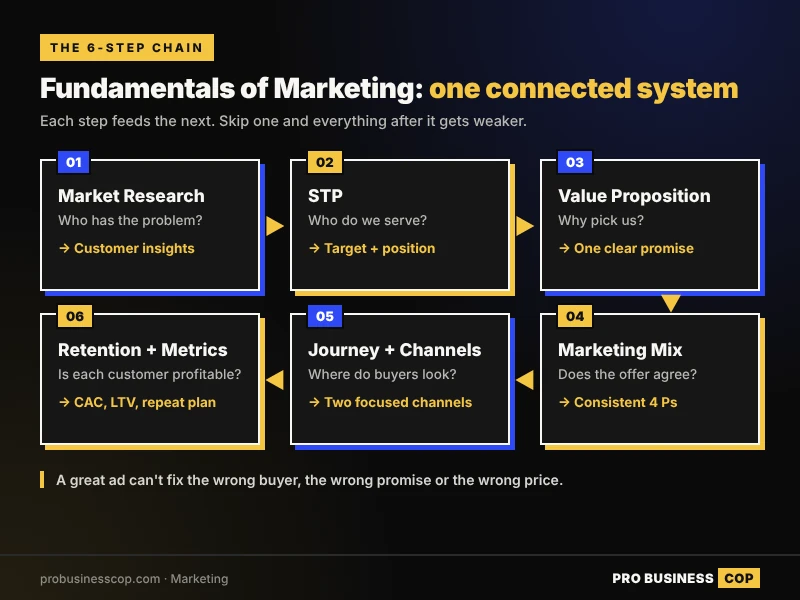
Here is the full system on one screen. Each step answers one question and produces one output you can actually use.
| # | Fundamental | The question it answers | What you walk away with | What breaks if you skip it |
| 1 | Market research | Who has the problem, and how badly? | Customer insights in their own words | You build for a buyer who does not exist |
| 2 | Segmentation, targeting and positioning (STP) | Which buyers do we serve, and how do we want them to see us? | A target segment and a positioning statement | Your message tries to please everyone and lands with no one |
| 3 | Value proposition | Why should they pick us? | One clear, repeatable promise | Customers cannot explain why you are different |
| 4 | Marketing mix | Do product, price, place and promotion support that promise? | A consistent offer | Your price or delivery contradicts your message |
| 5 | Customer journey and channels | Where do buyers look, and what do they need at each stage? | Two focused channels | Budget spreads thin across platforms that do not convert |
| 6 | Retention and measurement | Do customers come back, and is each one profitable? | CAC, LTV and a repeat-purchase plan | You keep buying new customers and never profit from them |
Our running example (hypothetical): Two former restaurant cooks in Columbus, Ohio want to start a weekly meal-prep business. They have cooking skills, a commercial kitchen they can rent by the hour and a $3,000 launch budget. Let’s walk them through every fundamental.
Fundamental 1: Research Your Market Before You Spend a Dollar
Most marketing mistakes start before any marketing happens. Owners guess who their customer is, and then spend months marketing to that guess.
Good market research for a small business does not need a research firm. It needs three habits:
Talk to real people about their problem, not your product. Ask “Walk me through what you ate during your last busy workweek” instead of “Would you buy healthy meals?” People say yes to hypothetical products all day. Their actual behavior tells the truth. Our free Idea stage checklist walks you through these customer conversations and other cheap ways to test demand before you invest heavily.
Use free public data. The US Census Bureau’s Census Business Builder shows population, income and business counts by area, which helps you check whether your local target market is big enough. Google Trends shows whether interest in your category is rising or fading.
Read your competitors’ reviews. One-star and three-star reviews are the cheapest competitive analysis you can run. They tell you exactly what buyers wish someone would fix.
What our Columbus cooks found: After 12 conversations, a pattern jumped out. The most frustrated people were not gym-goers (the market they expected). They were hospital night-shift workers. Nurses and techs described eating vending-machine snacks at 3 a.m. because the cafeteria was closed and their break was 30 minutes. Several complained that existing meal-prep brands delivered to homes on weekday afternoons, when shift workers are asleep.
That single insight shaped every decision that followed.
Fundamental 2: Segment, Target and Position (STP)
STP marketing turns research into focus. It has three moves.
Segment the market
Split potential buyers into groups that share needs. The four classic bases are:
- Demographic: age, income, occupation, household size
- Geographic: city, neighborhood, distance from you
- Psychographic: values, lifestyle, priorities
- Behavioral: what they currently buy, how often, and why
B2B sellers use firmographics instead, such as industry, company size and revenue.
Choose a target
Pick the segment where four things line up: it is big enough to sustain you, you can reach it affordably, it will pay your price, and competitors are not already serving it well.
For the meal-prep business, the target audience became: healthcare shift workers aged 25 to 45, working at hospitals within 10 miles of the kitchen, who currently buy fast food or vending snacks during shifts at least three times a week. That is specific enough to find, message and serve.
Many teams turn this description into a short buyer persona: a one-page profile of one typical customer, covering their daily routine, frustrations and what would make them buy. Pin it where everyone who writes ads or answers customers can see it.
Write a positioning statement
Brand positioning is the place you want to hold in your customer’s mind compared with the alternatives. A positioning statement puts it into one internal sentence (not an ad) that keeps every later decision honest. Use this fill-in template:
For [target customer] who [specific need], [brand] is the [category] that [key benefit] because [proof], unlike [main alternative].
Here is the meal-prep version:
For hospital shift workers who have 30-minute breaks and no open cafeteria, our service is the meal-prep subscription that delivers high-protein meals ready in three minutes, because every meal is designed for break-room microwaves and dropped at staff entrances, unlike home-delivery brands that arrive while you sleep.
If a new idea (a price change, a new channel, a menu item) does not fit this sentence, it probably does not belong.
Fundamental 3: Write a Value Proposition Customers Can Repeat
Your positioning statement is for your team. Your value proposition is the customer-facing version: the promise people see on your website, ads and packaging.
A strong value proposition answers four things fast: who it is for, what outcome they get, what proves it, and why it beats their current option.
The 5-second test: Show it to someone in your target market for five seconds, then ask them to repeat it. If they cannot, it is too vague.
| Version | Value proposition | Problem |
| Weak | “Healthy, delicious meals made with love.” | Every food brand says this. No target, no outcome, no proof. |
| Strong | “Six high-protein shift meals that reheat in 3 minutes, dropped at your hospital’s staff entrance every Sunday. $15 a meal, skip any week.” | Clear buyer, clear outcome, specific proof, low-risk offer. |
Notice the strong version came straight from the research. “Reheat in 3 minutes” and “staff entrance” are details only a real customer conversation could produce. That is the difference between marketing copy and marketing evidence.
Fundamental 4: Make Your Marketing Mix Agree With Itself
You probably know the marketing mix as the 4 Ps: product, price, place and promotion. (If not, we explain the 4 Ps with a real launch in our earlier guide.) The fundamental most owners miss is not knowing the Ps. It is making sure they do not contradict each other.
Your positioning sets the rules. Every P has to follow them.
| If your positioning says… | But your mix does this… | The customer concludes… |
| Premium and expert | Constant 50%-off promotions | “It is not really worth full price” |
| Fast and convenient | A five-step checkout and 10-day delivery | “They do not respect my time” |
| Built for professionals | Cartoon graphics and slang-heavy ads | “This is not for people like me” |
| Budget-friendly | A luxury showroom and long consultations | “I cannot afford this” |
For the meal-prep business, the mix lined up like this: product (meals engineered for microwaves and short breaks), price ($15 a meal, close to what a fast-food shift meal plus a drink actually costs), place (Sunday drop-offs at staff entrances, timed around shift changes) and promotion (where nurses already gather, covered next).
Notice the pricing strategy here is value-based, not lowest-in-town. Competing on price alone squeezes margins and attracts the least loyal buyers, which is why “the lowest price always wins” sits on our list of business myths, busted.
Which framework should you plan with? Use the 4 Ps for physical products. Use the 7 Ps (adding people, process and physical evidence) when your staff and experience are the product, like a salon or agency. Use the customer-side 4 Cs (customer needs, cost, convenience, communication) as a final check that every decision makes sense from the buyer’s chair.
Fundamental 5: Match Your Channels to the Customer Journey
Buyers do not go from “never heard of you” to “paying customer” in one step. The customer journey has stages, and each stage needs different content. Marketers often draw the first three stages as a marketing funnel, because fewer people make it through each step. Your job is to raise the conversion rate between stages, not just pour more people into the top.
| Stage | What the buyer is thinking | What helps them move forward | Meal-prep example |
| Awareness | “There has to be a better option than vending machines.” | Content that names their problem | Short Instagram videos about surviving night shifts; flyers on hospital community boards where permitted |
| Consideration | “Is this legit? Will it work for my schedule?” | Proof and specifics | Menu page with reheat times, real customer reviews, delivery map |
| Decision | “Is it worth trying?” | Low-risk first step | First box with a skip-anytime promise and simple checkout |
| Retention | “Should I keep ordering?” | Consistent quality and variety | Weekly menu email, easy skip button |
| Referral | “My coworker keeps asking about these.” | A reason to share | Free meal for each coworker who signs up |
Pick two channels, not six. One should be a channel you own (like an email list), and one should be where your buyers already spend time. The meal-prep team chose email plus Instagram, because their interviews showed nurses scrolled Instagram during breaks. Email came first for a reason: social reach can drop overnight, while a list is yours, which is why “more followers means more sales” is one of the myths we put under investigation. Our Marketing section has more small business marketing guides when you are ready to go deeper.
How AI search changes this stage: More buyers now ask AI assistants or read AI-generated answers in Google before they ever visit a website. The fundamental does not change: be useful where your buyer is looking. In practice that means a complete Google Business Profile, genuine reviews, and a website that answers common questions clearly (prices, delivery areas, how it works). AI tools tend to summarize businesses that explain themselves plainly.
Fundamental 6: Retention, the Step Most Beginners Skip
New owners pour almost all their energy into winning customers and very little into keeping them. That is backwards, especially on a small budget.
Research by Bain & Company, highlighted in Harvard Business Review, found that increasing customer retention by 5% can raise profits by 25% to 95%. That study came from financial services, so treat the exact range as illustrative, but the principle holds almost everywhere: a returning customer costs far less to serve than a new one costs to find.
Simple retention moves that cost little or nothing:
- Build an email list from day one and send something useful, not just promotions.
- Make it easy to pause instead of cancel. The meal-prep “skip a week” button saves customers who are on vacation, not unhappy.
- Ask for reviews and referrals right after a great experience, when goodwill is highest. Simple referral marketing, like the free meal for each coworker who signs up, turns a good customer experience into new customers.
- Track who stops buying and ask them why. One honest answer beats a dozen guesses.
The math for our example: Say the average subscriber stays 16 weeks. If better menus and the skip button stretch that to 20 weeks, each customer brings in four more weekly orders with zero extra ad spend. Across 100 subscribers, that is 400 extra orders. You will need an email platform and a simple CRM to run this well; our small business tool stack lists the names owners mention most in each category.
Measuring the Fundamentals: CAC, LTV and the Ratio That Matters
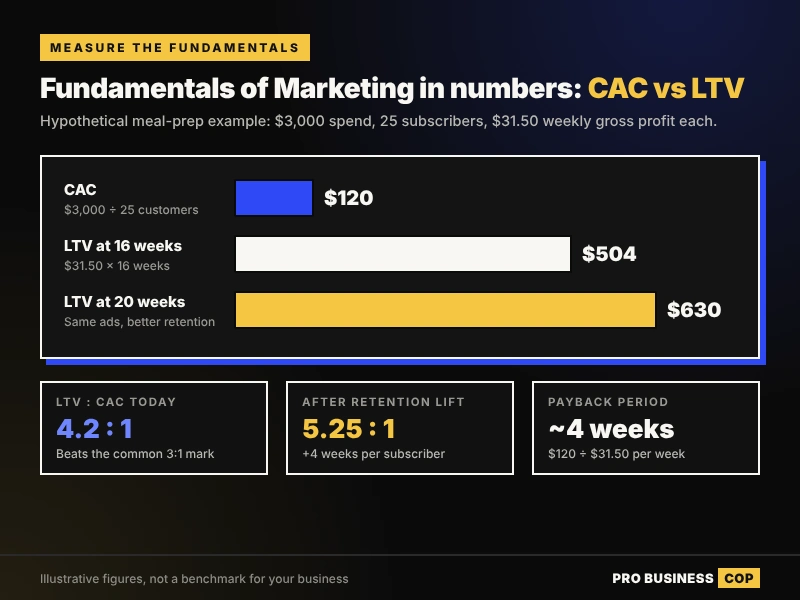
Our What Is Marketing guide covers basic marketing ROI on a single campaign. The fundamentals need a longer view, because a campaign that looks like a loss on the first sale can be very profitable over a customer’s lifetime. Two numbers do that job.
Customer acquisition cost (CAC) = total marketing and sales spend ÷ number of new customers won
Customer lifetime value (LTV) = average gross profit per purchase × number of purchases over the relationship
Using gross profit (revenue minus the direct cost of making the product) instead of revenue keeps you honest. Revenue you have to spend on ingredients is not money you earned.
Worked example (hypothetical numbers):
| Item | Value |
| Launch spend (Instagram ads plus printed flyers) | $3,000 |
| New subscribers won | 25 |
| CAC | $3,000 ÷ 25 = $120 |
| Weekly box price | $90 (six meals at $15) |
| Gross margin | 35% |
| Gross profit per week | $31.50 |
| Average weeks subscribed | 16 |
| LTV | $31.50 × 16 = $504 |
| LTV to CAC ratio | $504 ÷ $120 = 4.2 to 1 |
| Payback period | $120 ÷ $31.50 = about 4 weeks |
Now apply the retention improvement from the last section. At 20 weeks, LTV rises to $630 and the ratio climbs to 5.25 to 1. Same ads, same CAC, a much healthier business.
What is a good LTV to CAC ratio? The widely quoted benchmark is around 3 to 1. Keep in mind that it comes from subscription software, so product businesses with thinner margins should treat it as a rough guide and also watch payback period, meaning how fast you earn back what you spent. Below 1 to 1, you lose money on every customer. Far above 5 to 1, you may be underinvesting in growth.
Before you spend on any campaign, run your numbers through the free break-even calculator on Pro Business Cop. It shows how many sales you need each month to cover your costs, which tells you how much customer acquisition cost your business can actually afford.
US Marketing Rules Every Small Business Must Follow
Trust is a marketing fundamental too, and in the US some of it is written into law. These are the rules small businesses run into most often.
Fake reviews are banned outright. The FTC’s rule on consumer reviews and testimonials prohibits writing, buying or selling fake reviews, including AI-generated ones, and paying for reviews that must express a particular sentiment. Reviews from employees or relatives need a clear disclosure, and you cannot use threats to suppress negative reviews. The FTC can seek civil penalties per violation, with the maximum adjusted each year for inflation.
Paid endorsements need disclosure. If you give an influencer free product, a discount or payment, the FTC’s Endorsement Guides expect that connection to be clearly disclosed. “Thanks to the brand for the free meals” works. A hidden hashtag at the end of 30 others does not.
Email marketing follows CAN-SPAM. The FTC’s CAN-SPAM compliance guide requires honest subject lines and sender details, your valid physical postal address, and a working unsubscribe option that you honor within 10 business days. You stay responsible even if an agency sends emails for you.
Text messages need clear consent. Under the Telephone Consumer Protection Act, the FCC has long required prior express written consent before businesses send automated marketing texts. Some federal courts have questioned that written-consent rule recently, so the legal picture is shifting, but getting a clear, documented opt-in and honoring “STOP” replies immediately remains the safest practice. The FCC’s telemarketing and robocalls page is the official starting point.
This section is general information, not legal advice. Rules can vary by state, so check with a qualified attorney before launching review, influencer or SMS programs.
Diagnose Your Marketing: Which Fundamental Is Broken?
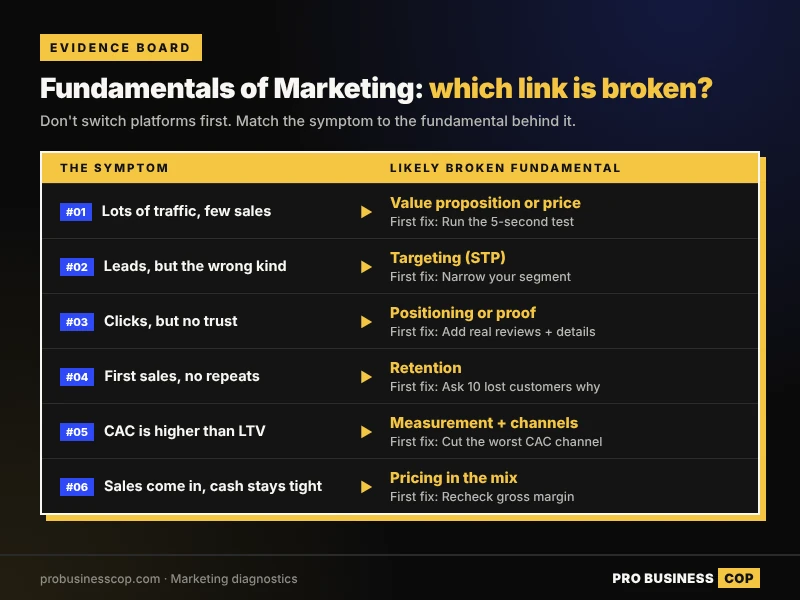
When marketing underperforms, owners usually blame the channel and switch platforms. Most of the time, the real problem sits further up the chain. Use the symptom to find the broken link.
| Symptom | Likely broken fundamental | First fix to try |
| Lots of traffic, few sales | Value proposition or price | Run the 5-second test; compare your price to the real alternative |
| Plenty of leads, but the wrong kind | Targeting | Tighten your target segment and rewrite ads for that segment only |
| People click ads but do not trust you | Positioning or proof | Add specific reviews, guarantees and real details to your landing page |
| First sales are good, repeat sales are weak | Retention or product | Ask the last 10 people who stopped buying why they left |
| Every new customer costs more than they bring in | Measurement and channel fit | Calculate CAC by channel and cut the worst performer |
| Sales come in, but cash is always tight | Pricing within the mix | Recheck gross margin; a small price increase on new customers is a low-risk test |
Not sure which row fits your business? Ask the Cop with your symptom and numbers. The best questions become full investigations on the site.
How to Learn the Fundamentals of Marketing for Free
You do not need a degree to learn the marketing basics. These free US resources cover the theory, and your own business supplies the practice.
- Google Skillshop’s Fundamentals of Digital Marketing: About 40 hours across 17 modules, from strategy and customer insight to search, social and email, with a badge you can add to LinkedIn.
- HubSpot Academy: Free courses on inbound marketing, email and content, useful for the journey and retention fundamentals.
- SBA Learning Platform: Free self-paced courses from the US Small Business Administration on planning, marketing and growth.
- SCORE: Free one-on-one mentoring from experienced volunteer business advisors, which is ideal for pressure-testing your positioning.
A 4-week practice plan using your own business:
- Week 1, research: Interview 10 customers or prospects about their problem. Pull one Census Business Builder report for your area.
- Week 2, STP and value proposition: Write your target segment and positioning statement. Run the 5-second test on your value proposition with three real people.
- Week 3, mix and journey: Fill in the mix consistency table above for your business. Map your journey stages and choose your two channels.
- Week 4, measurement and compliance: Calculate your CAC and LTV with real numbers. Check your reviews, emails and texts against the US rules above.
By the end, you will have a one-page marketing plan built on real evidence, which is more practical marketing work than many courses ask for.
Frequently Asked Questions
What are the 5 fundamentals of marketing?
There is no single official list, and textbooks group them differently. A practical five for small businesses are: understanding your customer, choosing a target and position, building a clear offer, getting that offer in front of the right people, and measuring whether each customer is profitable. This guide splits retention out as a sixth because it is where many small businesses quietly lose money.
What is the most important fundamental of marketing?
Understanding the customer. Every other decision, from price to channel to message, depends on knowing who buys and why. A brilliant ad aimed at the wrong person still fails, while a plain message aimed at the right person with a real problem often works.
How long does it take to learn the fundamentals of marketing?
You can learn the core concepts in a few weeks of focused study, and courses like Google’s run about 40 hours. Applying them well takes longer because each fundamental gets sharper with real customer feedback. Most owners see the biggest improvement after their first full cycle of research, launch and measurement.
Which marketing fundamentals matter most on a tiny budget?
Research, positioning and retention cost almost nothing but time, and they make every paid dollar work harder later. Customer interviews, a sharp value proposition, an email list and a habit of asking for reviews can carry a new business a long way before ads are worth buying. Our short answer on how to get your first ten customers shows where to start.
Are marketing fundamentals different for B2B businesses?
The fundamentals are the same, but the execution shifts. B2B sales usually involve several decision-makers, longer buying cycles and higher contract values, so research focuses on company needs (firmographics), proof leans on case studies and ROI, and relationship-building matters more than impulse.
Will AI replace the fundamentals of marketing?
No. AI tools speed up execution, like drafting copy, analyzing data or sizing up competitors, but they cannot decide who your business should serve or what promise it should keep. Those strategic choices still come from real customer understanding, and AI-generated output needs a human fact-check before it reaches customers.
Your Next Assignment
You now have the full system behind the fundamentals of marketing: research, STP, value proposition, a consistent mix, the right channels, retention and the numbers to prove it all works. Your assignment is simple: pick the weakest link in your own business and fix that one first.
Get The Brief, free. Join the Pro Business Cop newsletter for weekly, no-fluff business intel on marketing, money and growth that you can use the same day. Free forever, unsubscribe in one click.
- Ask the Cop: Stuck on your positioning statement or your CAC math? Send us your question, and the best ones become full investigations.
- Run the numbers: Use the free break-even calculator before your next campaign.
Disclaimer
This article is for general information and education only. It is not legal, financial or professional marketing advice. The Columbus meal-prep business and all of its numbers are hypothetical, created to illustrate how the fundamentals connect. Benchmarks such as the 3 to 1 LTV to CAC ratio vary by industry and business model. Laws on reviews, endorsements, email and text marketing can change and may vary by state, so confirm current requirements with official sources like the FTC and FCC, and consult a qualified professional before making major decisions. Pro Business Cop does not accept payment for the tools or resources mentioned. Read our full disclaimer.

1 Comment
Pingback: Scope Of Marketing: What It Covers, Proven Careers And Pay