


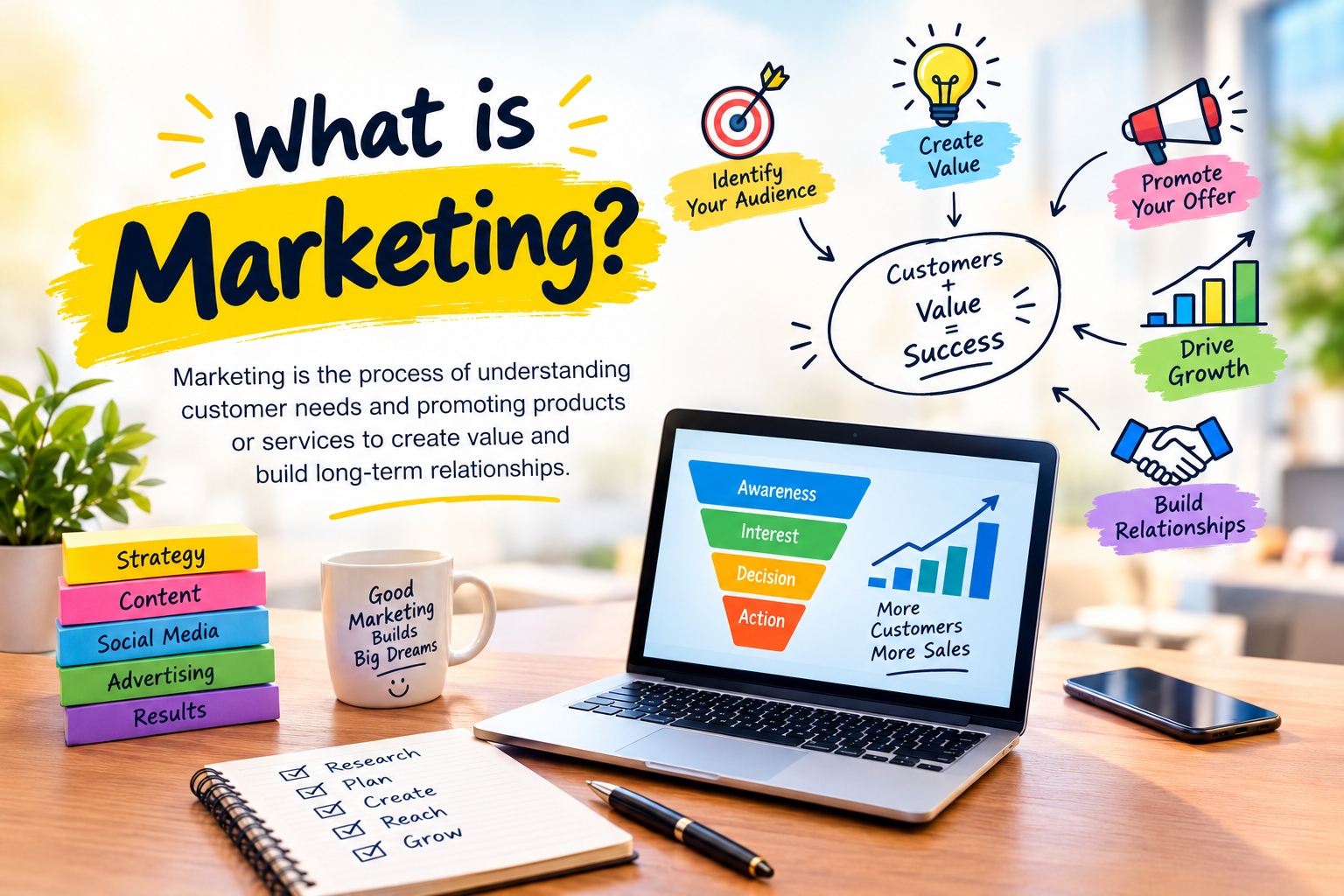
What is marketing? It is the work of understanding who needs what, then creating, pricing, delivering and promoting an offer so those people choose you, and keep choosing you. That covers research, product decisions, pricing, distribution and promotion, not just ads. The scale is huge: total US advertising, marketing and data spend reached $607.4 billion in 2025, and online channels took 65.1% of it, according to Winterberry Group.
| The evidence | The number | Source |
| US digital ad revenue, 2025 | $294.6 billion, up 13.9% | IAB/PwC Internet Advertising Revenue Report |
| Social media ad revenue, 2025 | $117.7 billion, up 32.6% | IAB/PwC |
| Search ad revenue (including AI search), 2025 | $114.2 billion, up 11% | IAB/PwC |
| Creator advertising, 2025 | $37 billion, forecast $44 billion in 2026 | IAB/PwC |
| Online share of US marketing spend | 65.1% in 2025, up from 56.4% in 2022 | Winterberry Group |
| Average marketing budget, large firms | 7.8% of revenue | Gartner 2026 CMO Spend Survey |
| Small businesses in the US | 36.2 million, 99.9% of all businesses | SBA Office of Advocacy |
In March 2012, a razor startup posted one YouTube video that cost $4,500 to make. Within 48 hours, Dollar Shave Club had 12,000 orders, and four years later Unilever bought the company for a reported $1 billion. Most people remember the video. Fewer notice that the video only worked because the product, the price and the delivery model were already built to match it. That gap between “the ad” and “the whole system” is exactly what this guide is about.
At Pro Business Cop, we put common business advice under investigation. Here we break down what is marketing in business, separate it from advertising and sales, show you where US marketing dollars actually go and give you the math to check whether your own marketing is paying off.
What Is Marketing, Really? A Working Definition
The official marketing definition from the American Marketing Association describes it as the activities and processes that create, communicate, deliver and exchange offerings with value for customers, partners and society. That is accurate, but hard to act on.
Here is a version you can use on a Monday morning:
Marketing is the system that decides who you serve, what you offer them, what you charge, how they get it and how they hear about it.
Other thinkers frame the same idea from different sides:
- Philip Kotler stresses identifying a target market’s needs and serving them at a profit.
- Peter Drucker put it most sharply: “The aim of marketing is to make selling superfluous.” In other words, if you understand the customer well enough, the product nearly sells itself.
- The Chartered Institute of Marketing adds anticipation: good marketing spots needs before customers say them out loud.
Strip away the wording and every serious marketing meaning lands on the same three points. It starts with the customer, it reaches far beyond promotion, and it has to create value for both the buyer and the business.
Case File: 5 Marketing Myths That Cost Owners Money
Bad assumptions about what is marketing lead straight to wasted budgets. Here are the five we see most often.
| The myth | The fact |
| “Marketing means running ads.” | Ads are one tool. A wrong price or a confusing checkout will sink the best ad you ever run. |
| “Marketing and sales are the same job.” | Marketing creates demand and qualified interest. Sales turns that interest into signed deals. |
| “If the product is great, it will sell itself.” | Great products still need distribution. Nobody buys what they never hear about. |
| “We should be on every platform.” | Two channels run well beat six channels run badly, especially on a small budget. |
| “Followers and likes prove it is working.” | Reach is not revenue. Track leads, sales and profit per channel instead. |
Marketing vs Advertising vs Sales: Who Does What
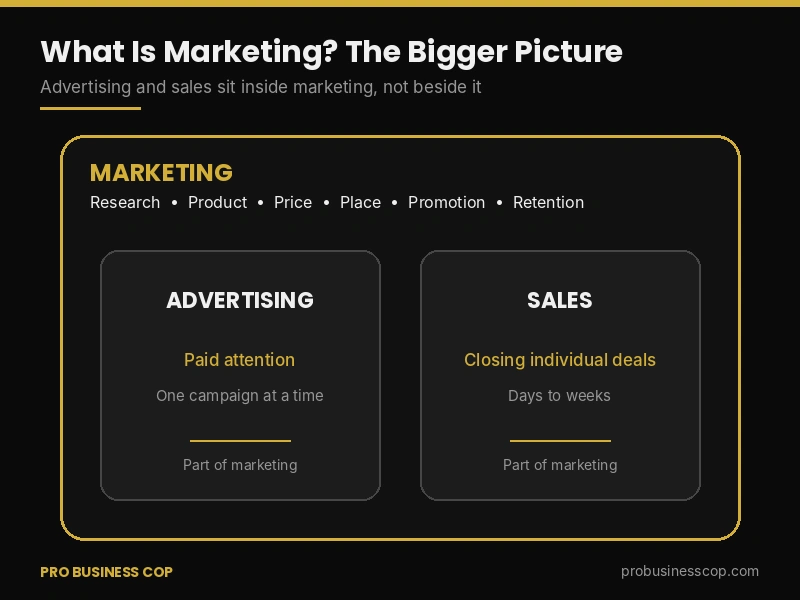
Marketing vs advertising confuses people because advertising is the most visible part of marketing. Marketing vs sales confuses them because both chase revenue. A quick scenario makes the split clear.
Picture a small coffee roaster in Denver launching a monthly bean subscription (a hypothetical example):
- Marketing decides the target buyer (home brewers who want specialty beans without a café habit), the product (two bags a month), the price ($32), the channel (online subscription plus a few local grocers) and the message (fresh roast, shipped within days).
- Advertising is the paid Instagram video and the local radio spot that announce the launch.
- Sales is the owner pitching the grocery store buyer face to face and closing a wholesale order.
| Marketing | Advertising | Sales | |
| What it owns | The whole customer system | Paid attention | Individual deals |
| Success looks like | Profitable, repeat customers | Reach, clicks, inquiries | Signed orders and closed revenue |
| Time horizon | Months to years | One campaign | Days to weeks |
If you remember one thing: advertising and sales both sit inside marketing, not beside it.
The 4 Ps of Marketing, Using a Real Launch
The 4 Ps of marketing, also called the marketing mix, are product, price, place and promotion. E. Jerome McCarthy popularized this four-part model in his 1960 textbook, Basic Marketing, building on Neil Borden’s broader idea of a “marketing mix.”
Here is how the Dollar Shave Club launch maps onto the 4 Ps, which explains why one cheap video could do so much work:
| P | The decision | Dollar Shave Club’s answer |
| Product | What do you sell, and to whom? | Razor blades by subscription for men tired of overpriced cartridges |
| Price | What will buyers pay? | Low monthly plans, with the price promise built into the brand name |
| Place | How do buyers get it? | Online, direct to consumer, mailed to the door |
| Promotion | How do people find out? | A funny, founder-led YouTube video that spread through social sharing |
Two extensions are worth knowing. Service businesses often use the 7 Ps, which add people, process and physical evidence, because the experience is part of the product. The 4 Cs flip the view to the buyer: customer needs, cost, convenience and communication. If you are still testing what to sell, our startups playbooks cover how to validate demand before you spend on the other three Ps.
Types of Marketing: Owned, Earned and Paid
Most lists of types of marketing run to twenty labels. A simpler way to sort them is by who controls the channel.
| Bucket | What it means | Common examples | Best for |
| Owned | Channels you control | Website, email list, blog, SMS | Long-term, low-cost repeat sales |
| Earned | Attention you do not pay for directly | Reviews, word of mouth, press, organic social shares | Trust and credibility |
| Paid | Attention you buy | Search ads, social ads, creator sponsorships, TV, direct mail | Fast, scalable reach |
Inside these buckets you will hear terms like digital marketing, content marketing, social media marketing, influencer marketing and local marketing. They are channels and tactics, not separate disciplines. A strong small business marketing plan usually starts owned and earned (an email list and reviews), then adds paid once it knows who buys and why. Our guide to picking marketing tools can help you choose an email platform and CRM without overspending.
Where US Marketing Money Actually Goes
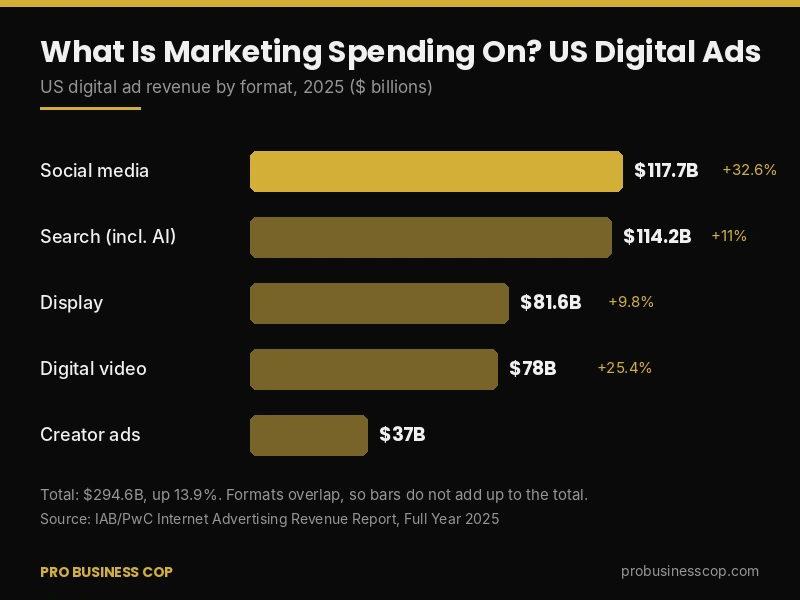
Following the money is the fastest way to see what marketing looks like now. According to the IAB/PwC Internet Advertising Revenue Report, US digital ad revenue hit a record $294.6 billion in 2025.
Three findings matter for small businesses:
- Social overtook search. Social media ad revenue grew 32.6% to $117.7 billion, while search, including AI search, grew 11% to $114.2 billion. Customers now discover brands in feeds as often as in search results.
- Video keeps climbing. Digital video, including connected TV and short-form, grew 25.4% to $78 billion.
- Creators became a real channel. Creator advertising reached $37 billion and is projected to reach $44 billion. For a local business, that can be as simple as a paid partnership with a respected local creator.
The bigger picture points the same way. Winterberry Group estimates online channels took 65.1% of all US marketing spend in 2025 and forecasts total spend of $664.2 billion for 2026. The catch: big platforms collect most of these dollars, so small businesses compete against brands with far deeper pockets. That is why precise targeting and owned channels like email matter so much at a smaller scale.
How Much Should a Small Business Spend on Marketing?
The most quoted rule of thumb, long associated with SBA guidance, is 7% to 8% of gross revenue for businesses under $5 million in sales with net margins around 10% to 12%. Gartner’s 2026 CMO Spend Survey found large companies average 7.8% of revenue, and 56% of those marketing leaders still said their budget fell short of their plan.
Treat these numbers as a starting range, not a rule. Gartner’s sample is mostly companies with over $1 billion in revenue, and The CMO Survey reports a median closer to 5% across a broader group of US firms. Here is what the range looks like for a business doing $400,000 a year:
| Budget level | % of revenue | Annual | Monthly |
| Lean | 5% | $20,000 | about $1,667 |
| Common benchmark | 8% | $32,000 | about $2,667 |
| Aggressive growth | 12% | $48,000 | $4,000 |
New businesses often spend above this range while they build awareness, and referral-heavy businesses can spend less. The smarter move is to fund a small test, measure the return and then scale what works. Our free break-even calculator on the Pro Business Cop homepage shows how many sales you need before any campaign is worth it.
Marketing ROI: The Math That Keeps You Honest
Marketing ROI answers one question: did this spending make you money? The formula is (return minus cost) divided by cost, shown as a percentage. The trap is choosing revenue as the “return” when profit is what pays your bills.
Take a hypothetical mobile dog grooming business:
| Item | Amount |
| Spend on local search ads | $1,200 |
| New clients from the campaign | 40 |
| Average first-visit price | $75 |
| Revenue | $3,000 |
| Gross margin (assumed) | 40% |
| Gross profit | $1,200 |
| ROI on revenue: (3,000 − 1,200) ÷ 1,200 | 150% |
| ROI on profit: (1,200 − 1,200) ÷ 1,200 | 0% |
On revenue, the campaign looks like a hit. On profit, it only broke even. Now add repeat business: if half those clients book three more visits, that is 60 extra appointments, $4,500 more revenue and $1,800 more gross profit. Suddenly the same campaign is clearly worth running. This is why smart owners judge marketing on profit and customer lifetime value, not first-sale revenue alone.
A 30-Day Starter Marketing Plan for a New Business
Knowing what is marketing only helps once you act on it. This four-week plan suits most new local or online businesses.
- Week 1: Define the customer. Write one sentence naming your buyer, their problem and why they would pick you. Talk to at least ten real prospects.
- Week 2: Fix the basics. Set your price, make buying easy (clear website, online booking or checkout) and claim your Google Business Profile.
- Week 3: Pick two channels. Choose one owned channel, such as an email list, and one channel where your buyers already spend time. Ignore the rest for now.
- Week 4: Measure and adjust. Track leads, sales and cost per customer for each channel. Keep what returns a profit and cut what does not.
Frequently Asked Questions
What is marketing in simple words?
Marketing is how a business finds the right customers, offers them something they value and gets that offer in front of them. It includes research, product, pricing, distribution and promotion, not only ads or social posts.
What are the 4 Ps of marketing?
Product, price, place and promotion. Together they form the marketing mix: what you sell, what you charge, how customers get it and how they find out about it.
What are the 7 Ps of marketing?
The 7 Ps add people, process and physical evidence to the original four. They are mostly used by service businesses, where staff, the customer experience and the look of the location shape what the buyer gets.
What is the difference between marketing and sales?
Marketing builds awareness and interest among the right audience. Sales works with individual prospects to close the deal. In a small business, one person often does both, but the goals and metrics differ.
Close the Case: Your Next Move
You now know what marketing is, what it is not and how to check whether it pays. Here is where to go next:
- Get The Brief. Subscribe for straight, no-fluff business intel delivered to your inbox.
- Keep investigating. Browse our full marketing category for channel-by-channel playbooks.
- Ask the Cop. Stuck on your marketing plan? Send us your question, and the best ones become full investigations.
Disclaimer
This article is for general information and education only and is not financial, legal or business advice. Industry figures come from published reports and can differ between sources because of different methods and time frames. The coffee roaster, dog grooming and $400,000 budget examples are hypothetical illustrations. Check the original sources, such as the American Marketing Association, the SBA Office of Advocacy and The CMO Survey, and talk to a qualified professional before making major spending decisions.

3 Comments
Pingback: Fundamentals Of Marketing: 6 Proven Steps For Small Business
Pingback: Scope Of Marketing: What It Covers, Proven Careers And Pay
Pingback: Rajkot Updates News: When Will The Tesla Phone Be Released?