

A prime number is a whole number greater than 1 that has exactly two factors: 1 and itself. The number 7 is prime because only 1 and 7 divide it without leaving a remainder. The smallest prime number is 2, and it is also the only even prime.
That definition is easy to say and surprisingly easy to misuse. Students often call 1 a prime number, or assume every odd number is prime. This guide explains what a prime number is in math, shows how it differs from a composite number, gives you a list of primes up to 100, and teaches a simple method to test any number yourself.
What Is a Prime Number in Math?
In math, a prime number is a natural number greater than 1 whose only positive factors are 1 and the number itself. A factor is a number that divides another number exactly, with no remainder. In India and the UK the subject is called maths, but the definition is the same everywhere.
Take 7. Try dividing it by 2, 3, 4, 5 and 6. None of them divides it exactly. Only 1 and 7 do, so 7 is prime. Now take 8. It divides exactly by 1, 2, 4 and 8, so it has four factors and is not prime.
Here is a picture that helps younger learners. Place 7 counters in equal rows. You can only make one row of 7, or seven rows of 1. Now try 12 counters. You can make 2 rows of 6, 3 rows of 4 or 4 rows of 3. A prime number of counters can only ever form one straight row.
Number Factors Prime? 2 1, 2 Yes 3 1, 3 Yes 4 1, 2, 4 No 9 1, 3, 9 No 13 1, 13 Yes 15 1, 3, 5, 15 No 29 1, 29 Yes 49 1, 7, 49 No
What Is the Smallest Prime Number?
The smallest prime number is 2. It has exactly two factors, 1 and 2, so it meets the definition. There is no smaller prime, because 1 has only one factor, and 0 and negative numbers are not part of the definition.
The number 2 is also the only even prime. Every other even number can be divided by 2, which gives it at least three factors: 1, 2 and itself. That is why every prime after 2 is odd. The reverse is not true. Many odd numbers, such as 9, 15 and 21, are not prime.
Why Is 1 Not a Prime Number?
The number 1 has only one factor, itself, so it fails the exactly two factors rule. There is also a deeper reason.
Mathematicians rely on the fundamental theorem of arithmetic. It says every whole number greater than 1 can be written as a product of primes in exactly one way. For 12, that product is 2 × 2 × 3. If 1 counted as a prime, you could also write 1 × 2 × 2 × 3, or 1 × 1 × 2 × 2 × 3, and the answer would no longer be unique. Leaving 1 out keeps the theorem clean.
Some older math books did count 1 as a prime. Modern convention leaves it out, mainly because of the unique factorisation reason above.
What Is a Composite Number?
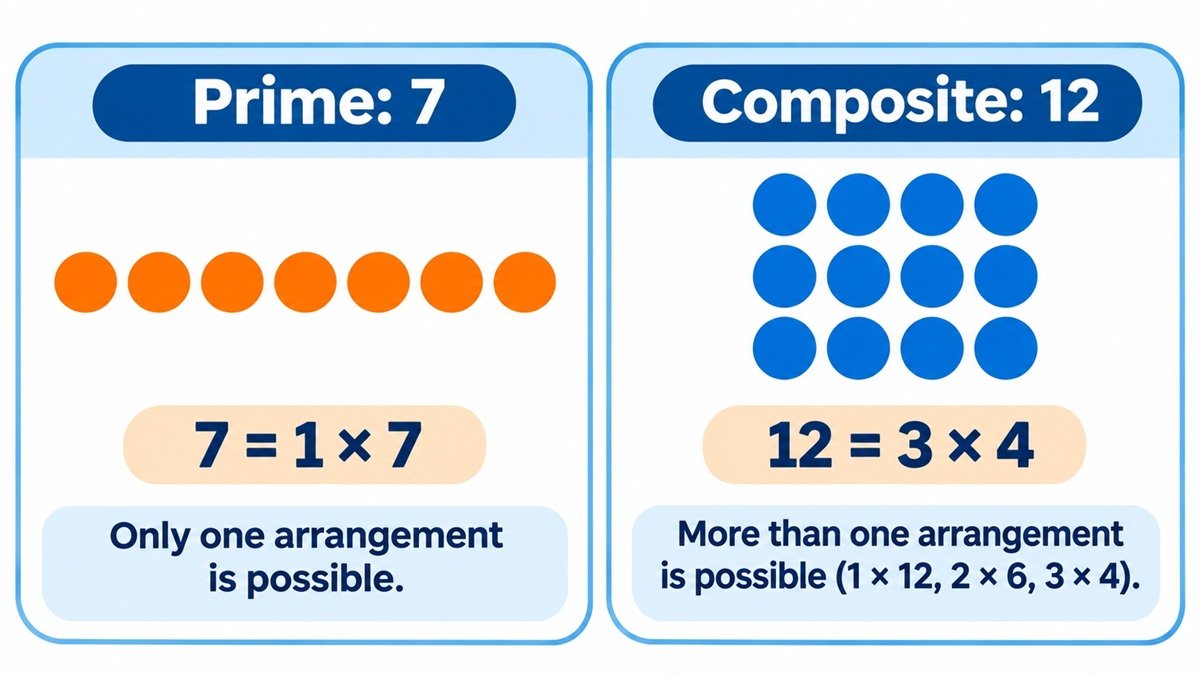
A composite number is a whole number greater than 1 that has more than two factors. In other words, you can build it by multiplying two smaller whole numbers. The number 12 is composite because it has six factors: 1, 2, 3, 4, 6 and 12.
| Type | Meaning | Number of factors | Examples |
|---|---|---|---|
| Prime | Greater than 1, with only two factors | Exactly 2 | 2, 3, 5, 7, 11, 13 |
| Composite | Greater than 1, with more than two factors | 3 or more | 4, 6, 9, 12, 15, 21 |
| Neither | Does not fit either definition | Not applicable | 0, 1 |
Every whole number greater than 1 is either prime or composite. There is no third option.
Composite numbers can always be broken into prime factors. For example, 60 = 2 × 2 × 3 × 5. This is called prime factorisation, and it is the method you use in school math to find the HCF and LCM of two numbers.
List of Prime Numbers From 1 to 100
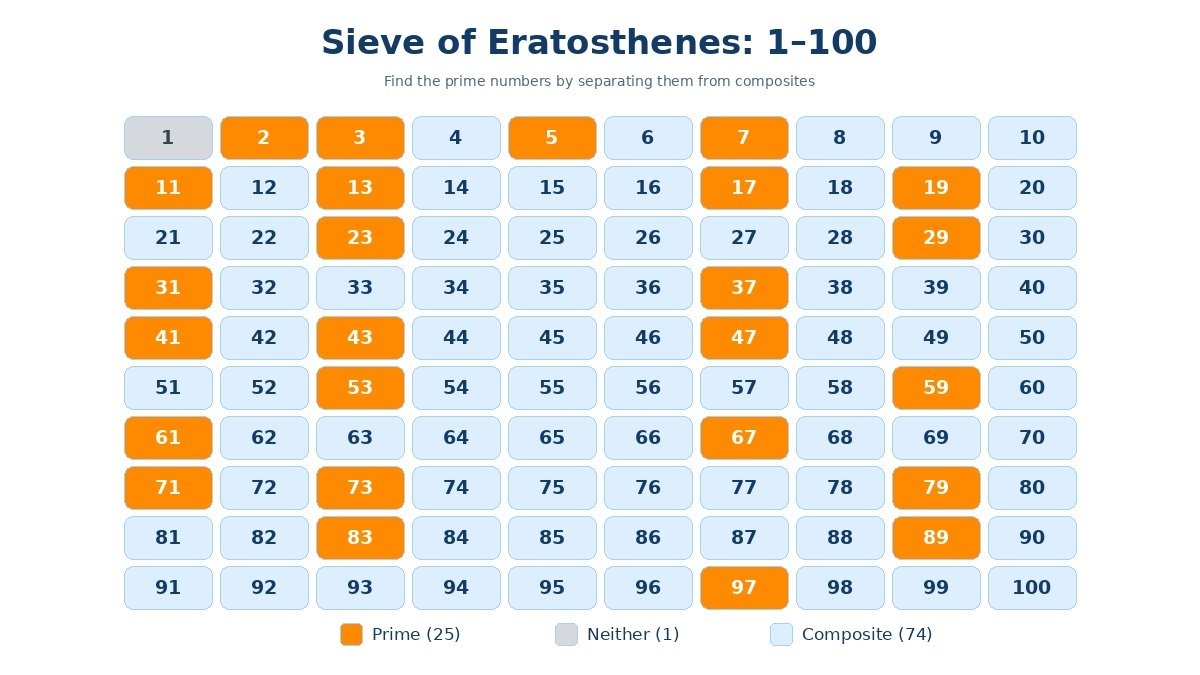
There are 25 prime numbers between 1 and 100:
2, 3, 5, 7, 11, 13, 17, 19, 23, 29, 31, 37, 41, 43, 47, 53, 59, 61, 67, 71, 73, 79, 83, 89, 97
| Range | Primes in the range | Count |
|---|---|---|
| 1 to 10 | 2, 3, 5, 7 | 4 |
| 11 to 20 | 11, 13, 17, 19 | 4 |
| 21 to 30 | 23, 29 | 2 |
| 31 to 40 | 31, 37 | 2 |
| 41 to 50 | 41, 43, 47 | 3 |
| 51 to 60 | 53, 59 | 2 |
| 61 to 70 | 61, 67 | 2 |
| 71 to 80 | 71, 73, 79 | 3 |
| 81 to 90 | 83, 89 | 2 |
| 91 to 100 | 97 | 1 |
Notice how primes thin out as numbers grow. There are four primes between 1 and 10, but only one between 91 and 100.
A quick shortcut: every prime greater than 5 ends in 1, 3, 7 or 9. That rules out many numbers at a glance. It does not prove a number is prime, though. The numbers 21, 27, 33 and 91 all end in those digits and are composite.
Prime Numbers From 101 to 200
There are 21 prime numbers between 101 and 200, which makes 46 primes up to 200:
101, 103, 107, 109, 113, 127, 131, 137, 139, 149, 151, 157, 163, 167, 173, 179, 181, 191, 193, 197, 199
How to Check Whether a Number Is Prime
You do not need to memorise a long list. Follow these steps for any number n.
- If n is 1 or less, it is not prime. If n is 2 or 3, it is prime.
- If n is even and greater than 2, it is not prime.
- If n ends in 5 and is greater than 5, it is not prime.
- Add the digits of n. If the sum divides by 3, then n divides by 3, so it is not prime (unless n is 3).
- Divide n by every prime up to the square root of n. If none divides it exactly, n is prime.
Why the square root? If n = a × b, at least one of a or b cannot be bigger than the square root of n. So if no number up to the square root divides n, nothing beyond it will either.
Example 1: Is 91 prime?
The square root of 91 is about 9.5, so test the primes 2, 3, 5 and 7. It is odd. Its digit sum is 10, which does not divide by 3. It does not end in 0 or 5. But 91 ÷ 7 = 13, so 91 = 7 × 13. It is composite.
Many students guess that 91 is prime because it passes the tests for 2, 3 and 5. Testing 7 catches it.
Example 2: Is 97 prime?
The square root of 97 is about 9.8, so test 2, 3, 5 and 7. It is odd. Its digit sum is 16, so 3 does not divide it. It does not end in 0 or 5. And 97 ÷ 7 leaves a remainder of 6. No prime up to 9 divides it, so 97 is prime.
Sieve of Eratosthenes: Find All Primes Up to 100
The Greek mathematician Eratosthenes described this method more than 2,000 years ago. It is the fastest way to list every prime up to about 100 on paper.
- Write the numbers 2 to 100 in a grid.
- Circle 2, then cross out every multiple of 2 (4, 6, 8 and so on).
- Move to the next number that is not crossed out, which is 3. Circle it and cross out all its multiples.
- Repeat with 5 and then 7.
- Stop at 7. The next prime is 11, and 11 × 11 = 121, which is already above 100. Every number that is not crossed out is prime.
Interesting Facts and Real-World Uses of Prime Numbers
- There are infinitely many primes. Euclid proved this around 300 BCE. His idea: assume you have a complete list of primes, multiply them all and add 1. The new number must have a prime factor that is not on your list, so the list was never complete.
- Twin primes are pairs that differ by 2. Examples are (3, 5), (11, 13), (17, 19), (29, 31) and (41, 43). Nobody has proved whether infinitely many twin prime pairs exist.
- The largest known prime is enormous. As of November 2026, it is 2 to the power of 136,279,841, minus 1. It has 41,024,320 digits. Amateur researcher Luke Durant found it in October 2024 through the Great Internet Mersenne Prime Search (GIMPS), running the search on a cloud-based computer network. Primes of this form, 2 to the power of p minus 1, are called Mersenne primes, and this is the 52nd known Mersenne prime. The same kind of large-scale computing now also drives modern AI, which we explain in our guide on what is artificial intelligence.
- Online security depends on primes. RSA encryption multiplies two very large primes to build a public key. Multiplying is quick for a computer, but working backwards from the product to the two primes is extremely slow when the numbers are large. Cryptography built on this idea helps protect your details when you open a secure website, such as a bank or a tax portal like the one in our GST portal login guide.
- Some cicadas keep prime time. Certain periodical cicadas in North America spend 13 or 17 years underground before they emerge. Both are prime numbers. One theory is that prime-length cycles make it harder for predators with shorter life cycles to line up with them.
Common Mistakes Students Make
- Calling 1 a prime number. A prime needs exactly two factors. The number 1 has only one.
- Assuming every odd number is prime. Numbers like 9, 15, 21 and 91 are odd and composite.
- Saying 2 is not prime because it is even. The number 2 has exactly two factors, so it is prime. It is the only even one.
- Stopping the test too early. Checking only 2, 3 and 5 is not enough. Test every prime up to the square root, as in the 91 example.
- Mixing up factors and multiples. Factors divide a number: the factors of 12 are 1, 2, 3, 4, 6 and 12. Multiples are what you get by multiplying: 12, 24, 36. The prime definition is about factors.
How Children Learn Prime Numbers: A Guide for Parents and Teachers
In US schools, prime and composite numbers are usually introduced in Grades 4 and 5. From Grade 6, students use prime factorisation to find the greatest common factor (GCF) and least common multiple (LCM). In India, the topic appears in Class 6, in the Prime Time chapter of the NCERT textbook Ganita Prakash.
These four habits help at home or in class:
- Start with objects, not rules. Let the child arrange counters, coins or LEGO bricks into equal rows, as in the counter example above. Primes are the numbers that refuse to form a rectangle.
- Use a hundreds chart. Colour the primes with crayons while following the sieve steps. The pattern sticks better than a memorised list.
- Ask why, not only what. Instead of asking whether 9 is prime, ask which number besides 1 and 9 divides it. A child who can name the factor 3 understands the definition.
- Make factor trees. Break 36 into 6 × 6, then into 2 × 3 × 2 × 3. Every branch ends in a prime, which shows why primes are called the building blocks of numbers.
Practice Questions
Try these before you read the answers.
- Is 51 a prime number?
- Is 53 a prime number?
- List all the primes between 20 and 40.
- Which two primes multiply to give 77?
- Write 84 as a product of primes.
Answers
- No. The digit sum is 5 + 1 = 6, which divides by 3, so 51 = 3 × 17.
- Yes. The square root of 53 is about 7.3. It is not divisible by 2, 3, 5 or 7, so it is prime.
- 23, 29, 31 and 37.
- 7 × 11 = 77.
- 84 = 2 × 2 × 3 × 7.
Challenge: Two prime numbers add up to 36. Find every possible pair.
Answer: 5 + 31, 7 + 29, 13 + 23 and 17 + 19. Check each prime in turn and see whether 36 minus that prime is also prime.
Frequently Asked Questions
What is a prime number in simple words?
A prime number is a number greater than 1 that can only be divided evenly by 1 and itself. For example, 5 is prime because nothing except 1 and 5 divides it exactly, while 6 is not prime because 2 and 3 also divide it.
What is the smallest prime number?
The smallest prime number is 2. It has exactly two factors, 1 and 2. It is also the only even prime number, because every other even number is divisible by 2 and therefore has more than two factors.
Is 1 a prime number?
No. The number 1 has only one factor, itself, so it does not have the required two. Excluding 1 also keeps the fundamental theorem of arithmetic true, which says every number greater than 1 has exactly one prime factorisation.
What is the difference between a prime number and a composite number?
A prime number has exactly two factors, 1 and itself. A composite number has more than two factors. For example, 11 is prime, while 12 is composite because 1, 2, 3, 4, 6 and 12 all divide it. The numbers 0 and 1 are neither.
How many prime numbers are there between 1 and 100?
There are 25 prime numbers between 1 and 100. The first is 2 and the last is 97.
Why is 2 the only even prime number?
Every even number greater than 2 is divisible by 2, so it has at least three factors: 1, 2 and itself. The number 2 is the only even number with just two factors.
What is the largest known prime number?
As of November 2026, the largest known prime number is 2 to the power of 136,279,841, minus 1. It has 41,024,320 digits and was found in October 2024 by Luke Durant through the Great Internet Mersenne Prime Search (GIMPS).
Are there infinitely many prime numbers?
Yes. Euclid proved more than 2,000 years ago that the list of primes never ends. If you assume a complete list, multiplying all the primes and adding 1 gives a number that needs a new prime factor, so the list cannot be complete.
Is 0 a prime number?
No. Prime numbers are defined only for whole numbers greater than 1, so 0 is not prime. It is not composite either. Both 0 and 1 are neither prime nor composite.
Why are prime numbers important?
Every whole number greater than 1 is either prime or a unique product of primes, so primes are the building blocks of numbers. They also protect online data, because multiplying two large primes is easy but splitting the product back into them is very hard.
Final Thoughts
A prime number is simply a number with exactly two factors, 1 and itself. Everything else in this topic, from the smallest prime to encryption, follows from that one rule.
Try the five practice questions without looking at the answers. If you can explain why 91 is not prime, you have understood the idea.
