

Most content plans do not fail because of weak writing. They fail because nobody decided what to write first, who it is for, and how it connects to the business. A content roadmap fixes that.
This guide explains what a content roadmap is, how it differs from a content calendar and a content strategy, and how to build one in six steps. You will also get a filled-in 90-day example and a template you can copy into Google Sheets today.
What Is a Content Roadmap?
A content roadmap is a high-level plan that shows what content you will create, who it is for, which business goal it supports, who owns it, and roughly when it will go live. It usually covers three months to a year and focuses on priorities and themes, not exact publishing dates.
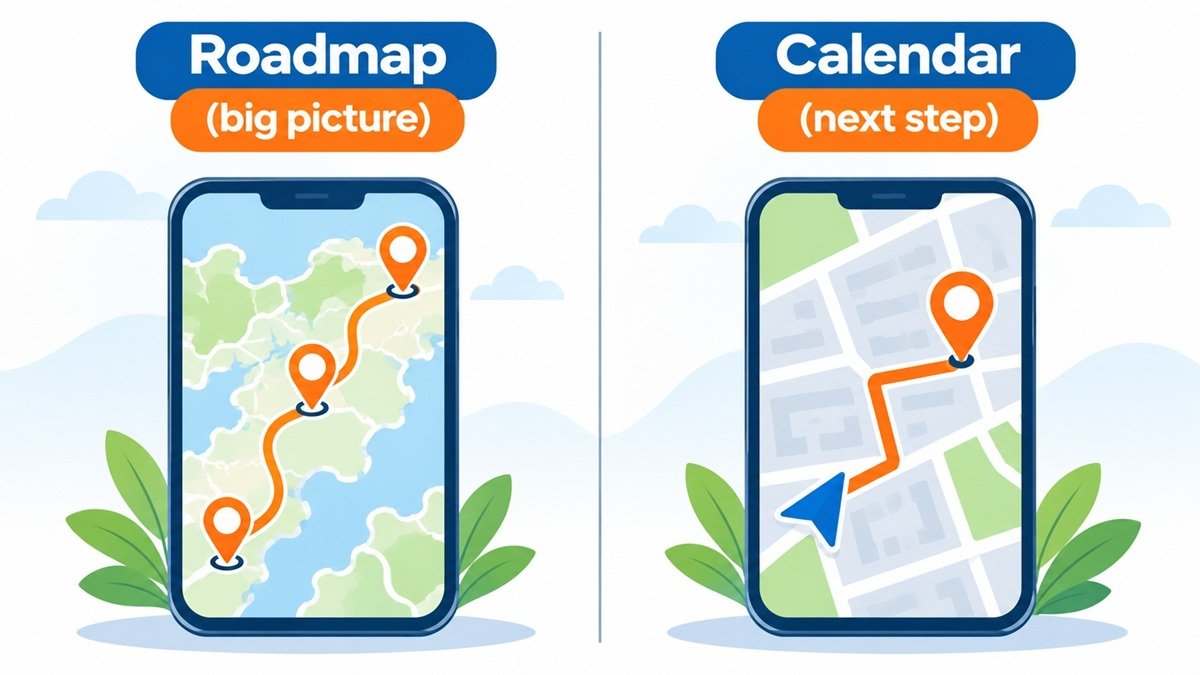
Think of Google Maps. The roadmap is the route you choose before you leave: which cities you will pass through and in what order. The content calendar is the turn-by-turn navigation that tells you what to do tomorrow morning.
A good roadmap answers four questions:
- What are we trying to achieve?
- Who are we creating content for?
- What will we work on first, and what can wait?
- How will we know it worked?
Content Roadmap vs Content Strategy vs Content Calendar
These terms get mixed up often, even by experienced marketers. Each one answers a different question.
| Document | Question it answers | Usual time frame | Example |
|---|---|---|---|
| Content strategy | Why do we create content, and for whom? | 1 to 3 years | Help small online sellers understand GST so they trust us with their filings |
| Content roadmap | What will we focus on, and in what order? | 1 to 4 quarters | Quarter 1: GST registration and basics. Quarter 2: GST notices and mistakes |
| Content calendar | What goes live on which day? | Weeks | Tuesday 14 January: publish the GST registration documents guide |
| Content brief | How should one piece be written? | One article | Target keyword, outline, sources, word count, expert reviewer |
You may also see the phrases content strategy roadmap and content marketing roadmap. In practice they mean the same thing as a content roadmap. Pick one term and use it consistently inside your team.
If you are new to the wider subject, start with our simple guide on what is marketing, then come back here to plan the content side.
Why a Content Roadmap Matters
Publishing without a plan feels productive until you check the results. A roadmap helps in five practical ways.
- It gives every post a job. A topic should support a goal such as enquiries, sign-ups or brand searches. If it does not, it waits.
- It protects you from random requests. When a manager or client asks for a post on a trending topic, you can check it against the roadmap and decide if it earns a slot.
- It builds depth on a subject. Search engines understand a site better when related articles cover a topic from several angles and link to each other. A roadmap lets you plan these clusters instead of finding them by accident.
- It makes workload visible. You can see that three big guides in one month is unrealistic for a two-person team before the deadline is missed.
- It makes results easier to read. When goals and time frames are written down, you can compare what happened with what you expected.
What to Include in a Content Roadmap
Keep the roadmap light. If it needs a manual, nobody will update it. These seven elements are enough for most teams.
- Business goal: The result content should support, with a number and a date. Example: 15 qualified enquiries per month by the end of March.
- Audience: One clear group, described by their situation. Example: sellers on Amazon and Meesho who have just crossed the GST registration limit.
- Themes or pillars: Three to five subjects you want to be known for.
- Content types and channels: Guides, comparison posts, videos, newsletters, and where each will be shared.
- Owners: One named person per initiative, plus any reviewer.
- Timeline: Months or quarters, not exact dates.
- KPIs: The few numbers you will check to judge progress.
Real Example: A 90-Day Content Roadmap for a Small Business
The example below is illustrative, built for a small GST consultancy with a founder, one writer and a part-time chartered accountant (CA). The targets are sample numbers, not industry benchmarks.
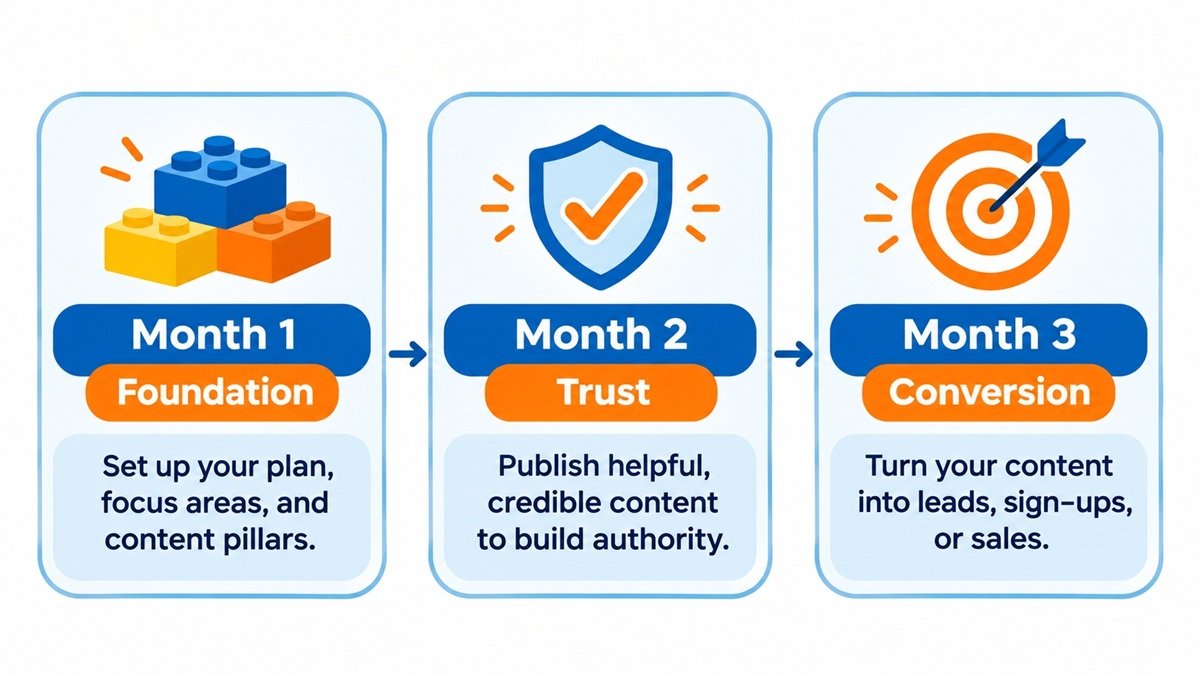
Goal: 15 qualified enquiries per month from the website by the end of month 3. Audience: Small online sellers who recently needed GST registration.
| Month | Theme | Content planned | Owner | Target |
|---|---|---|---|---|
| 1: Foundation | GST registration basics | 1 pillar guide, 4 supporting posts, refresh 3 old posts | Writer, CA reviews | All live, old posts updated |
| 2: Trust | Common GST mistakes and notices | 3 posts, 1 post based on a real client question (names removed), 1 free checklist | Writer and founder | 10 checklist downloads |
| 3: Conversion | Filing and compliance services | 2 comparison posts, 1 FAQ page, 1 how we work page | Founder | 15 enquiries |
Three things make this roadmap work:
- A subject expert reviews every tax post. For money and legal topics, accuracy and visible expertise matter more than speed.
- Refresh work has its own slot. Updating old posts is planned, not squeezed in when someone has time.
- Each month moves the reader closer to action. Month 1 attracts, month 2 builds trust, month 3 asks for the enquiry.
A news or finance blog can use the same idea with one change. Reserve one open slot per month for timely topics, such as a Budget announcement or a tax deadline, because those cannot be planned in advance. The roadmap holds the slot. The calendar fills it when the news breaks.
Types of Content Roadmaps
There is no single correct format. Choose the one your team will actually open every week.
- Timeline roadmap: Shows work across months on a horizontal chart. Best when several people depend on each other’s deadlines.
- Now, Next, Later roadmap: Three columns without dates. Best for solo creators and small teams whose priorities change often.
- Theme-based roadmap: Groups work by pillar, such as GST, income tax and small business funding. Best for blogs and publishers.
- Funnel-based roadmap: Groups work by reader stage: awareness, consideration and decision. Best when content must produce leads or sales.
If your marketing basics are still unclear, read our guide on the fundamentals of marketing before choosing a format. A roadmap built on unclear positioning will only organise the confusion.
How to Build a Content Roadmap in 6 Steps
Step 1: Start with a business goal, not a content goal
“Publish 12 posts” is an activity. “Get 15 qualified enquiries per month” is a result. Write the result first, then work backwards to the content that could produce it.
If you are still at the idea stage of a business, our guide on how to start a small business will help you decide the goal before you plan any content.
Step 2: Define one audience and collect their real questions
Good topics come from real questions, not guesses. Collect them from:
- Customer calls, emails and WhatsApp messages
- Queries and pages in Google Search Console
- The People Also Ask box on Google
- Reddit, Quora and Facebook groups where your audience asks for help
Save every question in one sheet. This becomes your topic bank.
Step 3: Audit what you already have
Before creating anything new, list your existing pages and mark each one as keep, update, merge or delete. Old posts that are slightly outdated often win faster than new ones, because they already have links and history. Gaps you find here become your first roadmap items.
Step 4: Choose themes and prioritise topics
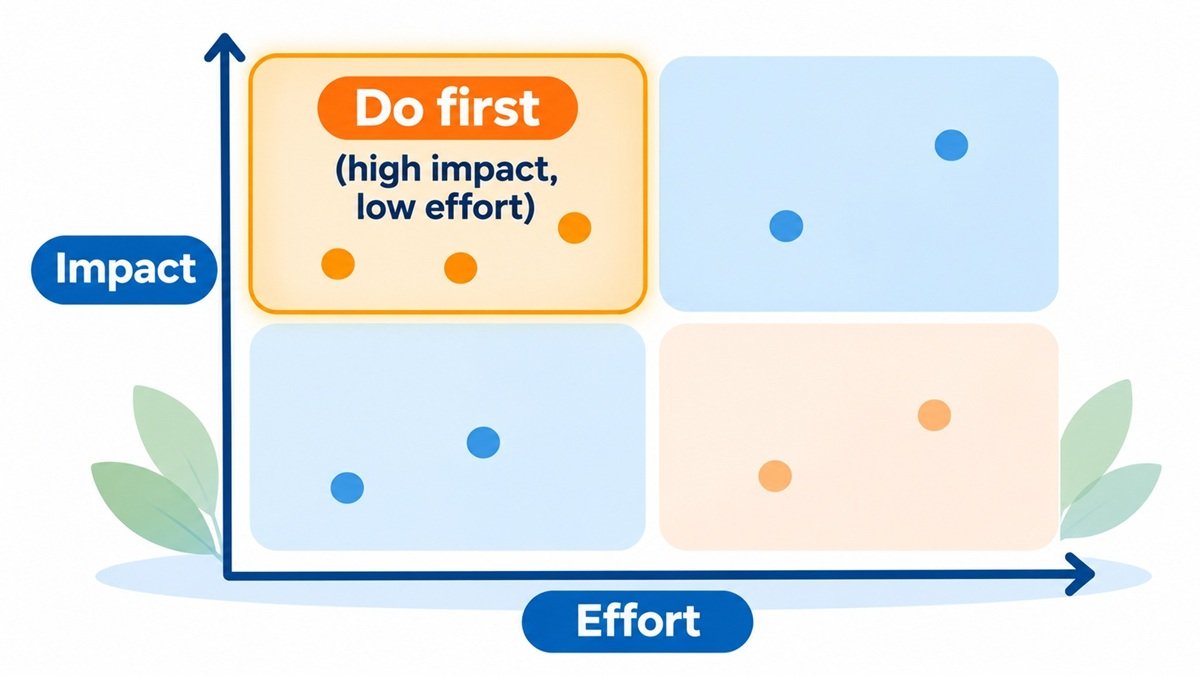
Pick three to five themes, then score each topic from 1 to 5 for impact (how much it helps the goal) and effort (how much work it needs). Start with high impact and low effort.
| Topic | Impact | Effort | Decision |
|---|---|---|---|
| GST registration documents | 5 | 2 | Do first |
| GST notice reply guide | 4 | 4 | Next quarter |
| History of GST in India | 2 | 4 | Later or skip |
The scores are your judgement, so they are not perfect. Their purpose is to force a conversation about what deserves your time.
Step 5: Assign owners, capacity and distribution
A roadmap breaks when it ignores time. Here is simple capacity maths. Suppose your team has 10 hours a week for content. A solid guide takes about 5 hours from research to publishing, and a short post takes about 2 hours. That means one guide and two short posts is the maximum, and you should plan less to leave room for updates.
Also add one distribution line to every initiative: email, LinkedIn, a WhatsApp channel, or outreach to journalists. The last one is a core part of public relations, and an original data point or expert comment from your own work gives reporters a reason to cite you.
Step 6: Set KPIs and a review rhythm
Track two kinds of numbers:
- Leading indicators: Pieces published on schedule, impressions and clicks in Google Search Console. These show early movement.
- Lagging indicators: Enquiries, sign-ups and revenue. These show whether the plan worked.
Review monthly and revise the roadmap every quarter. Free tools such as Google Search Console and Google Analytics 4 are enough to begin.
How to Use AI in Your Content Roadmap Without Losing Quality
AI can speed up planning, but it cannot replace experience.
Where AI helps:
- Grouping hundreds of audience questions into themes
- Drafting a first outline or content brief
- Summarising long research documents
Where a human must lead:
- Checking every fact, figure and date
- Adding first-hand experience, such as a client story, a screenshot or a test result
- Final editing for tone and accuracy
Google has said it rewards helpful, people-first content regardless of how it is produced. It also treats mass-produced pages created mainly to rank as spam under its scaled content abuse policy. A roadmap that relies on AI to publish volume will run into that problem. A roadmap that uses AI for research and humans for expertise will not.
Add one more item to your monthly review: search your main topics in Google, ChatGPT and Perplexity, and note which sources get cited and what they leave out. Those gaps are strong roadmap ideas. If AI terms are new to you, read our explainer on what is artificial intelligence.
Common Content Roadmap Mistakes
- Turning the roadmap into a 100-post calendar. Detail beyond three months usually changes. Plan 90 days in detail and the rest as themes.
- No single owner. When everyone owns the roadmap, nobody updates it. Name one person.
- Only new content, no refresh slots. Outdated pages lose trust. Reserve 20 to 30 percent of your capacity for updates.
- Goals without numbers. “Grow traffic” cannot be reviewed. “Reach 5,000 organic clicks per month by June” can.
- Copying a competitor’s topic list. If you add nothing new, there is no reason for a reader or a search engine to choose you. Add your own data, examples or expert input.
- Never reviewing it. A roadmap that is not checked monthly becomes a document nobody reads.
Content Roadmap Template You Can Copy
Create a Google Sheet with these columns and fill one row per initiative.
| Quarter | Business goal | Audience | Theme | Content piece | Format | Owner | Publish window | KPI | Status |
|---|---|---|---|---|---|---|---|---|---|
| Q1 | 15 enquiries per month | Small online sellers | GST basics | GST registration documents guide | Long guide | Writer, CA review | January, week 2 | Clicks, enquiries | In progress |
Keep the sheet to one tab at first. Add filters for owner and status once it grows.
Frequently Asked Questions
What is a content roadmap in simple words?
A content roadmap is a plan that lists what content you will create, who it is for, why it matters to your business, who will make it, and in which time frame. It covers months, not days, and helps you decide what to work on first.
What is the difference between a content roadmap and a content calendar?
A roadmap sets direction and priorities for a quarter or year, such as which themes to cover. A calendar schedules individual pieces on specific dates, such as which post goes live next Tuesday. You build the roadmap first, then create the calendar from it.
How long should a content roadmap be?
Most small teams do well with a detailed 90-day plan and a lighter 12-month view of themes. Detail beyond three months usually changes, so avoid scheduling every topic for the whole year.
Who should own the content roadmap?
One person should be accountable. In a small business that is usually the founder or marketing lead. Writers, subject experts, designers and sales should give input, but a single owner keeps priorities clear.
How often should I update a content roadmap?
Review progress every month and revise the roadmap every quarter. Update it sooner if your goals, product, audience behaviour or search results change in a major way.
Do I need a paid tool to create a content roadmap?
No. A Google Sheet is enough to start. Tools like Trello, Notion or Asana become useful when several people work together and need task tracking.
How does a content roadmap help SEO?
It helps you plan related articles that cover a topic in depth, link to each other and get refreshed on schedule. This structure is easier for readers and search engines to follow than scattered one-off posts.
How do I plan content for AI search?
Answer the main question clearly near the top of each page, use descriptive headings, add FAQs, show the author and update date, and cite reliable sources. Then check whether Google AI Overviews, ChatGPT and Perplexity mention or cite your pages.
Final Thoughts
A content roadmap is not a big document. It is a short, honest plan that tells you what to publish next and why. Open a sheet today, write one business goal, choose three themes and list your first twelve topics. You can refine it every month.
If you are building a career around this work, our guide on the scope of marketing shows how content planning connects with other marketing roles.

2 Comments
Pingback: What Is Marketing? Essential Guide, 5 Mistakes To Avoid
Pingback: Fundamentals Of Marketing: 6 Proven Steps For Small Business