


By Pro Business Cop | Last reviewed: November 2026
Logistics is not one business. A truck owner, a warehouse operator, a courier startup and a global freight forwarder all work in “logistics”, but they earn money in very different ways. That is why logistics business category classification matters. It tells you what a company actually does, which rules apply to it, and who its competitors are.
In this guide from Pro Business Cop, we explain the main logistics categories in simple language. We also show how to find your own category, how official industry codes work, and what mistakes to avoid.
Quick Answer: What Is Logistics Business Category Classification?
Logistics business category classification is the method of grouping logistics companies by the main service they sell, such as transport, storage, forwarding, courier delivery or supply chain management. Companies can also be grouped by transport mode, service level (1PL to 5PL) and the goods they handle.
The key rule: classify a company by its main source of revenue, not by the broad word “logistics”.
Why Does Classification Matter?
People search this topic for different reasons. Knowing your reason helps you read the right section.
- Understanding business types: You want to know what kinds of logistics companies exist.
- Choosing an industry code: You need the right activity code when you register a small business in India or file reports.
- Filling profiles: You must pick a category on business listings and registration portals.
- Market research: You want to compare competitors in the same segment.
A wrong category can create confusion in licences, taxes, insurance, tenders and bank paperwork. It can also make your business harder to find online.
Major Categories of Logistics Businesses (By Service)
1. Transportation and Freight Logistics
These companies move goods by road, rail, air or sea. Services include full truckload (FTL), part truckload (PTL), local delivery and long-distance freight. Trucking companies and shipping lines belong here.
2. Warehousing and Storage
These businesses store goods and manage inventory. They may offer short-term or long-term space, picking, packing, labelling and dispatch. Distribution centres and fulfilment warehouses fall in this group.
3. Courier and Parcel Delivery
These companies deliver small packages and documents. They offer same-day, express and standard delivery, and they power most e-commerce last-mile delivery.
4. Freight Forwarding
A freight forwarder arranges shipments on behalf of customers. They book carriers, prepare documents, coordinate customs work and consolidate cargo. Many forwarders do not own vehicles or ships.
5. Distribution and Supply Chain Logistics
These providers move goods from manufacturers to wholesalers, retailers and customers. They manage distribution centres, replenishment and regional networks.
6. Specialized Logistics
This group handles goods that need special care:
- Cold chain (food, vaccines, medicines)
- Hazardous materials
- Heavy equipment and project cargo
- Automotive logistics
7. Reverse Logistics
Reverse logistics manages returns, repairs, refurbishing and recycling. It has grown fast because of online shopping returns.
Logistics Companies Classified by Transport Mode
- Road: Trucking, FTL, PTL and local freight.
- Rail: Bulk and long-distance cargo.
- Air: Fast, high-value or time-sensitive shipments.
- Ocean: Container and bulk cargo for international trade.
- Multimodal: A mix of modes, such as rail plus road, under one contract.
Cost differs a lot by mode. India’s official logistics cost study found that rail averages about ₹1.96 per tonne-km, while air costs about ₹72 per tonne-km (DPIIT–NCAER, 2025). This is one reason mode is a key classification factor.
Classification by Service Model (1PL to 5PL)
| Level | Meaning | Example |
|---|---|---|
| 1PL | A company handles its own logistics | A manufacturer with its own trucks |
| 2PL | A provider supplies an asset or one service | Trucking firm, shipping line, warehouse owner |
| 3PL | Outsourced bundle of services (transport, storage, fulfilment) | Contract logistics company |
| 4PL | Manages and coordinates several logistics providers and strategy | Supply chain integrator |
| 5PL | Technology-led network coordination, often for e-commerce | Digital supply chain platform |
Note: the 4PL and 5PL labels are used differently by different companies. Treat them as business-model labels, not legal categories.
Asset-Based vs Asset-Light Logistics
This is one of the most useful ways to classify a logistics business, especially for startups.
| Factor | Asset-based | Asset-light |
|---|---|---|
| Owns trucks or warehouses | Yes | Little or none |
| Startup capital | High | Lower |
| Main risk | Idle assets, fuel, maintenance | Dependence on partners, thin margins |
| Typical examples | Trucking firm, warehouse owner | Freight forwarder, broker, aggregator |
| Revenue model | Per km, per tonne, per pallet per month | Commission or service fee |
From a business perspective, I find the asset-light logistics model particularly interesting because it allows a company to start without investing heavily in trucks, warehouses, or other expensive assets. For example, a small freight service provider can connect customers with independent truck owners and earn revenue by coordinating shipments. This approach reduces the initial investment, but it also requires reliable partners, clear communication, and careful control over service quality. On the other hand, owning trucks gives a company more control over operations, but vehicles sitting idle can quickly increase operating costs and put pressure on cash flow in small businesses. This is why choosing between an asset-based and asset-light model should depend on demand, available capital, and the company’s ability to secure regular business.

Company Logistics Business Category Classification: How to Classify a Company
To classify a specific company, ask five questions:
- What does the company sell most? Transport, storage, forwarding, delivery or management?
- Which mode does it use? Road, rail, air, sea or multimodal?
- Who are the customers? Businesses, consumers, e-commerce sellers or government?
- Is it local, national or international?
- Is it asset-based or asset-light?
| Company Type | Primary Category | Main Service |
|---|---|---|
| Trucking company | Freight transportation | Road cargo delivery |
| Courier company | Parcel logistics | Package delivery |
| Warehouse operator | Warehousing | Storage and inventory |
| Freight forwarder | Freight forwarding | Shipment coordination |
| E-commerce fulfilment provider | Fulfilment logistics | Order processing and shipping |
| Cold-chain provider | Specialized logistics | Temperature-controlled transport |
| Shipping company | Maritime logistics | Ocean cargo transport |
What If a Company Does More Than One Thing?
Many companies are hybrids. A 3PL may run warehouses and trucks. A forwarder may own a few vehicles. In such cases, choose the activity that brings the largest share of revenue. Official systems also work on this “principal activity” idea. Mention the other services as secondary activities.
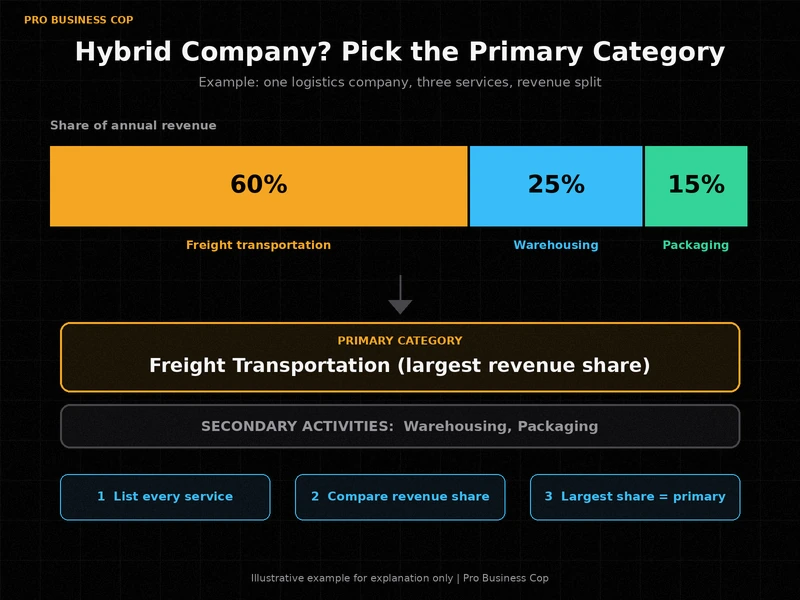
One thing I have noticed while researching different business models is that a company’s name does not always clearly explain its main activity. A business may describe itself as a logistics provider while offering transportation, storage, packaging, and delivery services together. In such cases, I would look at the service that generates the largest share of its revenue rather than simply listing every service it offers. For example, if most of its income comes from transporting goods for other businesses, freight transportation would be its primary category, while warehousing and packaging could be listed as secondary activities. This makes the company’s business classification clearer for customers, directories, and business records.
Official Industry Codes: NIC, NAICS and ISIC
Beyond business types, governments group companies using industry codes.
| Business Activity | Where it generally sits |
|---|---|
| Road, rail and pipeline transport | NIC 2008 Division 49 |
| Water (sea and inland) transport | NIC 2008 Division 50 |
| Air transport | NIC 2008 Division 51 |
| Warehousing and transport support (including cargo handling and forwarding-type services) | NIC 2008 Division 52 |
| Postal and courier activities | NIC 2008 Division 53 |
In the United States, logistics-related businesses mainly fall under NAICS sectors 48–49 (Transportation and Warehousing). The international ISIC system follows a similar structure.
Important: The table shows the broad division only. The exact 4- or 5-digit code depends on your activity and the version of the code list in use. Always confirm the final code on the official MoSPI NIC document or the registration portal you are using (for example, Udyam in India).
Where You Pick a Category Online
Logistics owners often have to choose a category in several places: government registration portals, Google Business Profile, LinkedIn and B2B directories. Keep the wording consistent everywhere. Choose the most specific option, such as “freight forwarding service” or “trucking company”, rather than a vague “logistics”.
Why Wrong Classification Causes Problems
- Licences: A forwarder, a customs broker and a transporter may need different permissions. A business lawyer can confirm what applies to you.
- Taxes and invoicing: Service type affects how a business is billed and reported.
- Insurance and liability: Carrying goods and arranging goods are treated differently.
- Tenders and loans: Buyers and banks check your declared activity.
- Customer trust: Customers may not find you if your category is unclear.
A common mistake businesses make is selecting a broad category simply because it sounds suitable. For example, a company that mainly arranges shipments through third-party transporters may describe itself only as a transportation company. However, its actual business activity may be closer to freight forwarding or logistics coordination. A more specific classification can help potential customers understand what the company offers and make it easier to appear in relevant business searches. Before selecting a category, I recommend reviewing the company’s main service, customer requirements, revenue source, and the terminology commonly used in its industry.
Logistics Cost in India: Why Categories Matter

For years, India’s logistics cost was quoted as 13–14% of GDP, based on partial data. The first official study by DPIIT and NCAER (released in 2025) estimated logistics cost at 7.97% of GDP, about ₹24.01 lakh crore for 2023–24. It also found that small firms spend about 17% of their output on logistics, against about 7.6% for large firms.
The takeaway: your category, scale and model strongly affect your costs and competitiveness. The National Logistics Policy, launched on 17 September 2022, aims to improve this further. Some reports still quote the older 13–14% figure, so always check the date and source of any number you use.
Sources: PIB “Supercharging India’s Logistics” (27 Nov 2025): https://static.pib.gov.in/WriteReadData/specificdocs/documents/2025/nov/doc20251127708001.pdf and Outlook Business coverage of the DPIIT–NCAER study.
How to Choose the Right Category for a New Logistics Business
If you are still at the idea stage, read our guide on how to start a small business first.
- List what you will actually sell in year one.
- Check how much capital you can invest in trucks, vehicles or space. If you need funding, compare a business loan vs a personal loan.
- Study your local demand: manufacturing, e-commerce, agriculture or pharma.
- Decide on asset-based or asset-light.
- Check the licences and codes for that exact activity.
- Start focused, then add services later.
Logistics Business Ideas for Startups
- Local delivery or courier: Low entry cost, strong e-commerce demand.
- Trucking and transport: Needs capital, steady contracts and fleet management.
- Freight brokerage or forwarding: Asset-light, but needs strong relationships and documentation skills.
- Warehousing and fulfilment: Good for online sellers and D2C brands.
- Specialized niches: Cold chain or project cargo, which can offer better margins for companies with the right expertise.
- Technology-enabled logistics: Tracking, route planning and digital freight platforms. See how AI agents are changing business operations.
In my view, last-mile delivery and e-commerce fulfilment are among the most interesting opportunities for new logistics businesses. Online sellers need dependable services to move orders from warehouses to customers, handle returns, and manage delivery problems. However, I would not assume that demand automatically means profitability. A business needs to consider delivery density, fuel costs, failed deliveries, staffing, and competition in its target area. For someone starting with limited capital, partnering with existing delivery operators or focusing on a specific local market may be a more practical approach than building a large fleet from day one.
Frequently Asked Questions (FAQs)
What are the main categories of logistics businesses?
The main categories are transportation, warehousing, courier and parcel delivery, freight forwarding, distribution, fulfilment, reverse logistics and specialized logistics such as cold chain.
How do you classify a logistics company?
Classify it by its main revenue-earning service, then by transport mode, service level (2PL, 3PL, 4PL), customer type and whether it owns assets.
What category does a trucking company belong to?
A trucking company generally belongs to freight transportation or road logistics.
Is a freight forwarding company a logistics business?
Yes. Freight forwarding is a logistics service that coordinates transport, documents and shipment handling, often without owning vehicles.
What is the difference between a 3PL and a freight forwarder?
A 3PL provides broader outsourced services such as storage, fulfilment and transport. A freight forwarder mainly arranges and coordinates shipments. Some companies do both.
Is a transport company the same as a logistics company?
Not always. A transport company mainly moves goods. A logistics company may also handle storage, inventory, fulfilment and supply chain planning.
Which logistics business is best for startups?
It depends on your capital, location, customers and skills. Asset-light models like brokerage or forwarding need less money, while trucking and warehousing need more.
Can one company belong to two categories?
Yes, many do. Choose the main revenue activity as the primary category and list the others as secondary.
Conclusion
Logistics business category classification helps you understand what a company does, how it earns, and which rules apply. You can classify by service, transport mode, service level, asset model and official industry code. Start with one question: what is our main source of revenue? Answer that clearly, and choosing a category becomes much easier.
For more guides on business categories, startups and company classification, keep exploring Pro Business Cop.

4 Comments
Pingback: How To Register A Small Business In India (2026 Guide)
Pingback: How To Start A Small Business: Beginner’s Guide (2026)
Pingback: What Is A Business Development Executive? Role, Salary & Skills (India)
Pingback: Business Lawyer Guide: Costs, Duties & When You Need One