

Last updated: November 19, 2026 | Reading time: 7 minutes
A few years ago, AI in business mostly meant a chatbot that answered simple questions. Today, AI agents can read an invoice, check it against a purchase order, flag a mismatch, and send it for approval, all with little human effort.
This is changing how companies run support, finance, sales, HR, and IT. But it also brings new risks, and most businesses are still learning how to use agents safely.
This guide explains what AI agents are, where they are used, what the latest data says, and how a small or mid-sized business can start without getting burned.
Quick Answer
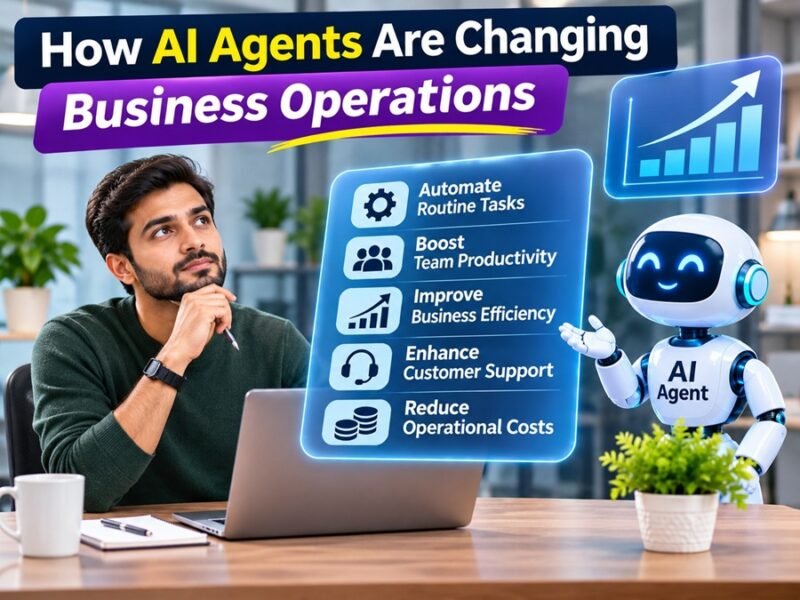
AI agents are software systems that can plan and complete multi-step tasks on their own, using tools and company data. They are changing business operations by:
- Automating repetitive work like ticket handling, invoice matching, and report preparation
- Speeding up decisions by pulling data from many systems at once
- Freeing employees to focus on judgment-heavy work
The catch: most companies still keep a human in the loop, and few have fully prepared their processes for agents.
What Is an AI Agent? (And How Is It Different From a Chatbot?)
An AI agent is an AI system that is given a goal, decides the steps needed, uses tools (like email, a CRM, or accounting software), and takes action.
A chatbot mostly answers. An agent does.
| Feature | Traditional Chatbot | AI Agent |
|---|---|---|
| Main job | Answers questions | Completes tasks |
| Steps | One reply at a time | Plans multiple steps |
| Tools | Usually none | Connects to apps, databases, and APIs |
| Example | “What is your refund policy?” | Checks the order, verifies the policy, and processes the refund |
| Human oversight | Low | Needed for approvals and exceptions |
If you want the basics first, read our guide on what artificial intelligence is.
How AI Agents Are Changing Business Operations
1. Customer Support
Agents can read a customer’s history, find the right answer, update the ticket, and escalate only complex cases to a human. In one Zapier survey of enterprises (2025 edition), customer support was the department most likely to have deployed AI agents, followed closely by operations.
2. Finance and Accounting
Agents help with invoice reconciliation, expense checks, and payment follow-ups. For small businesses, this can ease pressure on working capital. Pair it with these tips on improving cash flow in small businesses.
3. Sales and Business Development
Agents can research leads, draft outreach, update the CRM, and schedule meetings. This does not replace a good salesperson, but it saves them hours of admin work. See what a business development executive actually does to understand where human skill still matters.
4. Marketing and Content
Agents can collect campaign data, suggest content ideas, and prepare first drafts. A solid plan still comes first, so start with the fundamentals of marketing and a clear content roadmap.
5. HR and IT Operations
Agents can answer employee queries, help with onboarding paperwork, reset access, and triage IT tickets.
6. Supply Chain and Logistics
Analysts are also watching “physical AI”, where agents coordinate sensors, robots, and supply chain systems in real time.
What Does the Latest Data Say?
Surveys differ in method and sample, so treat the numbers as direction, not exact truth. Here is what recent reports show:
- Adoption is high: Zapier’s 2026 survey reports that 88% of enterprise leaders say their organizations are using or testing AI agents, up from 72% in 2025. It also says most agents still need a human in the loop.
- Scaling is harder: A McKinsey finding, cited by Joget, says 88% of organizations use AI somewhere, but only 23% are actively scaling an agentic system in any single function.
- Process readiness is low: A Deloitte survey found only 5% of organizations say their business processes are highly prepared for AI agents.
- Future outlook: A Deloitte survey of leaders across 24 countries reports that 74% expect AI agents to be part of operations by 2027.
- Trust needs controls: A survey reported on November 18, 2026 says 94% of executives want a complete audit trail and 90% want defined approval limits before giving agents more autonomy.
Benefits of AI Agents in Business
- Speed: Tasks that took hours can finish in minutes.
- Consistency: Agents follow the same steps every time.
- 24/7 availability: Useful for support and monitoring.
- Better use of people: Staff spend more time on strategy, relationships, and problem solving.
- Scalability: You can handle more work without hiring at the same pace.
Risks and Challenges You Should Know
- Accuracy: Agents can make mistakes or act on wrong data. Human review is still important for high-stakes work.
- Security and privacy: Agents often access sensitive systems and customer data.
- Integration problems: Old software and messy data slow everything down.
- Lack of accountability: Without logs and approval limits, it is hard to know who or what made a decision.
- Change management: Employees may worry about job loss. Clear communication and training matter.
How a Small Business Can Start With AI Agents
You do not need a big budget. Follow these steps:
- Pick one repetitive task. Good examples: answering common customer questions, sorting invoices, or booking appointments.
- Map the process first. Write down each step. If the process is messy, an agent will only make the mess faster.
- Start with a pilot. Test with a small team or one workflow for 30 days.
- Keep a human in the loop. Require approval for payments, refunds, legal text, and customer-facing promises.
- Set rules and limits. Decide what the agent can and cannot do, and keep an audit trail.
- Measure results. Track time saved, error rate, and customer satisfaction before expanding.
If you are still building your business foundation, begin with how to start a small business and then add automation step by step.
Common Mistakes to Avoid
- Automating a broken process
- Giving an agent full access to sensitive data on day one
- Skipping staff training
- Expecting perfect results without monitoring
- Choosing tools based on hype instead of a clear business problem
Which Companies Are Building AI Agents?
A fast-growing group of startups and large tech firms is building agent platforms. For a look at the wider startup scene, see our list of the hottest AI startups in Silicon Valley.
Frequently Asked Questions (FAQs)
What is an AI agent in simple words?
It is software that can take a goal, plan the steps, use tools, and complete a task on its own, instead of only answering questions.
Will AI agents replace employees?
They are more likely to change jobs than remove them entirely. Routine tasks get automated, while roles that need judgment, empathy, and accountability stay with people. Impact varies by industry and company.
Are AI agents safe for business use?
They can be, with proper controls: limited access, human approval for risky actions, activity logs, and regular review. Without these, risks go up.
How much do AI agents cost?
Costs vary widely by tool, usage, and setup. Many platforms offer free or low-cost starting plans, but integration and training can add cost. Check current pricing with each provider.
Can small businesses in India use AI agents?
Yes. Many tools work through simple no-code setups. Start with one task, test it, and expand only if you see clear results.
What is the difference between AI agents and automation?
Traditional automation follows fixed rules. AI agents can handle variation, make choices within limits, and adjust steps to reach a goal.
Final Verdict
AI agents are moving from experiments to real business operations, but the winners will not be the companies that automate the most. They will be the ones that choose the right tasks, keep humans in control, and measure results.
Start small, protect your data, and scale only when the numbers prove it works.
Disclaimer: This article is for general information only. Survey figures come from third-party reports with different samples and methods. Tools, pricing, and regulations change quickly, so verify details before making business or legal decisions.

1 Comment
Pingback: Logistics Business Category Classification: Types & Categories