


Quick Answer: How do you fill a cheque deposit slip?
Write the date, your account number and name as per passbook, then each cheque’s number, date, drawee bank, branch and amount. Add the total in figures and words, sign, and attach the cheque with your name, account number and mobile written on its back. Get the counterfoil stamped at the counter.
Source: HDFC Bank, RBI circular on cheque drop box facility.
How to fill cheque deposit slip questions usually come up at the worst moment: you are at the branch, someone has handed you a cheque, and the slip in front of you has more boxes than the cheque itself. The good news is that a deposit slip asks for only two kinds of information, details about you and details about the cheque, and both can be copied straight from documents you already hold. This Pro Business Cop guide walks you through a filled sample, the SBI slip, and one right most customers do not know they have.
Before You Touch the Slip: Check the Cheque

A perfectly filled slip cannot rescue a faulty cheque. Spend 30 seconds on the cheque first.
- Is it still valid? A cheque must be presented within three months of the date written on it. RBI cut the validity from six months to three months from 1 April 2012. An older cheque is stale and will be returned.
- Is your name spelled correctly? The payee name must match your bank account name. If it is wrong, ask the person who gave it to issue a new one, because corrections on a cheque are not allowed other than the date.
- Are the amount in words and figures the same? If not, the cheque will likely be returned. Ask for a fresh one.
- Is it signed? An unsigned cheque is useless.
If you are the one writing the cheque, our guide on how to fill a cheque correctly covers every field, including account payee crossing.
Write these details on the back of the cheque
HDFC Bank advises writing your name, account number and contact number on the flip side of the cheque before attaching it to the slip. This is a small step with a big payoff. If the cheque ever gets separated from the slip in the clearing process, the bank can still credit it to the right account, and it knows how to reach you if there is a problem.
Keep this writing on the back only. Never write, stamp or staple anything on the white MICR band along the bottom front of the cheque, which machines read during clearing.
Back of cheque showing name account number and mobile written before deposit
How to Fill Cheque Deposit Slip: Field by Field
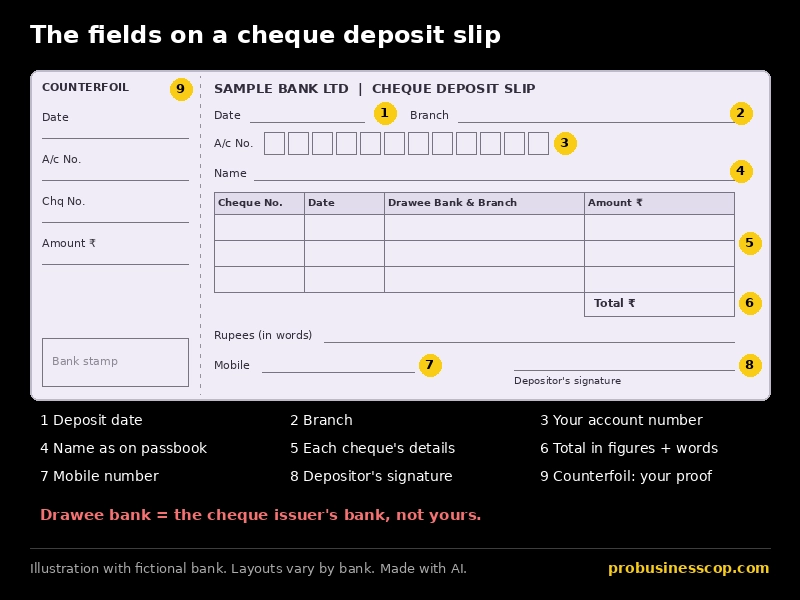
Every bank’s slip looks a little different, but they all ask for the same information. A typical slip has two parts: the main slip that the bank keeps, and a smaller counterfoil (also called the customer copy or acknowledgment) that comes back to you with the bank’s stamp.
Sample cheque deposit slip with every field numbered
1. Date. Write the date you are depositing, not the date on the cheque.
2. Branch. The branch where you are depositing, if the slip asks for it.
3. Account number. Copy it from your passbook or cheque book, digit by digit. A single wrong digit can send the money to the wrong account or get the deposit held. Write it slowly and read it back.
4. Account holder’s name. Write your full name as mentioned in your passbook, not a nickname or short form. HDFC Bank specifically asks for the name exactly as it appears on the passbook.
5. Cheque details. For each cheque, there is usually a row with columns for:
| Column | Where to find it on the cheque |
|---|---|
| Cheque number | Six-digit number printed at the start of the MICR band at the bottom |
| Cheque date | Date written in the boxes at the top right |
| Drawee bank and branch | Bank name and branch printed at the top of the cheque |
| Amount | Amount in figures from the box on the cheque |
“Drawee bank” means the bank of the person who gave you the cheque, not your own bank. This is the most common mix-up on deposit slips.
6. Total amount. Add up all the cheques on the slip and write the total in figures, then in words ending with “Only”.
7. Mobile number. Optional on many slips, but fill it. It is how the branch contacts you if a cheque has an issue.
8. Signature. Sign as the depositor. If someone else is depositing a cheque into your account, they sign as the depositor.
9. Counterfoil. Repeat the date, account number, cheque number and amount on the small detachable part. This is your proof of deposit.
10. Leave the bank-use boxes blank. Boxes marked “for bank use”, “scroll number” or “passing officer” are for staff.
Cross out what you do not use
Many slips are combined cash-and-cheque slips. If you are depositing only a cheque, draw a line through the cash denomination table so no one can fill it in later. Do the same for any empty cheque rows if you are depositing fewer cheques than the slip allows.
A Filled Example: Depositing Two Cheques at Once

Say Priya Nair has received two cheques: ₹18,000 from a client and ₹4,500 from a friend, drawn on two different banks. Here is how her slip comes together.
Filled cheque deposit slip sample with two cheques and total
| Field | What Priya writes |
|---|---|
| Date | 05/12/2026 |
| Account number | Her 12-digit account number from the passbook |
| Name | Priya Nair |
| Cheque 1 | No. 004512, dated 01/12/2026, Sample Bank Ltd, MG Road, ₹18,000 |
| Cheque 2 | No. 118204, dated 03/12/2026, Demo Bank Ltd, Civil Lines, ₹4,500 |
| Total | 22,500/- and “Rupees Twenty Two Thousand Five Hundred Only” |
| Mobile | Her registered number |
| Counterfoil | Date, account number, both cheque numbers, total ₹22,500 |
The names and banks are fictional, but the arithmetic is the part people get wrong most often. Before you sign, add the cheque amounts again and confirm the total in figures matches the total in words.
Can one slip carry more than one cheque? It depends on your bank. HDFC Bank notes that some banks let you deposit one or more cheques using the same slip, while others require a separate slip for each cheque. If the slip has several cheque rows, it usually allows multiple cheques. If it has room for only one, use one slip per cheque.
How to Fill an SBI Deposit Slip
SBI branches commonly use a combined pay-in slip with space for both cash and cheques. The cheque details go in the column headed with words like “Cash/Cheque No., Date & Name of Bank & Branch”. The process is the same as above, with three SBI-specific points worth knowing:
- The PAN box is not for cheques. SBI’s slip has a PAN field near the top, which confuses many people depositing a cheque. Under Income Tax Rule 114B, PAN must be quoted for a cash deposit exceeding ₹50,000 in any one day. A cheque deposit does not trigger this rule, so you can leave the PAN box empty when depositing only cheques.
- Cross out the cash table. Since the slip is combined, strike through the note denomination section when you are depositing only a cheque.
- Check the stamped counterfoil before you leave. Make sure it shows your account number, the date and the amount, and keep it until the money appears in your account.
Counter, Drop Box or Machine: Which Should You Use?
Once the slip is filled, you have three ways to hand it over, and they are not equal.
| Method | You get | Best for |
|---|---|---|
| Bank counter | Stamped counterfoil as proof | High-value cheques, cheques you cannot afford to lose |
| Cheque drop box | No stamped proof unless the box gives one | Small, routine cheques when the branch is busy |
| Cheque deposit machine or app (where available) | Machine or app receipt | Quick deposits, if your bank supports it for that cheque type |
You have a right to a counter acknowledgment
This is the part most bank customers do not know. RBI has told banks that both the drop box and the counter must be available, that customers must not be compelled to use the drop box, and that no branch should refuse to give an acknowledgment if you hand the cheque in at the counter.
RBI also asked banks to display a notice on the drop box itself saying customers can tender cheques at the counter and get an acknowledgment on the pay-in slip. So if a branch staff member waves you towards the drop box for a ₹2 lakh cheque, you can politely ask for a stamped counterfoil at the counter instead.
After You Deposit: Timing, Tracking and Returns
How fast is the money credited? Cheque clearing in India has been continuous since 4 October 2025. Cheques are scanned and presented through the day, and RBI requires presenting banks to release funds to customers immediately and no later than one hour after settlement. A faster second phase planned for 3 January 2026 was postponed by RBI until further notice, so a cheque deposited in the morning is often credited the same working day, but allow for your bank’s own processing.
How do you track it? Watch your account statement or app for the credit. Keep the stamped counterfoil until the amount shows up. If it has not appeared within two working days, take the counterfoil to the branch.
What if the cheque is returned? If the cheque bounces, the bank returns it to you with a memo giving the reason. The amount is not credited, and if your bank had credited it provisionally, it is reversed. If the reason is insufficient funds, the person who issued it may face action under Section 138 of the Negotiable Instruments Act, but you, as payee, must act within strict deadlines, starting with a written notice within 30 days of receiving the return memo.
Common Deposit Slip Mistakes

Common cheque deposit slip mistakes and fixes
| Mistake | What happens | Fix |
|---|---|---|
| Wrong digit in account number | Deposit held or credited wrongly | Copy from passbook and read it back |
| Your own bank written as drawee bank | Confusion at processing | Drawee bank is the cheque issuer’s bank |
| Total does not match the cheques | Slip rejected or deposit delayed | Re-add before signing |
| Nothing written on the back of the cheque | Hard to trace if separated from slip | Write name, account number and mobile on the back |
| Stale cheque (over three months old) | Returned unpaid | Ask the issuer for a fresh cheque |
| Large cheque dropped in the drop box | No proof of deposit | Use the counter and get a stamped counterfoil |
| Cash table left open on a combined slip | Risk of tampering | Strike through unused sections |
Frequently Asked Questions
Do I need to sign the cheque deposit slip?
Yes. The depositor signs the slip. If a family member is depositing a cheque into your account, they can fill and sign it as the depositor, using your account number and name.
Can I deposit a cheque into someone else’s account?
Yes, as long as the cheque is made out to that person. Fill in their account number and name on the slip and sign as the depositor. An account payee cheque can only be credited to the account of the person named on it.
Is PAN required when depositing a cheque?
Not under Income Tax Rule 114B, which requires PAN for cash deposits exceeding ₹50,000 in a day. Leave the PAN box empty on a cheque-only deposit unless your bank asks for it for another reason.
Can I deposit a cheque at any branch of my bank?
Usually, yes. Clearing is image-based across the country, so the branch you choose rarely changes the outcome. Your home branch remains the easiest place to sort out any problem later.
Can the branch force me to use the drop box?
No. RBI has advised banks that customers must not be compelled to use the drop box and that no branch should refuse a counter acknowledgment when you hand in a cheque.
How long should I keep the counterfoil?
Until the money shows up in your account. If the credit is delayed or the cheque is returned, the stamped counterfoil is your proof that you deposited it on that date.
Deposit It Right the First Time
A deposit slip takes two minutes if you have the cheque, your passbook and a pen in front of you. Copy your account number carefully, write the drawee bank as the cheque issuer’s bank, add up the total twice, and hand high-value cheques in at the counter for a stamped counterfoil. Writing a cheque yourself? Start with the Pro Business Cop guide on how to fill a cheque, with filled samples for self cheques, payments to another person and SBI cheques. Need your bank details first? See how to find your HDFC Bank customer ID or browse more finance guides.
Disclaimer
This article is for general information only and is not financial or legal advice. Slip formats, limits and processing times vary by bank and can change, so follow your branch’s current instructions. The sample slips and names shown are fictional illustrations. Read our full disclaimer.
Last updated: 28 November 2026

2 Comments
Pingback: How To Fill Cheque: Self, Other Person & SBI Cheque Guide 2026
Pingback: Bajaj Cheque Bounce Message: Meaning, Charges & Next Steps