


Quick Answer: How do you fill a cheque correctly?
Write the date (DD/MM/YYYY), the payee’s name or “Self”, the amount in words ending with “Only”, the amount in figures ending with “/-“, and sign as per bank records. For account transfers, write “A/C Payee” between two lines at the top left. RBI says no corrections are allowed except the date.
Source: RBI FAQs on Cheque Clearing (updated 7 January 2026).
How to fill cheque leaves is one of those skills most people learn the hard way, usually at a bank counter with a queue behind them. A cheque has only six things you write by hand, but one wrong word in the payee line or one overwritten digit can get it rejected. This Pro Business Cop guide takes you through every field, then shows exactly what changes when you write a cheque to yourself, to another person, or on an SBI cheque book, with filled samples you can copy.
How to Fill Cheque Correctly: Every Field Explained

Every bank in India issues cheques in the same CTS-2010 format, which is why an SBI, HDFC or Canara cheque all look nearly identical. RBI standardised the placement of fields so that cheques can be scanned and cleared as images. That standardisation is good news for you: learn one cheque and you can fill any of them.
Sample cheque with every field numbered for how to fill cheque
Here is what you fill, in the order a bank officer reads it:
| # | Field | Where it is | What you write |
|---|---|---|---|
| 1 | Date | Top right, in 8 boxes | Day, month, year, one digit per box (DD MM YYYY) |
| 2 | Pay | Long line after “Pay” | Payee’s full name, or “Self” |
| 3 | Rupees | Line below “Pay” | Amount in words, ending with “Only” |
| 4 | Amount box | Small box with ₹ | Amount in figures, ending with “/-“ |
| 5 | Signature | Bottom right | Your signature, exactly as given to the bank |
| 6 | Crossing (optional) | Top left corner | Two parallel lines, often with “A/C Payee” |
What you never write on is the white band at the bottom. That is the MICR band, which carries the cheque number, the bank’s MICR code and a two-digit transaction code. SBI asks customers to quote this two-digit instrument type, found at the bottom right of the MICR band, when they register a cheque under Positive Pay. Writing, stapling or stamping over this band can make the cheque unreadable for the clearing machine.
Step 1: Write the date in the boxes
Fill all eight boxes. For 5 December 2026, write 0 5 1 2 2 0 2 6. A cheque is valid for three months from the date written on it, a rule RBI brought in from 1 April 2012 when it cut validity from six months. If you write a future date, it becomes a post-dated cheque, and the bank will not pay it before that date.
Step 2: Write the payee’s name
Write the name exactly as it appears on the payee’s bank account. “Ramesh Kumar” and “R. Kumar” are not the same thing to a bank officer checking a cheque presented for cash. Start writing right next to the word “Pay” so no one can add a name or initial before yours.
Step 3: Write the amount in words
Start with “Rupees”, use the Indian numbering system (thousand, lakh, crore), and end with “Only”. Draw a line through any empty space after “Only”. Some worked examples:
| Amount | In words | In figures |
|---|---|---|
| ₹12,500 | Rupees Twelve Thousand Five Hundred Only | 12,500/- |
| ₹1,25,000 | Rupees One Lakh Twenty Five Thousand Only | 1,25,000/- |
| ₹7,450.50 | Rupees Seven Thousand Four Hundred Fifty and Paise Fifty Only | 7,450.50 |
The amount in words is called the legal amount and the amount in figures is the courtesy amount. Both must match. If they differ, do not try to fix it. Tear up the leaf and write a fresh one.
Step 4: Write the amount in figures
Write the digits close to the ₹ symbol, with no gap where someone could squeeze in an extra digit, and finish with “/-“. Use commas in the Indian style (1,25,000) so the amount reads clearly at a glance.
Step 5: Sign where the bank expects it
Sign in the space above “Please sign above” or “Authorised Signatory”. Your signature must match the one in the bank’s records. If you have changed how you sign since opening the account, update it at the branch before writing a high-value cheque, because a mismatch is a common reason for a cheque being returned.
Step 6: Decide whether to cross it
Two parallel lines across the top left corner make it a crossed cheque, which can only be paid into a bank account, not as cash over the counter. Writing “A/C Payee” between the lines restricts it further so the money goes only into the payee’s account. Use crossing whenever you are paying someone by transfer, and skip it only when the payee needs cash.
The One Rule Most People Get Wrong: No Corrections
Many people still fix a mistake by striking it out and signing next to it. Under the current clearing system, that no longer works. RBI’s FAQs say no changes or corrections can be made on cheques, other than for date validation if required, and that customers should use a fresh cheque leaf for any change in the payee’s name, the amount in figures, or the amount in words.
The reason is practical. Cheques now travel as scanned images, and the bank paying the cheque cannot easily tell a genuine correction from a fraudulent alteration on a screen. So the rule is simple: if you make a mistake anywhere other than the date, write “CANCELLED” across the leaf in capital letters and use the next one. Keep the cancelled leaf or destroy it, but never leave it signed and lying around.
How to Fill a Cheque for Self (Cash or Transfer)
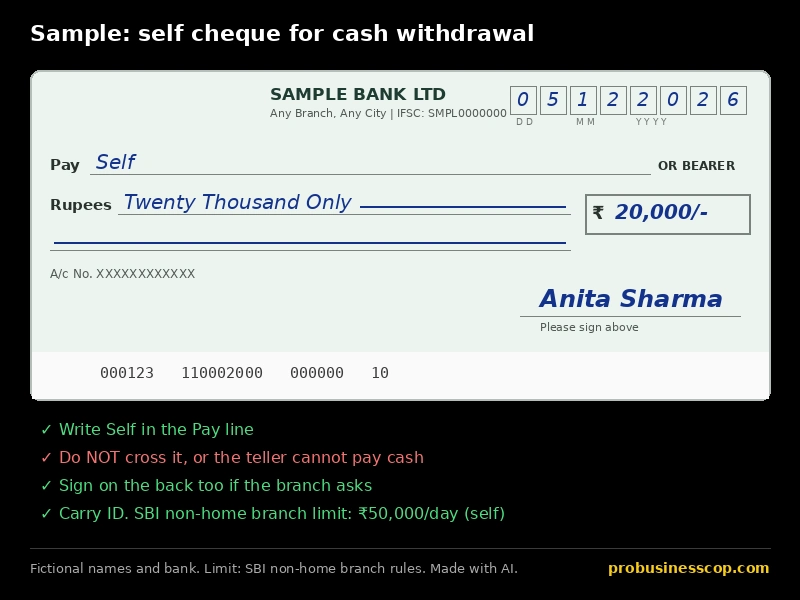
A self cheque is one where you are both the person paying and the person being paid. People use it to withdraw cash from their own account at the branch, or to move money to another account in their own name.
Filled self cheque sample for cash withdrawal at the bank
To withdraw cash:
- Date: today’s date.
- Pay: write “Self”. Do not write your name, as “Self” makes it clear you will collect it in person.
- Amount in words and figures, as above.
- Sign on the front, and sign again on the back. Many branches ask for a signature on the reverse when you collect cash.
- Do not cross it. A crossed self cheque cannot be paid as cash, which defeats the purpose.
- Carry ID. The teller may ask for it, especially at a branch other than your home branch.
To transfer to your own other account: write your full name (or “Self”, if your bank accepts it for transfers), cross it with “A/C Payee”, and submit it with a deposit slip for the receiving account.
A real constraint to know before you go: SBI’s rules for non-home branches, published on its website, set a daily limit of ₹50,000 for cash withdrawal by self for personal banking customers. If you need more, go to your home branch or check the current limit with your branch first.
How to Fill a Cheque for Another Person

This is the most common cheque you will write: paying rent, a contractor, a school or a supplier. The steps are the same as above. What changes is the payee line and the crossing, and that depends on how the person will receive the money.
Filled account payee cheque sample for paying another person
| How the payee will get the money | Pay line | Crossing | “OR BEARER” |
|---|---|---|---|
| Deposit into their bank account (safest) | Their full name as per bank | Two lines + “A/C Payee” | Strike it out |
| Cash at your bank’s branch | Their full name | Do not cross | Strike it out if only that person should collect it |
| A company or institution | Its registered name, such as “ABC Traders Pvt Ltd” | Two lines + “A/C Payee” | Strike it out |
The “OR BEARER” printed at the end of the Pay line matters more than most people realise. If you leave it, anyone holding the cheque can encash it. Striking it out turns the cheque into an order cheque, so the bank pays only the named person or their account.
Third-party cash has limits. If someone else is collecting cash on your cheque, the bank will check their identity. At SBI, the same non-home branch rules state that cash cannot be paid to third parties at a non-home branch for personal banking customers. So if you are giving a cheque to your driver or a relative to collect cash, tell them to go to your home branch.
Paying a large amount? Read the Positive Pay section below before you hand the cheque over.
How to Fill an SBI Cheque: What Is Different
The writing part of an SBI cheque is identical to any other bank’s, because SBI uses the same CTS-2010 format. Date boxes on the top right, Pay line, amount in words and figures, signature at the bottom right. If you can fill one, you can fill an SBI cheque.
What is specific to SBI is the paperwork around it:
1. Positive Pay for high-value cheques. Under Positive Pay, you tell the bank the key details of a cheque before the payee presents it, and the bank matches them at the time of payment. SBI’s page (last updated 2 December 2025) says it plans to make this mandatory for:
- Savings account cheques of ₹5 lakh and above
- Current account, cash credit and overdraft cheques of ₹10 lakh and above
Once the mandatory rule applies, cheques at or above these amounts without correct details “would be returned unpaid”, though no cheque return charge would apply. You lodge the account number, cheque number, date, amount, payee name and the two-digit instrument type through the branch, internet banking, YONO, YonoLite or SBI Quick SMS. Registration is a one-time step for the account.
2. Lower amounts still benefit. RBI’s FAQs say banks have been advised to enable Positive Pay for all account holders issuing cheques of ₹50,000 and above. SBI also lets you choose your own account-level limit, so you can register a lower threshold if you write large cheques often.
3. Non-home branch limits. As covered above, self cash withdrawal at a non-home SBI branch is capped at ₹50,000 a day for personal banking customers, and third-party cash is not paid there. Your home branch is the safer place to encash.
How Long Will the Cheque Take to Clear?
Faster than it used to. Since 4 October 2025, RBI has moved cheque clearing to a continuous system, where branches scan and send cheques through the day instead of in fixed batches. RBI says presenting banks must release funds to customers immediately and no later than one hour after settlement.
A faster second phase, which would have required banks to confirm cheques within three hours, was due on 3 January 2026. RBI postponed it until further notice in December 2025, so Phase 1 continues for now. In practice, a cheque deposited in the morning on a working day can often be credited the same day, but your bank’s own processing time still applies. If you are the one receiving a cheque, a correctly filled slip avoids most delays, and our guide on how to fill a cheque deposit slip shows a filled sample.
Common Cheque Mistakes and the Fix

Common cheque filling mistakes and how to avoid them
| Mistake | What can happen | The fix |
|---|---|---|
| Overwriting the amount or name | Cheque returned or treated as altered | Cancel the leaf, write a new one |
| Amount in words and figures differ | Cheque returned | Check both before signing |
| Leaving “OR BEARER” on a high-value cheque | Anyone holding it can encash it | Strike out “OR BEARER” |
| Crossing a self cheque meant for cash | Teller cannot pay cash | Leave self cash cheques uncrossed |
| Signature not matching bank records | Cheque returned | Update your signature at the branch |
| Writing or stapling on the MICR band | Clearing machine cannot read it | Keep the bottom band clean |
| Presenting after three months | Cheque is stale and will not be paid | Ask for a fresh cheque |
| Not registering Positive Pay for a high-value cheque | May be returned unpaid once mandatory | Lodge details before handing it over |
A bounced cheque is more than an inconvenience. If a cheque you issue is returned for insufficient funds, the payee can send a legal notice under Section 138 of the Negotiable Instruments Act (our Bajaj cheque bounce message guide explains the 30, 15 and 30 day timeline), so only write a cheque when the money is already in the account.
Before You Hand Over Any Cheque: A 30-Second Check
- Date filled in all eight boxes, not more than three months old
- Payee name spelled as on their bank account
- “OR BEARER” struck out if only the payee should be paid
- Words and figures match, with “Only” and “/-“
- No overwriting anywhere except the date
- Signature matches bank records
- Crossed with “A/C Payee” if it is not for cash
- Positive Pay lodged if the amount is high
- Cheque number, date, payee and amount noted on the counterfoil or in your phone
That last step is underrated. When a payee calls months later saying a cheque never reached them, the cheque number is the only thing that lets you trace it or ask the bank to stop payment.
Frequently Asked Questions
Can I use a pencil or gel pen to fill a cheque?
Avoid both. Pencil can be erased and light gel ink may not scan clearly in the image-based clearing system. Use a ball pen with dark, permanent ink.
What do I write in the Pay line for a self cheque?
Write “Self” if you are withdrawing cash for yourself at the branch. Leave it uncrossed and sign on the back as well when the teller asks.
Can I correct a mistake on a cheque and sign next to it?
Only the date can be corrected. RBI asks customers to use a fresh cheque leaf for any change in the payee’s name or either amount, because the paying bank sees only a scanned image.
How many days is a cheque valid in India?
Three months from the date written on the cheque. After that, it is a stale cheque and the bank will not pay it, so the payee must ask for a new one.
Is Positive Pay compulsory for SBI cheques?
SBI has said it will make Positive Pay mandatory for savings account cheques of ₹5 lakh and above and for current, cash credit and overdraft account cheques of ₹10 lakh and above. Below that, it is optional but recommended.
What happens if I write a cheque without enough money in the account?
The cheque will be returned unpaid, your bank may charge you, and the payee can start legal action under Section 138 of the Negotiable Instruments Act after sending a notice. Never issue a cheque you cannot honour.
Write It Once, Write It Right
Cheques are slower than UPI, but they are still how rent, deposits, school fees and business payments get done across India. Fill the six fields carefully, never correct anything but the date, and cross every cheque that is not meant for cash. If you run a small business that writes cheques every month, our guide to the best small business accounting software in India can help you track every cheque you issue. For more plain-language banking help, explore the Pro Business Cop finance guides, including how to find your HDFC Bank customer ID and the Airtel Payments Bank IFSC code.
Disclaimer
This article is for general information only and is not financial or legal advice. Bank rules, limits and clearing timelines can change, so confirm the current rules with your bank before writing a high-value cheque. Sample cheques shown are illustrations with fictional names and are not real bank instruments. Read our full disclaimer.
Last updated: 28 November 2026

3 Comments
Pingback: How To Fill Cheque Deposit Slip: Filled Sample & SBI Format
Pingback: Bajaj Cheque Bounce Message: Meaning, Charges & Next Steps
Pingback: Cancelled Cheque Image: Samples, How To Make & Upload Right