

Quick Answer
Is the Naaptol scratch card prize letter real?
No. Naaptol customer care has told recipients that these letters and scratch cards are completely fake and that it runs no such prize distribution. The senders demand a “processing fee” before paying out a prize that does not exist. Pay nothing. If you already paid, call 1930 or report at cybercrime.gov.in immediately.
Source: Naaptol customer care replies on ConsumerComplaints.in; Indian Cyber Crime Coordination Centre (I4C), Ministry of Home Affairs.
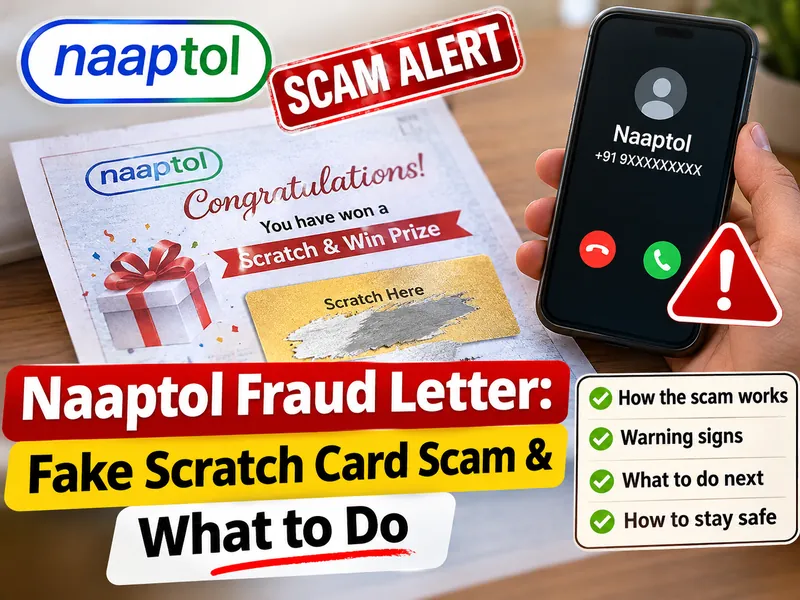
A Naaptol fraud letter usually turns up by India Post, addressed to you by your real name, with a scratch card inside that “wins” you anywhere from ₹7.5 lakh to a brand new SUV. It feels personal because it is: the senders know your name, your address and often that you once ordered something from Naaptol. That is exactly what makes the scam work.
This guide breaks down what the letter looks like, how the money is taken from you step by step, what Naaptol has said about it, and what to do in the first hour if you have already paid.
What a Naaptol Fraud Letter Looks Like

Dozens of people have described the same package in public complaints on Consumer Complaints between 2019 and 2025, and one complaints page alone lists 122 reports. The details change slightly, but the template stays the same.
- Delivery: a registered post or ordinary India Post envelope sent to your home address.
- The story: a “lucky draw” to celebrate Naaptol’s 11th, 12th, 13th or 14th anniversary, or a festival offer such as a “Holi Dhamaka”.
- The prize: a scratch card that reveals cash (₹7.5 lakh, ₹12.5 lakh, ₹15.4 lakh are commonly reported) or a car such as a Mahindra XUV or Kia Seltos.
- Fake trust signals: a line saying the prize is “guaranteed by HSBC Bank”, a signature from a named “finance manager”, a prize code and serial number.
- Contact details: a helpline number plus a WhatsApp number, and sometimes a lookalike website such as naaptolprize.co.in instead of the real naaptol.com.
- A Kolkata address: many letters list a “prize division” office in New Town, Kolkata.
- A strange instruction: some letters tell you not to contact Naaptol’s regular customer care. A genuine company never asks you to avoid its own support team.
Seven warning signs of a fake Naaptol prize letter
How the Fake Naaptol Prize Scam Works, Step by Step

The letter is only the hook. The real fraud happens over WhatsApp and phone calls in the days after you reply.
- The letter arrives with your correct name and address, so it looks targeted rather than random.
- You scratch the card and see a prize big enough to cloud judgement.
- You are asked to fill in a claim form and send a photo of it on WhatsApp, along with Aadhaar, PAN and bank account details.
- A “processing fee” appears. Victims have reported demands of ₹7,500, ₹16,000 and ₹24,000, described as registration, TDS, GST or transfer charges.
- The fees keep growing. Each payment unlocks a new charge. One complainant reported losing ₹1,20,750 before stopping.
- The prize never arrives and the numbers go silent.
The Reserve Bank of India described this exact mechanism years ago: fraudsters open bank accounts in India, ask the public to deposit money towards “charges, taxes, duties”, then withdraw it and vanish. The RBI also notes that remitting money in any form to take part in lottery schemes, or to secure prize money, is prohibited under the Foreign Exchange Management Act, 1999.
How the fake Naaptol lucky draw scam takes money in six steps
A worked example of how the fees escalate
Here is an illustration built from amounts victims have actually reported. It shows why people keep paying once they start.
| Stage | What the caller says | Amount asked | Running total |
|---|---|---|---|
| Day 1 | “Pay registration to release your ₹12.8 lakh prize” | ₹7,500 | ₹7,500 |
| Day 2 | “TDS must be paid before transfer” | ₹16,000 | ₹23,500 |
| Day 3 | “GST on the prize is pending” | ₹24,000 | ₹47,500 |
| Day 5 | “Bank has put a hold, one last clearance fee” | Higher again | Keeps rising |
Every step sounds official, and every payment makes it harder to walk away from the money already sent. That is the sunk cost trap, and the scammers rely on it.
7 Red Flags That Prove a Lucky Draw Letter Is Fake
| Red flag | What the letter says | Why it gives the scam away |
|---|---|---|
| You never entered | “You are our lucky winner” | No contest you joined means no prize you can win |
| Fee before prize | “Pay processing charges to claim” | A genuine prize deducts tax from the payout. It never asks you to send money first |
| WhatsApp only | “Send the form on this WhatsApp number” | Real companies use their official app, website and email |
| Avoid customer care | “Do not call our customer care” | Scammers know the real support team will expose them |
| Bank “guarantee” | “Guaranteed by HSBC Bank” | Banks do not guarantee e-commerce lucky draws |
| Lookalike website | naaptolprize.co.in or similar | The official domain is naaptol.com. Extra words in the domain are a warning |
| Pressure to pay fast | Repeated calls asking you to pay “today” | Rushing you stops you from checking with family or the company |
If a letter shows even two of these signs, treat it as fraud.
What Naaptol Itself Has Said About These Letters
Naaptol’s customer care has replied publicly to many of these complaints with the same message: the letter and scratch card are “completely fake and no such prize distribution has being organised”. In its replies, the company has said the documents are sent by people pretending to be from Naaptol and using its goodwill to get people to deposit money in their bank accounts.
So the fraud is being carried out by impersonators using Naaptol’s name, not by the company. The safest rule is simple: verify any offer only through the official Naaptol website or app, never through a number printed on a letter.
Already Paid or Shared Your Details? Do This Now
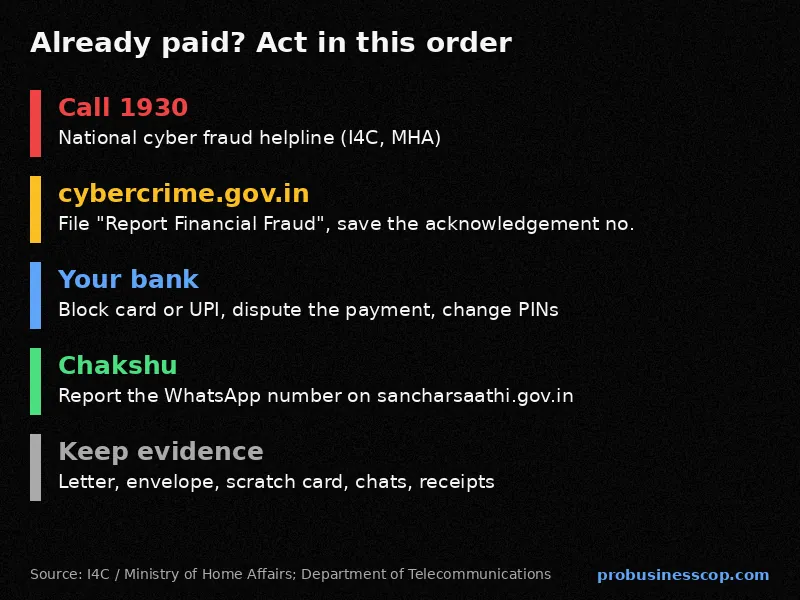
Speed matters. Police call the first hour after a financial fraud the “golden hour”, because a quick report gives banks the best chance to stop money moving further. Even if more time has passed, still report it.
- Call 1930. This is the national cyber fraud helpline run by the Indian Cyber Crime Coordination Centre (I4C) under the Ministry of Home Affairs. Keep transaction IDs, the UPI ID or account number you paid, and dates ready.
- File a complaint at cybercrime.gov.in. Choose “Report Financial Fraud” and save the acknowledgement number for follow-ups.
- Call your bank. Ask it to block your card or UPI, flag the transaction, and raise a dispute. Change your net banking and UPI PIN if you shared any of them.
- Lock your Aadhaar biometrics on the official UIDAI website if you sent your Aadhaar copy.
- Report the WhatsApp number on Chakshu. The Department of Telecommunications’ Chakshu facility on the Sanchar Saathi portal (sancharsaathi.gov.in) takes reports of suspected fraud calls, SMS and WhatsApp messages received in the last 30 days.
- Keep the evidence. Do not throw away the envelope, letter or scratch card. Save screenshots of chats and payment receipts.
- Ignore “recovery” offers. If someone later calls promising to get your money back for a fee, that is usually a second scam aimed at the same victims.
What to do after paying a Naaptol fraud letter scammer
Received the Letter but Haven’t Replied Yet?
You are in the best position. Do not call or message the numbers on the letter, not even to “check”. Replying confirms your number is active and leads to more calls.
Instead, report the number on Chakshu, keep the letter in case police ask for it, and tell older family members about it. Scam letters often reach parents and grandparents who are less likely to search online before replying.
How Did Scammers Get My Name and Address?
There is no official public explanation for how these senders obtain addresses. Many complainants say they had placed orders on Naaptol before, and several have asked the company to investigate a possible data leak. Treat that as a reported concern, not a confirmed fact.
What you can control is how much you share from here. Avoid filling in “free gift” forms at malls or online, and never send Aadhaar or PAN copies to anyone who contacts you first. The same goes for bank documents: our guide on when you actually need a cancelled cheque explains who can legitimately ask for one.
Why Fake Lucky Draw Letters Keep Working in India
This is not only a Naaptol problem. In November 2021, Mumbai Police’s cyber cell warned that fraudsters were sending “online shopping lucky draw contest” letters and scratch cards in the names of reputed e-commerce firms, promising prizes of ₹1 lakh to ₹10 lakh.
The method works for three reasons. Physical post feels more trustworthy than an SMS. The victim’s real name and order history make it look genuine. And the first fee is small compared with the prize, so paying it feels like a reasonable risk. Knowing the pattern is the best protection, because the brand name on the next letter may be different. The same trick shows up when listed companies change names, with callers asking for a fee to “convert” old shares, as we explain in our Indiabulls Housing Finance to Sammaan Capital explainer.
Frequently Asked Questions
Is the Naaptol lucky draw real?
No. Naaptol customer care has repeatedly told people who received these letters that the documents are fake and that the company has organised no such prize distribution.
Does Naaptol send scratch cards by post?
The scratch cards people receive by post in the company’s name are fake, according to Naaptol’s own replies to complainants. Check any real offer on the official naaptol.com website or app.
I already paid the processing fee. Can I get my money back?
Recovery is not guaranteed, but reporting quickly improves the chances. Call 1930, file at cybercrime.gov.in and inform your bank the same day so the receiving account can be flagged.
Where can I report the WhatsApp number from the letter?
Use the Chakshu facility on sancharsaathi.gov.in for suspected fraud calls, SMS or WhatsApp messages from the last 30 days. If you lost money, also call 1930.
Is it legal to pay money to claim a prize or lottery?
The RBI has said that remitting money in any form to participate in lottery schemes, or to secure prize money or awards, is prohibited under the Foreign Exchange Management Act, 1999.
Is it safe to keep shopping on Naaptol?
These letters come from impersonators, not from the company’s order system. For genuine purchases, use only the official website or app and the customer care details listed there.
Stay a Step Ahead of Scams With Pro Business Cop
Scams change their brand names, but the playbook rarely changes. Share this guide with parents and older relatives who are most likely to receive a letter like this. For more plain-English explainers on business, money and fraud, browse our Scam Alerts section and keep reading Pro Business Cop: Business Intel, No Fluff.
Disclaimer: This article is for general information only and is not legal or financial advice. Pro Business Cop is not affiliated with Naaptol. Details are based on public complaints, company replies and official government sources available at the time of writing. For a specific case, contact the cyber crime helpline 1930, your bank or the police.
